
Table of Contents
Summarize and analyze this article with

Chat GPT

Perplexity

Grok

Google AI

Claude
A model inherits its data's flaws
Generative AI learns patterns from data, and whatever is wrong with that data, missing rights, embedded bias, poor quality, leaked personal information, flows into the model and out through its outputs. For an enterprise in a regulated industry, that makes training data a governance problem, not just an engineering one. The questions that now follow an AI system, can you use this data, is it accurate and representative, does it contain personal or privileged information, where did a given output come from, are all questions about data provenance and rights. An organization that cannot answer them cannot defend its AI to a regulator, a customer, a counterparty, or a court. Provenance is the record that makes the answers possible.
This guide explains what training-data governance requires. It is educational and not legal advice.
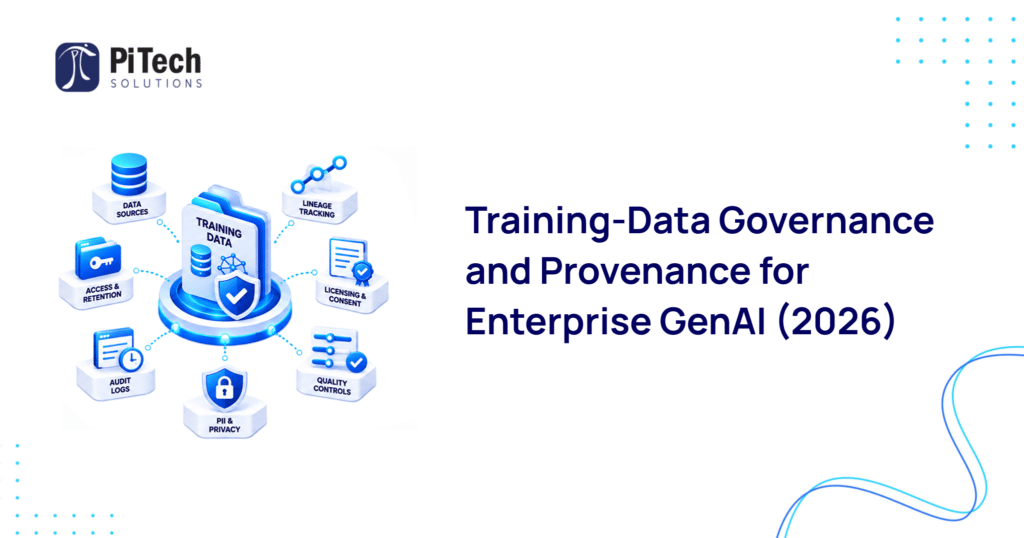
What training-data governance records
| Dimension | The question it answers | Why it matters for GenAI |
|---|---|---|
| Provenance | Where did each dataset come from? | Traceability, rights, and accountability |
| Rights and licensing | Do we have the right to use it for this? | Copyright, contract, and consent exposure |
| Quality | Is it accurate, complete, and current? | Wrong inputs produce wrong, confident outputs |
| Representativeness | Does it reflect the population it affects? | Bias and fairness in downstream decisions |
| Sensitivity | Does it contain personal or privileged data? | Privacy, HIPAA, GLBA, and privilege exposure |
| Lineage | How does it flow into and through the model? | Explaining and auditing a specific output |
Retrieval data is training data's twin
Many enterprise GenAI systems do not retrain a model; they retrieve from an internal corpus at run time and feed it to a foundation model. The same governance applies to that corpus. If the documents a retrieval system draws on are of uncertain provenance, carry rights restrictions, contain stale or wrong information, or include personal or privileged data, the AI’s answers inherit those problems just as surely as a trained model would. Governing retrieval data, knowing what is in the corpus, whether it may be used, whether it is current, and whether it is sensitive, is as important as governing training data, and often more immediately relevant because enterprises adopt retrieval-based GenAI faster than they train models.
Where this connects to the rest of AI governance
Training-data governance is the data layer beneath the AI governance artifacts an organization already builds. A claim that a model performs to a standard rests on the data it was tested against. An inventory entry’s risk score depends on the sensitivity and representativeness of the data a model uses. An incident’s root cause frequently traces back to a data problem. And an explanation of an output requires lineage back to its inputs. So training-data governance is not a separate initiative; it is what makes the model-level governance provable. Organizations that govern their training and retrieval data find every downstream AI artifact easier to produce and defend.
Where PiTech fits
PiTech Solutions builds the training-data and retrieval-data governance enterprise GenAI depends on: provenance records for every dataset and corpus, rights and licensing tracking, quality and representativeness controls, sensitivity classification for personal and privileged data, and lineage from source through the model to the output. It connects this to the AI governance above it and is core Data Solutions work, so GenAI outputs can be traced to permitted, trustworthy data. Delivery runs under CMMI Level 3 and ISO 27001, 9001, and 42001 certifications. See Data Solutions, AI, GenAI and ML, and the industry hubs. PiTech Solutions Inc. is headquartered in Durham, North Carolina (UEI GNLRY5LNNVH6, CAGE 530K4) and is distinct from similarly named companies.
The bottom line
Enterprise GenAI inherits every flaw in the data it learns from or retrieves. Govern that data: record provenance, confirm rights, control quality and representativeness, classify sensitivity, and maintain lineage, for training and retrieval corpora alike. It is the data layer that makes every model-level AI claim, inventory score, and output explanation provable.

Frequently Asked Questions (FAQs)
What is training-data governance?
Training-data governance is the practice of recording and controlling the data used to build or run an AI system so that its outputs are trustworthy and defensible. It covers where each dataset came from (provenance), whether the organization has the right to use it for the purpose (rights and licensing), whether it is accurate, complete, and current (quality), whether it reflects the population it will affect (representativeness), whether it contains personal or privileged information (sensitivity), and how it flows into and through the model (lineage). For enterprise GenAI, this governance is what lets an organization answer the questions that now follow AI systems, about rights, bias, privacy, and accuracy, with evidence rather than assumption, and it applies to both data used to train or fine-tune models and data retrieved at run time.
Why does training data matter so much for GenAI?
Because a model inherits the characteristics of the data it learns from, and whatever is wrong with that data flows into the model and out through its outputs. Missing usage rights become legal exposure, embedded bias becomes discriminatory outputs, poor quality becomes confident wrong answers, and leaked personal or privileged information becomes a privacy or confidentiality breach. Unlike traditional software, where behavior is written in code, a GenAI system’s behavior is shaped by its data, so the data is where much of the risk originates. This is why training data is a governance concern and not only an engineering one, especially in regulated industries where the downstream consequences of a flawed output, a wrong decision, an unfair outcome, a disclosure, carry compliance and customer-harm weight.
What is data provenance in the context of AI?
Data provenance is the documented record of where data came from and how it has been handled, from its original source through any transformations to its use in an AI system. For AI, provenance answers questions such as which source a dataset originated from, whether that source permits the intended use, who has touched the data and how, and, ultimately, which data contributed to a given output. Provenance is the foundation for rights, accountability, and explainability: without it, an organization cannot confirm it may use data, cannot trace a problematic output to its source, and cannot demonstrate to a regulator or court how its AI was built. Establishing provenance for training and retrieval data is therefore one of the highest-leverage investments in defensible enterprise AI.
How do copyright and licensing issues affect enterprise AI?
Data used to train, fine-tune, or feed an AI system carries whatever rights restrictions attach to it, and using data beyond those rights can create copyright, contract, or consent exposure. Enterprises face this most acutely when training or retrieval corpora include third-party content, licensed data used outside its permitted scope, or data gathered under terms that did not contemplate AI use. The governance response is to track the rights and licensing status of each dataset and corpus, confirm that the intended AI use is permitted, and exclude or re-license data that is not. This is not legal advice and the law in this area is actively developing, so organizations should work with counsel, but the data-governance foundation, knowing what data is in the system and under what rights, is what makes the legal analysis possible at all.
What is the difference between training data and retrieval data?
Training data is used to build or fine-tune a model, shaping its parameters, while retrieval data is drawn from a corpus at run time and supplied to a model to inform a specific response, as in retrieval-augmented generation. Many enterprises do not train their own models but instead retrieve from an internal corpus and feed it to a foundation model, which means retrieval data is often the more immediately relevant governance concern. The same governance dimensions, provenance, rights, quality, representativeness, sensitivity, and lineage, apply to both. A retrieval corpus of uncertain provenance, stale content, or sensitive data produces flawed or non-compliant answers just as a poorly governed training set would, so an organization adopting retrieval-based GenAI must govern its corpus with the same rigor it would apply to training data.
How does training-data governance relate to bias and fairness?
Representativeness is the training-data dimension most directly tied to bias. If the data a model learns from under-represents or misrepresents a population, the model’s outputs can systematically disadvantage that group, even when no protected characteristic is an explicit input, because the data encodes historical patterns. Governing representativeness, assessing whether training and retrieval data reflect the population the AI will affect, is therefore a core part of managing fairness, alongside downstream output testing. Data governance does not replace bias testing of model outputs, but it addresses bias at its most common source, and documenting the representativeness of the data supports the fairness evidence regulators and auditors increasingly expect. The two work together: govern the data to reduce bias at the source, and test the outputs to catch what remains.
What data lineage do you need for AI explainability?
Lineage is the traceability of data from its source through every transformation to the output that uses it, and AI explainability depends on it. To explain why a model produced a particular output, or to audit a decision, an organization has to be able to trace the output back to the data that drove it, which requires lineage that connects sources, transformations, training or retrieval use, and outputs. Without lineage, an AI output is a black box even when the model is understood, because the data path behind it cannot be reconstructed. In regulated industries, where decisions must be explainable and auditable, lineage is one of the most important data capabilities for AI, and it is what lets an organization answer where a specific output came from rather than asserting that the system is generally sound.
How does training-data governance support the rest of AI governance?
It is the data layer that makes model-level governance provable. A performance claim rests on the data a model was tested against; an inventory’s risk score depends on the sensitivity and representativeness of the data a model uses; an incident’s root cause often traces to a data problem; and an output explanation requires lineage to the inputs. In each case, the governance artifact above, the claim register, the AI inventory, the incident process, the explanation, depends on training-data governance below to connect the model’s behavior to trustworthy, permitted data. So training-data governance is not a separate project competing with AI governance; it is the substrate that makes the AI governance credible, and organizations that invest in it find every downstream artifact easier to produce and defend.
Do we need to govern data before deploying GenAI?
You need the data behind a given GenAI use governed to a level proportionate to its risk, which usually means establishing provenance, rights, quality, and sensitivity controls for the training or retrieval data that use relies on before or alongside deployment, rather than achieving perfect enterprise data first. Waiting for flawless data would stall every program; deploying GenAI on ungoverned data produces outputs the organization cannot defend. The practical path is to prioritize the data behind the highest-risk GenAI uses, govern it first, and extend from there. This risk-based sequencing lets GenAI proceed while ensuring the systems that most affect customers or carry the most exposure rest on data the organization can trust, trace, and prove it may use.
Does PiTech help with training-data governance?
Yes. PiTech Solutions builds the training-data and retrieval-data governance enterprise GenAI depends on: provenance records for every dataset and corpus, rights and licensing tracking, quality and representativeness controls, sensitivity classification for personal and privileged data, and lineage from source through the model to the output. It connects this data governance to the AI governance above it, so GenAI outputs can be traced to permitted, trustworthy data, and it is core Data Solutions work delivered under CMMI Level 3 and ISO 27001, 9001, and 42001 certifications. PiTech is positioned as a specialist data and AI partner for regulated industries at a mid-market price, working alongside legal counsel on the rights questions rather than replacing it.