
Financial Services Compliance Automation Is Delivering Real Returns. Here’s Why Most Deployments Still Fall Short.

Table of Contents

Summarize and analyze this article with

ChatGPT

Chat GPT

ChatGPT

Perplexity

 
ChatGPT

Grok

 
ChatGPT

Google AI

ChatGPT

Claude


The business case for compliance automation in financial services is no longer speculative. Financial institutions using AI-driven compliance automation report 40 to 60 percent reductions in document processing times and 30 to 50 percent improvements in response times for compliance-related inquiries. Gartner projects that 90 percent of finance functions will deploy at least one AI-enabled technology by 2026. Regulatory monitoring, transaction surveillance, suspicious activity reporting, and customer due diligence workflows are all areas where AI has demonstrated measurable performance improvements at institutions that have deployed it correctly.

But these headline numbers obscure a more nuanced story about what is working, what is failing, and what separates institutions that are actually transforming compliance operations from those running expensive pilots. The failure mode is consistent: governance deployed after the technology, compliance documentation that describes the system better than it actually operates, and validation approaches designed for traditional statistical models applied to AI systems that behave differently. Getting compliance automation right requires a foundational question to be answered before technology is selected: does the organization have the process maturity to govern automated systems?

Where Compliance Automation Delivers Real Value
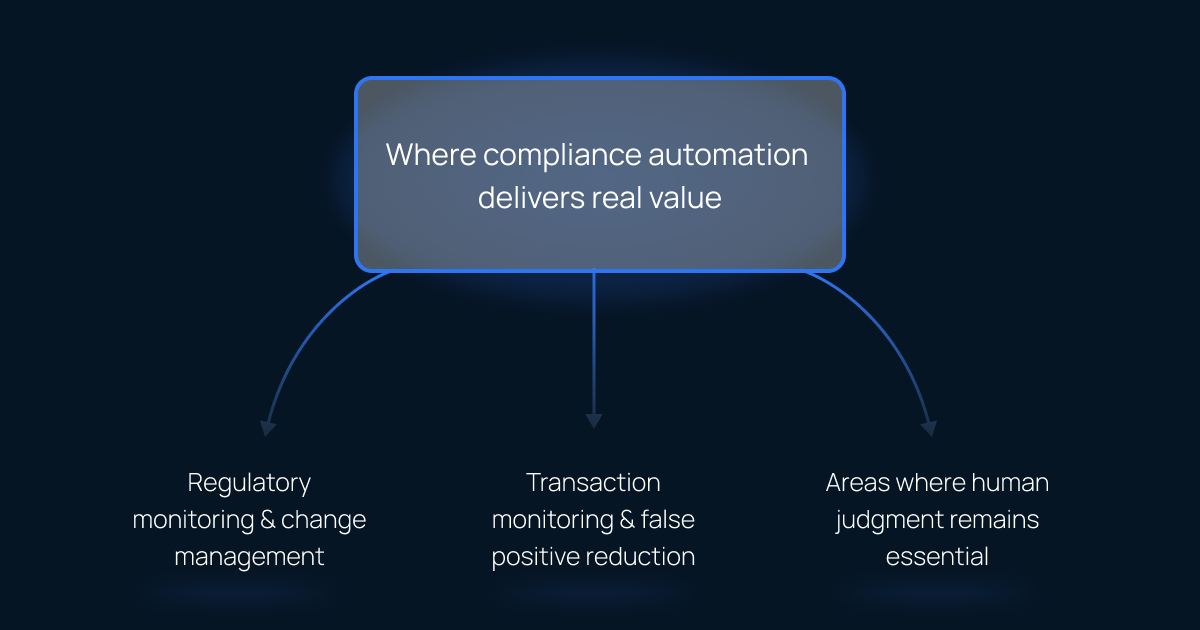
Regulatory Monitoring and Change Management

Monitoring for new regulations, rule changes, enforcement actions, and guidance documents across federal and state jurisdictions is a natural fit for AI automation. The task is information-intensive, time-sensitive, and pattern-driven exactly the profile where AI systems outperform manual processes. Institutions with automated regulatory monitoring reduce the time between a regulatory change being published and the compliance team being notified from days or weeks to hours, and they virtually eliminate the risk of missing a change entirely  a risk that grows as regulatory volume increases and compliance teams face resource constraints.

Transaction Monitoring and False Positive Reduction

BSA/AML transaction monitoring is where financial services AI has the longest track record. AI models that combine supervised learning on known suspicious patterns with anomaly detection for novel patterns have significantly reduced false positive rates compared to rule-based systems, which typically generate false positive rates exceeding 95 percent. The practical consequence of false positive reduction is substantial: compliance analysts spend their time investigating actual suspicious activity rather than clearing alerts that turn out to be legitimate transactions. This is measurable return on compliance automation investment that shows up in operational metrics.

Areas Where Human Judgment Remains Essential

Regulatory examination response, implementation of remediation plans, and consent order management remain primarily human-driven activities requiring judgment about institutional strategy, risk appetite, and regulatory relationship management. AI can support these activities  organizing documentation, identifying relevant precedents, drafting initial responses for human review  but the consequential judgment calls must remain with experienced compliance professionals. Institutions that over-automate these functions produce technically complete responses that are strategically inadequate.

The Governance Foundation That Makes Compliance Automation Work

Every financial institution that asks PiTech about compliance automation leads with the same question: what AI tool should we buy? It is the wrong first question. The right first question is whether the organization has the process maturity to govern automated compliance systems. Because what happens when it does not is entirely predictable: the institution deploys an AI-driven transaction monitoring system, the system performs better than the rule-based predecessor, and six months later a regulator asks for the model’s validation documentation. The institution cannot produce it because nobody defined the validation process before deployment. Or the regulator asks for training data lineage documentation. The institution cannot provide it because data governance processes were not updated to account for AI training data requirements.
These are not technology failures. They are governance failures that are entirely preventable with the right organizational foundation. PiTech’s Financial Services Compliance Automation practice is built on a governance-first delivery model that addresses this sequencing problem directly.

How PiTech Delivers Compliance Automation That Survives Regulatory Scrutiny

PiTech’s approach to compliance automation in financial services begins with governance infrastructure before technology deployment  updating model risk management policies for AI, extending data governance to cover AI training data, defining explainability requirements for each compliance use case, and establishing ongoing monitoring and validation processes aligned with OCC SR 11-7 and applicable regulatory frameworks. For organizations with ISO 27001 certification and CMMI-certified processes, this foundation phase accelerates the implementation because the organizational infrastructure for documentation, risk assessment, and change management already exists and needs to be extended to cover AI-specific requirements rather than built from scratch.
Our compliance automation engagements cover the full technology and governance stack: selecting automation approaches appropriate to the specific compliance use case, implementing model validation that satisfies independent validation requirements, building data governance that covers training data provenance and quality monitoring, designing explainability architecture appropriate to the regulatory context of each function, and establishing operational monitoring that continuously tracks performance against defined thresholds. We build compliance automation that can be defended in a regulatory examination, not just demonstrated in a proof of concept.

For BSA/AML specifically, PiTech designs hybrid monitoring architectures that combine interpretable models for the suspicious activity determination layer  the layer that regulators directly scrutinize in SAR filings  with more sophisticated models for upstream pattern detection. This architecture satisfies BSA/AML documentation requirements while capturing the performance advantage of advanced pattern detection. The SAR narrative documentation produced by the system reflects the actual model reasoning, not a generic description that creates examination risk.

PiTech’s ongoing compliance monitoring service tracks model performance, false positive rates, detection rates for known suspicious patterns, demographic fairness across relevant dimensions, and data quality for model inputs  continuously, with escalation workflows for conditions requiring human review or model intervention. This operational monitoring is what satisfies the ongoing monitoring expectations of OCC SR 11-7 and provides the evidence that regulators are increasingly expecting institutions to produce on demand rather than compile reactively in response to examination requests.

Frequently Asked Questions (FAQs)

What does PiTech's HIPAA-Aligned AI Architecture service include?

Regulatory monitoring and change management, transaction monitoring for BSA/AML, customer due diligence screening, and regulatory report data aggregation and validation are well-suited to AI automation today. These functions share common characteristics: high information volume, time-sensitive requirements, pattern-driven analysis, and clear performance metrics. Functions requiring judgment about institutional strategy, regulatory relationships, or complex legal interpretation should remain primarily human-driven with AI support.
PiTech applies OCC SR 11-7 model risk management requirements to AI systems used in compliance functions, including documented development methodology, independent validation, ongoing monitoring with defined thresholds, change management processes, and clear documentation of intended use and limitations. We help institutions update their existing model risk management frameworks to address AI-specific requirements — training data governance, drift monitoring, adversarial testing — rather than applying frameworks designed for traditional statistical models to AI systems with different behavior profiles.
PiTech’s governance foundation phase covers updating model risk management policies for AI systems, extending data governance to cover AI training data provenance and quality monitoring, defining explainability requirements for each compliance use case based on regulatory context, establishing independent validation processes, and implementing ongoing monitoring frameworks. For ISO 27001-certified organizations, this phase extends existing information security governance to cover AI-specific requirements — typically a faster path than building governance infrastructure from scratch.

PiTech maps compliance automation systems against both US regulatory frameworks OCC, FDIC, Federal Reserve, CFPB, FinCEN  and EU AI Act requirements for high-risk financial services AI systems. We build dual-compliance governance architectures that satisfy both regulatory regimes simultaneously rather than maintaining parallel compliance programs, leveraging the substantial overlap between US model risk management requirements and EU AI Act conformity assessment requirements to minimize duplicative compliance effort.