
Table of Contents
Summarize and analyze this article with

Chat GPT

Perplexity

Grok

Google AI

Claude
What CMMC Full Enforcement Actually Requires
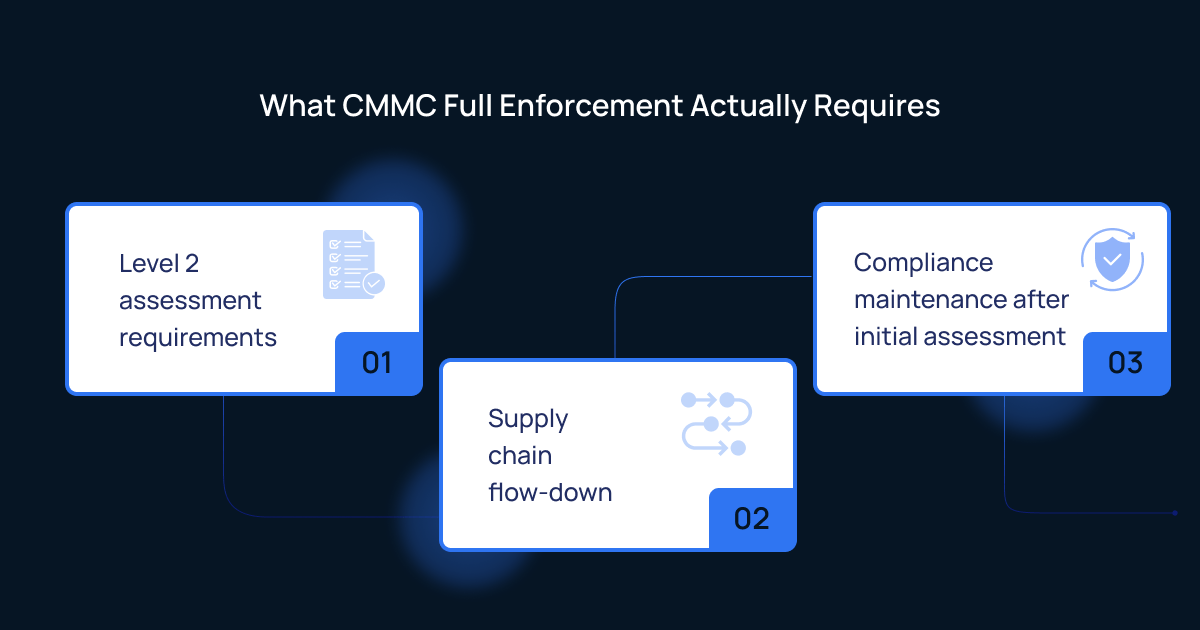
Level 2 Assessment Requirements
Most organizations handling Controlled Unclassified Information require CMMC Level 2, encompassing all 110 security practices from NIST SP 800-171. Level 2 requires third-party assessment by a Certified Third Party Assessment Organization conducted by assessors holding current ISACA-managed CCA or CCLA credentials. Self-attestation is available only for a narrow subset of contracts where the government has specifically accepted it. For the vast majority of CUI-handling defense contractors, the independent third-party assessment is the only path to demonstrated compliance.
Supply Chain Flow-Down
CMMC obligations do not stop at your organizational boundary. Prime contractors and upper-tier subcontractors have compliance verification obligations for subcontractors in their supply chain that handle CUI. This means flow-down clauses, supplier compliance documentation requirements, and in some cases active monitoring of subcontractor security posture. Organizations managing their supply chain through annual questionnaires face real contract risk both from their own primes who require compliance documentation and from the downstream liability if a non-compliant subcontractor creates a breach in their supply chain.
Compliance Maintenance After Initial Assessment
CMMC certification requires ongoing compliance maintenance, not just initial assessment achievement. The 110 practices must be operational continuously not just for the assessment window. Organizations that achieve initial CMMC authorization through intensive pre-assessment preparation and then allow security posture to drift will face findings in their next assessment cycle. Sustainable CMMC compliance requires institutionalized security practices, not periodic compliance sprints.
How PiTech Helps Defense Contractors Navigate CMMC
Our CMMC Readiness Assessment evaluates current security posture against all 110 NIST SP 800-171 practices, identifies gaps, and produces a prioritized remediation roadmap with realistic timelines and resource requirements. We assess not just whether controls are documented but whether they are operationally implemented and consistently applied — the distinction that ISACA-credentialed assessors are trained to evaluate. Organizations that receive our readiness assessment know exactly where they stand before committing to an assessment timeline and exactly what investment is required to reach sustainable compliance.
Our CMMC Compliance Program Development service establishes the governance infrastructure that makes CMMC sustainable: documented security policies and procedures aligned with the practice requirements, configuration management discipline covering all technology assets in the assessment scope, incident response processes with the documentation standards required for reporting obligations, continuous monitoring programs that maintain compliance evidence between assessment cycles, and the employee training and awareness programs that prevent the behavioral security failures that assessors specifically probe.
PiTech’s 3PAO Coordination service supports organizations through the actual third-party assessment process: preparation for the assessment interviews and documentation reviews, resolution of preliminary findings before they become final findings, and post-assessment remediation support for any identified gaps. We have worked alongside ISACA-credentialed assessors and understand what evidence presentation satisfies their evaluation criteria, what documentation is substantive versus performative, and where the most common assessment findings originate.
Our ISO 27001 certification and CMMI certification are not incidental to our CMMC practice. They are the operational evidence that our delivery processes are institutionalized and our security practices are consistent. Defense contractor clients evaluating technology partners should look for exactly this kind of externally-verified process evidence — because the same process discipline that makes our CMMI and ISO certifications meaningful is what makes our CMMC compliance programs sustainable rather than dependent on the next preparation sprint.
The Cybersecurity Threat Context That Makes This Urgent
Frequently Asked Questions (FAQs)
What CMMC level applies to most defense subcontractors and what does it require?
Most organizations handling Controlled Unclassified Information require CMMC Level 2, encompassing all 110 security practices from NIST SP 800-171 and requiring third-party assessment by a C3PAO. Level 3 applies to organizations handling the most sensitive CUI categories and requires a government-led assessment. Organizations should confirm with their prime contractors which level applies to their specific contract scope contract flow-down language specifies the required CMMC level.
How does PiTech's CMMC Readiness Assessment differ from self-assessment?
How does PiTech integrate CMMC and FedRAMP compliance for contractors with both requirements?
What does sustainable CMMC compliance require after initial certification?
Sustainable CMMC compliance requires institutionalized security practices that operate continuously not periodic compliance sprints before assessment cycles. This means documented policies and procedures that employees actually follow, continuous monitoring that maintains compliance evidence and detects deviations, configuration management that tracks all technology assets and changes, and incident response processes that are tested rather than just documented. PiTech’s ongoing compliance support service maintains these operational elements between assessment cycles, ensuring that initial certification leads to successful re-assessment rather than finding-filled reviews.