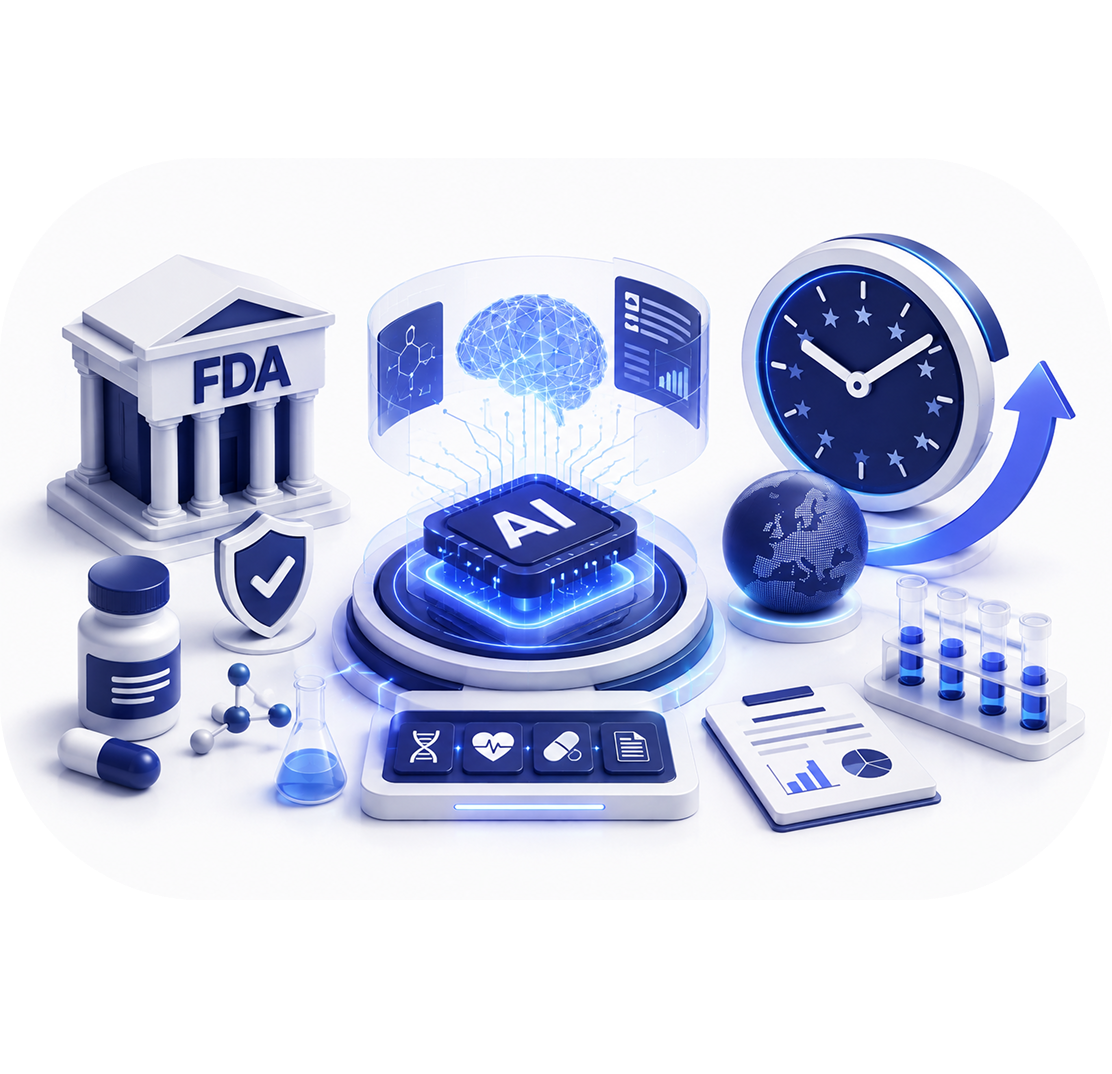
Four developments landed in health and life sciences that every executive in a regulated industry should have on their desk this week. Mike and Laura walk through what changed, what it means operationally, and what belongs on your Monday morning agenda. The through line: AI in this sector has moved out of the pilot phase and into the phase where it is governed, financed, and accountable.
The FDA opens the generative AI question : On August 18, 2026, the FDA announced it is seeking public feedback to inform its regulatory approach for generative AI enabled medical devices, issuing a discussion paper and opening a public comment period under docket FDA-2026-N-7874, with comments due by October 19, 2026. Acting FDA Commissioner Kyle Diamantas, CDRH Director Michelle Tarver, and Digital Health Center of Excellence Director Rick Abramson all went on the record the same day. Context matters here: the FDA said in January 2025 that it had already authorized more than 1,000 AI enabled devices through established premarket pathways. This is not an agency meeting AI for the first time. It is an agency confronting a class of model that breaks the assumptions its existing pathways were built on.
Europe resets the clock, not the obligation : The EU AI Omnibus entered into force on July 27, 2026, following the Commission’s proposal of the Digital Omnibus package on November 19, 2025. Obligations for high risk AI systems listed in Annex III now apply from December 2, 2027, and obligations for high risk AI embedded in physical products under Annex I now apply from August 2, 2028. Laura makes the case that a longer deadline is not a lighter obligation, and that compliance programs which go quiet when a date slips pay for it later in compressed, expensive remediation.
Regulators converge before they legislate : On January 14, 2026, the European Medicines Agency and the FDA published a joint document, the Guiding Principles of Good AI Practice in Drug Development, setting out ten principles. European Commissioner for Health and Animal Welfare Oliver Varhelyi described them as a first step of a renewed EU and US cooperation. Shared vocabulary before shared rules is the right order of operations, and mapping your AI governance against those ten principles now, while it is voluntary, is the cheapest version of that work you will ever do.
Capital follows conviction : In early August 2026, Pathos AI announced a global licensing agreement with Alphamab Oncology for JSKN016, a first in class TROP2/HER3 bispecific antibody drug conjugate, granting Pathos AI exclusive rights outside mainland China, Hong Kong, Macau and Taiwan. Terms are US$125 million upfront and up to US$2,093 million in milestone payments, and the Pathos AI clinical stage pipeline now includes four assets. The notable part is not the size of the check but its direction: an AI company taking clinical asset risk directly rather than selling software to the companies that carry it.
To learn more about how PiTech Solutions helps carriers and regulated enterprises turn AI ambition into governed, production grade capability, visit pitechsol.com.