
Reconciliation Errors
100
Customer Disruption
100
Cost Overruns
100
TSYS → FDR
Processor Migrated
Client Snapshot
Industry
Banking & Financial Services
Client Type
Larger Regional Bank
Scope
Credit card processor cutover · Cardholder data migration · Reconciliation integrity

Platform
IBM DB2 · IBM InfoSphere DataStage · HP ALM
Engagement
Data Migration · Cutover Management · DR/BCP Continuity
The Challenge
- Migrating credit card data from TSYS to FDR is among the highest-risk operational events a card-issuing bank can execute. A botched cutover does not produce a temporary inconvenience it produces months of reconciliation recovery, regulatory scrutiny, and customer service failures that damage the institution's reputation and strain examiner relationships.
- The migration required translating the complete cardholder data state account structures, transaction histories, authorization rules, billing cycles, and dispute records from one processor's proprietary data model to another's, without losing data integrity or introducing the reconciliation discrepancies that are the primary failure mode of processor migrations.
- Live customer accounts had to remain fully functional throughout the transition period. There was no maintenance window long enough to take credit card operations offline the cutover had to be orchestrated so that cardholders, merchants, and internal operations teams experienced continuity, not disruption.
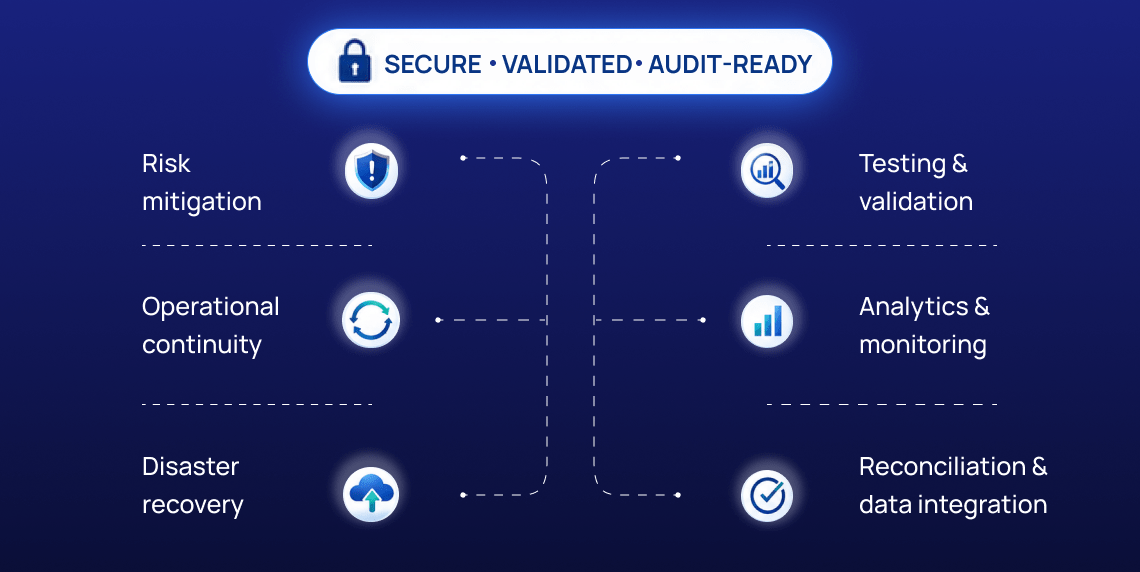
- The bank's disaster recovery and business continuity programs had to remain in a fully tested, audit-ready state throughout the migration. A migration that compromised DR/BCP readiness even temporarily was not acceptable to the bank's risk management function or its regulators.
- The migration had to be executed within the bank's existing enterprise data technology program, sharing infrastructure, team resources, and governance frameworks with concurrent modernization initiatives requiring precise dependency management to prevent migration activities from disrupting other program workstreams.
The PiTech Solution
- Developed a comprehensive data migration capability covering the complete cardholder data scope mapping every field from the TSYS data model to its FDR equivalent, identifying and resolving model discrepancies during the mapping phase rather than during cutover, and building validation rules that confirmed data integrity at each migration stage.
- Built a parallel-run framework that allowed both processor environments to operate simultaneously during the transition period enabling the bank to validate that FDR- processed transactions reconciled against the TSYS record before committing to full cutover. Discrepancies surfaced during parallel running were resolved before any customer account was migrated.
- Coordinated all migration activities within the bank's enterprise DBA framework, maintaining IBM DB2 and IBM InfoSphere DataStage environments in continuous operational readiness throughout. The migration was executed as a controlled program event, not a disruptive all-hands effort.
- Maintained and validated the bank's disaster recovery and business continuity programs at every stage of the migration. DR/BCP testing schedules were preserved, documentation was kept current throughout, and the migration execution plan included explicit rollback procedures that could be invoked at any cutover gate without customer impact.
- Used HP ALM to manage the full testing program including pre-migration data validation, parallel-run reconciliation, cutover acceptance testing, and post-migration monitoring. Every test case was traceable to a specific data integrity or operational continuity requirement, producing an audit record of the migration's quality assurance process.
Results That Matter
Processor migration from TSYS to FDR completed with zero reconciliation errors the
single most important outcome measure for a migration of this type, and the one most
difficult to achieve without rigorous parallel-run validation.
Zero disruption to credit card operations or customer accounts during or after the
cutover. Cardholders, merchants, and internal operations teams experienced no service
degradation throughout the migration lifecycle.
DR/BCP programs maintained in audit-ready state throughout the engagement
satisfying the bank's risk management requirements and preserving the institution's
regulatory standing.
A comprehensive migration audit record produced through the HP ALM testing
framework documented every validation step, reconciliation result, and acceptance
test outcome, giving the bank a defensible record of migration quality assurance.
Delivered on time and on budget, zero cost overruns executed within the bank's
enterprise data program without disrupting concurrent modernization workstreams.
Technology Stack
Databases
Databases
IBM DB2 (source and target data management)
Data Integration & Migration
Data Integration & Migration
IBM InfoSphere DataStage (ETL, field mapping,
transformation)
Testing & Quality Assurance
Testing & Quality Assurance
HP ALM (test case management, reconciliation tracking,
acceptance testing)
Migration Framework
Migration Framework
Parallel-run architecture, field-level data mapping documentation,
rollback procedures
Why PiTech
PiTech manages credit card processor migrations the way federal programs manage high-
consequence technology transitions with detailed playbooks, gate-controlled cutover sequences, and rollback procedures that are tested, not theoretical. The discipline that prevents a $10 million migration from becoming a $50 million recovery is built into the program design
from day one.

Ready to achieve results like these?
Talk to PiTech. Federal-grade delivery discipline. Deep domain expertise. Zero cost overruns.

Reach Our Customer Service Team
-
Address
4000 Sancar Way, Suite 205, Durham, NC 27709
-
Contact Details
(919) 439-3163
