
Modern
Shared Ingestion Platform
Multi- Track
Agile Delivery Model
Cost Overruns
0
%
Full
Regulatory Compliance
Client Snapshot
Industry
Banking & Financial Services
Client Type
Larger Regional Bank
Scope
Enterprise data ingestion · Regulatory reporting · Shared data services

Platform
IBM InfoSphere DataStage · IBM DB2 · Netezza · Control-M
Engagement
Architecture Gap Analysis · Roadmap Development · Platform Migration ·Agile Delivery
The Challenge
- The legacy ingestion architecture was a bottleneck on both fronts that matter most in a regulated bank: it could not keep pace with the volume and frequency of regulatory reporting requirements, and it could not absorb the business-driven change requests that piled up from downstream analytics teams who needed new data sources to support product decisions.
- No architecture gap analysis existed before this engagement. The bank had been managing around the legacy layer's limitations rather than confronting them systematically a pattern that creates invisible technical debt and makes the eventual reckoning harder to scope, fund, and defend to leadership. Committing modernization investment without a documented gap analysis would have been indefensible.
- Downstream analytics teams were effectively blocked from supporting new business initiatives because the ingestion layer could not reliably deliver the data they needed at the frequency they needed it. The constraint was compounding as the bank's product roadmap continued to generate new data requirements that the existing architecture could not absorb.
- The modernization required simultaneous coordination across three distinct workstreams business analysis, development, and technology without disrupting the existing regulatory reporting obligations that the legacy system was still running. Governance and sequencing discipline were as important as the technical work.
- Previous modernization initiatives at the bank had stalled or delivered partial results because the scope had not been grounded in a rigorous current-state baseline. PiTech had to establish that baseline before a credible roadmap could be built and had to do it quickly enough to maintain program momentum.
The PiTech Solution
- Conducted a comprehensive architecture gap analysis of the existing ingestion layer, evaluating it systematically against current and projected regulatory reporting requirements, business-driven data demand, and the bank's 3-year technology roadmap. The analysis documented the specific gaps driving the bottleneck and produced the business case for modernization investment.
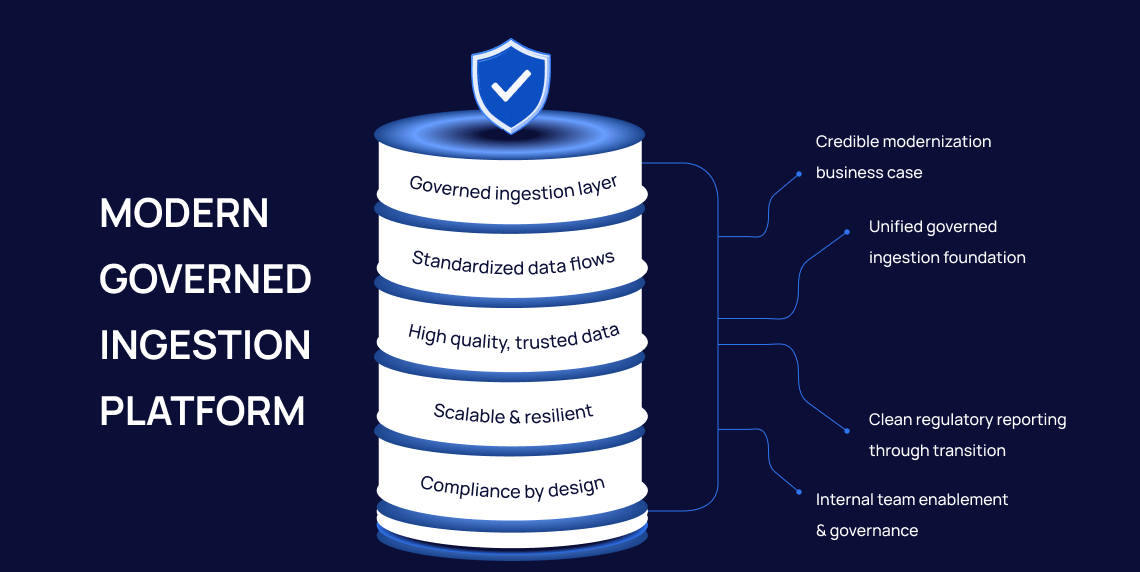
- Developed the next-generation ingestion roadmap and shared data services architecture, designed to serve multiple downstream consumers regulatory reporting, analytics, and operational systems from a single governed ingestion layer. The design was validated through a structured pilot with selected data flows before scaling to the full platform.
- Stood up a multi-track Agile delivery program integrating Business Analysis, Development, and Technology workstreams in a coordinated delivery governance model. Track dependencies were actively managed to prevent the workstream sequencing failures that had undermined previous modernization efforts.
- Executed the full platform migration to IBM InfoSphere DataStage, mapping all critical process flows and information flows to the new architecture. Migration sequencing was prioritized by regulatory criticality the most compliance-sensitive flows were migrated and validated first, ensuring the bank maintained clean regulatory reporting throughout the transition.
- Delivered structured handover documentation and knowledge transfer to the bank's internal data engineering team including architectural decision records, operational runbooks, and a governance framework for managing change requests against the new platform.
Results That Matter
A modern, governed, shared ingestion platform now serves regulatory reporting,
analytics, and operational consumers from a single architecture eliminating the data-
silo dynamics and change management bottlenecks that had characterized the legacy
environment.
Downstream analytics teams regained the ability to support new business initiatives in a
timely manner, removing a constraint that had been limiting the bank's product
development velocity.
Multi-track Agile delivery completed under an integrated governance model with federal-
grade QA discipline a delivery approach that maintained program integrity across
three parallel workstreams without losing pace.
Regulatory reporting obligations were maintained without disruption throughout the
migration a non-negotiable requirement that the phased, compliance-first sequencing
approach delivered.
Delivered on time and on budget, zero cost overruns consistent with PiTech's track
record across nine banking engagements at this institution spanning more than a
decade.
Technology Stack
Primary Ingestion Platform
Primary Ingestion Platform
IBM InfoSphere DataStage
Databases
Databases
Decision-support dashboard design, credit operations KPI visualization
Scheduling & Orchestration
Scheduling & Orchestration
Control-M enterprise job scheduler
Delivery Methodology
Delivery Methodology
Multi-track Agile (Business Analysis · Development · Technology)
Architecture Artifacts
Architecture Artifacts
Gap analysis documentation, migration runbooks, operational
governance framework
Why PiTech
PiTech's gap-analysis-first approach means no modernization investment is committed without
a defensible, documented baseline of what exists and what needs to change. That discipline
protects the bank's budget and credibility with leadership and it is the same standard PiTech
applies to federal program modernization work. Architecture decisions at this scale deserve the
same rigor as a federal acquisition.

Ready to achieve results like these?
Talk to PiTech. Federal-grade delivery discipline. Deep domain expertise. Zero cost
overruns.

Reach Our Customer Service Team
-
Address
4000 Sancar Way, Suite 205, Durham, NC 27709
-
Contact Details
(919) 439-3163
