
Repeatable
Capital Planning
Methodology
Board- Level
Defensible Investment
Model
Multi-Year
Financial Modeling
Delivered
Cost Overruns
100
Client Snapshot
Industry
Banking & Financial Services
Client Type
Larger Regional Bank
Scope
IT portfolio analysis · Capital planning · Financial modeling · Executive reporting

Disciplines
Portfolio Analysis · Financial Modeling · Architecture Assessment · Executive Reporting
Engagement
Framework Design · Decision Model Development · Strategic Planning Support
The Challenge
- Executive leadership had no repeatable methodology to defend IT spend to the bank's board. Each annual planning cycle required the IT leadership team to reconstruct the investment justification from scratch a time-intensive process that produced inconsistent presentations and gave the board no basis for comparing one year's recommendations against another's or holding the IT function accountable for stated outcomes.
- There was no framework for tying IT investments to business outcomes at the portfolio level. Individual projects had business cases, but the portfolio as a whole had no structured lens for evaluating whether the aggregate investment mix was aligned to strategic priorities, generating the returns the bank expected, or systematically addressing the risk and capability gaps leadership had identified.
- Capital planning for technology at a regional bank sits at the intersection of regulatory expectation and board governance. Regulators expect institutions to demonstrate that technology investment decisions are made within a structured, risk-aware framework. The bank's existing approach project-by-project approvals without portfolio context was not consistent with that expectation.
- Multi-year financial modeling for IT portfolios requires a methodology that accounts for investment phasing, maintenance cost trajectories, capability decay curves on aging systems, and the opportunity cost of deferred investment. None of these were being modeled systematically, which meant that the bank's capital plan underrepresented both the risk of inaction and the full lifecycle cost of approved investments.
- The framework had to be operationalizable by the bank's internal team after delivery not a consulting artifact that required PiTech's continued presence to apply. Sustainability of the methodology was a design requirement from the start.
The PiTech Solution
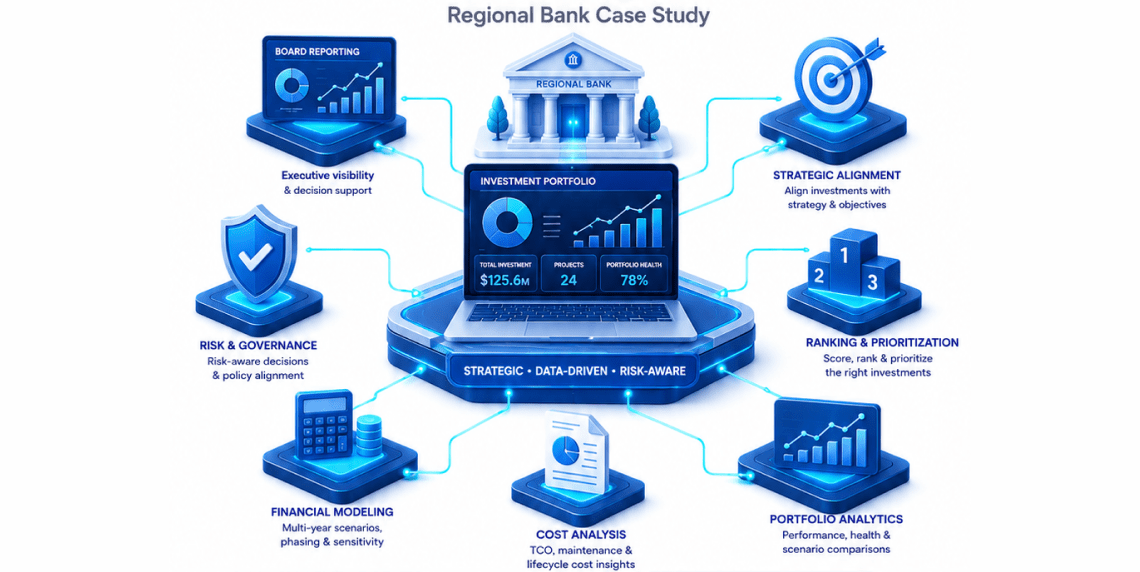
- Designed the portfolio evaluation methodology defining the dimensions along which IT and data investments would be assessed (strategic alignment, risk reduction, capability gap closure, total cost of ownership, financial return), calibrating the scoring model to the bank's specific strategic priorities, and documenting the methodology in a form the internal team could apply independently in future cycles.
- Developed the decision models and tooling that operationalize the methodology investment evaluation templates, portfolio scoring tools, and a comparative ranking framework that allows leadership to prioritize investments against a consistent set of criteria rather than responding to individual project advocacy.
- Mapped the framework to the bank's Capital Planning Strategic Plan, ensuring that IT investment decisions were integrated into the institution's broader capital allocation process rather than managed as a separate planning track that competed for attention during the annual budget cycle.
- Delivered advanced financial modeling covering multi-year investment scenarios including phased investment paths, maintenance cost trajectories, lifecycle cost models for aging systems, and sensitivity analysis on key assumptions giving leadership the quantitative grounding to defend investment recommendations in board and regulatory settings.
- Produced a current-state assessment of the bank's existing IT and data portfolio evaluating investment performance against stated objectives, identifying underperforming assets and capability gaps, and developing transition recommendations that the capital planning framework could sequence and fund in subsequent planning cycles.
Results That Matter
A repeatable, documented capital planning methodology that the bank's IT leadership
team can apply independently in every subsequent planning cycle eliminating the
annual reconstruction effort and producing consistent, comparable presentations for
board review.
Portfolio-level investment prioritization capability built into the institution's planning
process allowing leadership to evaluate the full investment mix against strategic
priorities rather than approving projects in isolation.
Board-defensible financial models and multi-year projections that quantify both the return
on proposed investments and the cost of deferral supporting the governance standard
regulators expect from technology capital planning at an institution of this size.
Current-state portfolio assessment delivered alongside the framework giving
leadership an immediate starting point for applying the methodology and a documented
baseline against which future portfolio performance can be measured.
Delivered on time and on budget, zero cost overruns with a full methodology transfer
ensuring the framework remained operational after PiTech's delivery engagement
concluded.
Technology Stack
Methodology
Methodology
Portfolio evaluation framework, investment scoring model, strategic
alignment mapping
Financial Modeling
Financial Modeling
Multi-year scenario models, lifecycle cost analysis, sensitivity
analysis templates
Architecture Assessment
Architecture Assessment
Current-state capability mapping, gap identification, transition
sequencing
Deliverables
Deliverables
Investment evaluation tools, capital planning templates, board-reporting
frameworks
Why PiTech
PiTech builds IT capital planning frameworks to the same standard of rigor that federal program
management requires for acquisition decisions. That standard produces models that boards
recognize and regulators accept not because they are complex, but because they are
disciplined, documented, and consistently applied. The deliverable is a methodology the bank
owns and uses independently, not a dependency on continued consulting engagement.

Ready to achieve results like these?
Talk to PiTech. Federal-grade delivery discipline. Deep domain expertise. Zero cost overruns.

Reach Our Customer Service Team
-
Address
4000 Sancar Way, Suite 205, Durham, NC 27709
-
Contact Details
(919) 439-3163
