
Stronger
Fraud Detection
Reduced
False Positives
Richer
Data Capture for Modeling
TSYS → FDR
Processor Migrated
Client Snapshot
Industry
Banking & Financial Services
Client Type
Larger Regional Bank
Scope
Financial crimes platform · Fraud detection · BSA/AML data coverage

Platform
Fiserv Financial Crimes Management · IBM InfoSphere DataStage · IBM DB2
Engagement
Gap Analysis · Platform Architecture · Application Development
The Challenge
- The existing financial crimes platform had critical data coverage gaps Proof of Deposit records and other high-signal inputs were inconsistently captured, limiting the platform's ability to detect the fraud patterns that pose the greatest risk to a regional bank's consumer and commercial portfolios. The detection problem was fundamentally a data problem.
- High false-positive rates were inflating investigator caseloads at a compounding cost. Every false positive required investigator review time, case documentation, and disposition and those resources came directly at the expense of the deeper investigation work that high-risk alerts require. The bank was paying twice: once for the detection failure, and once for the remediation overhead.
- Financial crimes modeling including BSA/AML pattern recognition is only as good as the data it operates on. The platform's modeling capability was constrained not by the sophistication of the models but by the completeness and consistency of the data feeding them. Improving the models without fixing the data foundation would have produced marginal gains at best.
- The bank's financial crimes function was under regulatory pressure to demonstrate continuous improvement in its fraud detection and BSA/AML capabilities. Regulators expected to see not just outcome metrics but evidence of a systematic approach to identifying and closing capability gaps. The gap analysis methodology PiTech applied directly addressed that expectation.
- Rebuilding the platform had to be sequenced carefully to avoid disrupting active investigations and ongoing BSA/AML monitoring obligations. The bank could not suspend financial crimes operations during the rebuild work had to continue on the existing platform while the new capture processes and application logic were developed and validated in parallel.
The PiTech Solution
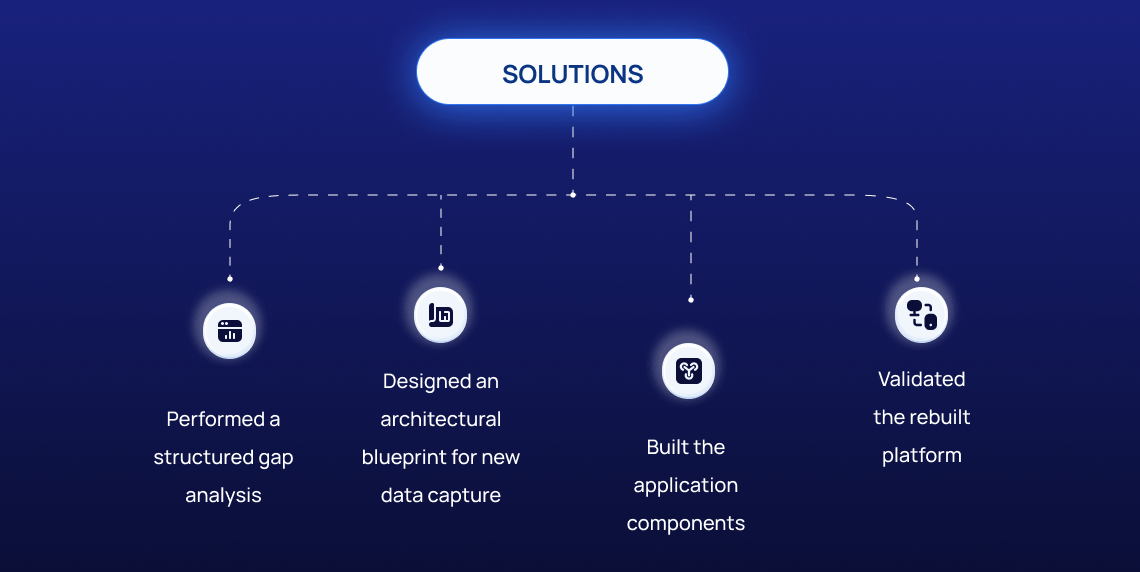
- Performed a structured gap analysis of the existing financial crimes platform's data coverage, process logic, and detection outcomes identifying the specific inputs whose absence or inconsistency was driving detection failures and false-positive inflation. The analysis produced a prioritized remediation roadmap tied to documented risk impact.
- Designed an architectural blueprint for a new data capture process covering Proof of Deposit, transaction context signals, and other high-signal inputs identified in the gap analysis. The blueprint specified not just what data to capture but at what point in the transaction lifecycle, under which governance controls, and with what validation logic to ensure consistent quality.
- Built the application components to operationalize the capture blueprint integrating new data inputs into the Fiserv Financial Crimes Management platform through IBM InfoSphere DataStage and IBM DB2 and calibrated the detection logic to maximize true-positive signal while systematically suppressing the false-positive patterns identified in the gap analysis.
- Validated the rebuilt platform against a historical transaction sample before production deployment, confirming that the new detection configuration improved recall on the fraud patterns the gap analysis had identified as under-detected, and reduced false-positive volume in the alert queues most burdened by investigator caseload.
- Delivered the rebuilt platform with complete technical documentation data flow diagrams, transformation logic specifications, detection rule documentation, and a post- implementation monitoring guide supporting the bank's ongoing regulatory examination and internal audit obligations.
Results That Matter
Rebuilt financial crimes and fraud detection platform with measurably stronger detection
coverage across the high-risk transaction patterns that the gap analysis had identified as
under-detected.
False-positive alert volume reduced materially, allowing investigator capacity to shift
from low-value queue work toward the deeper investigation of genuinely high-risk alerts
improving both detection outcomes and investigator productivity.
Richer, more consistent data capture across Proof of Deposit and other high-signal
inputs improved the quality of fraud modeling inputs for downstream BSA/AML pattern
recognition and risk scoring.
Complete technical documentation and regulatory-facing artifacts delivered alongside
the platform supporting the bank's examiner-facing narrative of continuous capability
improvement with concrete evidence of systematic gap closure.
Delivered on time and on budget, zero cost overruns with a validated platform and a
post-implementation monitoring framework that the bank's financial crimes team could
operate and evolve independently.
Technology Stack
Financial Crimes Platform
Financial Crimes Platform
Fiserv Financial Crimes Management
Data Integration
Data Integration
IBM InfoSphere DataStage (capture process, transformation, platform
integration)
Databases
Databases
IBM DB2
Architecture Deliverables
Architecture Deliverables
Data coverage gap analysis, capture process blueprint,
detection logic documentation
Why PiTech
PiTech approaches financial crimes platform work the way regulators do starting with a
systematic gap analysis of data coverage and detection outcomes, not a technology selection.
The gap-analysis-first methodology is the same discipline PiTech applies to federal program
audits, and it produces the documented, defensible improvement narrative that banking
regulators expect to see.

Ready to achieve results like these?
Talk to PiTech. Federal-grade delivery discipline. Deep domain expertise. Zero cost
overruns.

Reach Our Customer Service Team
-
Address
4000 Sancar Way, Suite 205, Durham, NC 27709
-
Contact Details
(919) 439-3163
