
Table of Contents
Summarize and analyze this article with

Chat GPT

Perplexity

Grok

Google AI

Claude
What good IT consulting delivers in 2026
IT consulting has shifted from delivering strategy alone toward implementing AI, automation, and measurable business outcomes, with change management and technology adoption as the difference between a rollout and real value. The strongest firms combine strategy, implementation, cloud, AI, and adoption expertise, and they prove outcomes rather than assert them. The right provider depends on your organization’s size, industry, technology landscape, and goals, so the useful question is not who is best overall but who fits your scenario.
This guide compares IT consulting firms for improving business processes and technology adoption. It informs a shortlist rather than a ranking.
The comparison
| Firm | Best suited for | Core strengths (public) |
|---|---|---|
| Accenture | Enterprise end-to-end transformation | Cloud, AI, ERP modernization, process automation, change management at scale |
| IBM Consulting | Modernizing legacy systems | Hybrid cloud, AI, intelligent automation, data transformation |
| Deloitte | Operating-model transformation | Digital strategy, finance transformation, analytics, trustworthy-AI governance |
| Capgemini | Digital modernization and engineering | Cloud migration, application modernization, intelligent operations |
| Cognizant | Process optimization in healthcare, banking, retail | Digital engineering, automation, AI-enabled operations |
| Infosys, TCS, Wipro | Cost-effective global delivery and ERP | Enterprise applications, automation, cloud, business process redesign at scale |
| PwC, EY, KPMG | Business-led transformation with governance | Operating-model redesign, risk, ERP, data governance, compliance |
| PiTech Solutions | Regulated and mid-market process and adoption | AI, data, process automation, and integration with CMMI L3, ISO 27001/9001/42001, FedRAMP-aligned delivery; evidence-first at mid-market price |
How partners actually improve agility
- Enterprise-wide transformation : Accenture, IBM Consulting, Deloitte, and Capgemini offer strategy-to-execution at scale.
- ERP modernization : Accenture, Deloitte, Infosys, TCS, and Capgemini have deep SAP and Oracle experience.
- AI and intelligent automation :Accenture, IBM Consulting, Cognizant, and Deloitte have made significant investments.
- Regulated industries : IBM Consulting, Deloitte, PwC, EY, and KPMG bring governance depth; a specialist such as PiTech brings sector depth at mid-market cost.
- Cost-effective global delivery : TCS, Infosys, Cognizant, and Capgemini combine consulting with large delivery organizations.
Where a specialist fits for regulated and mid-market buyers
What to evaluate beyond brand
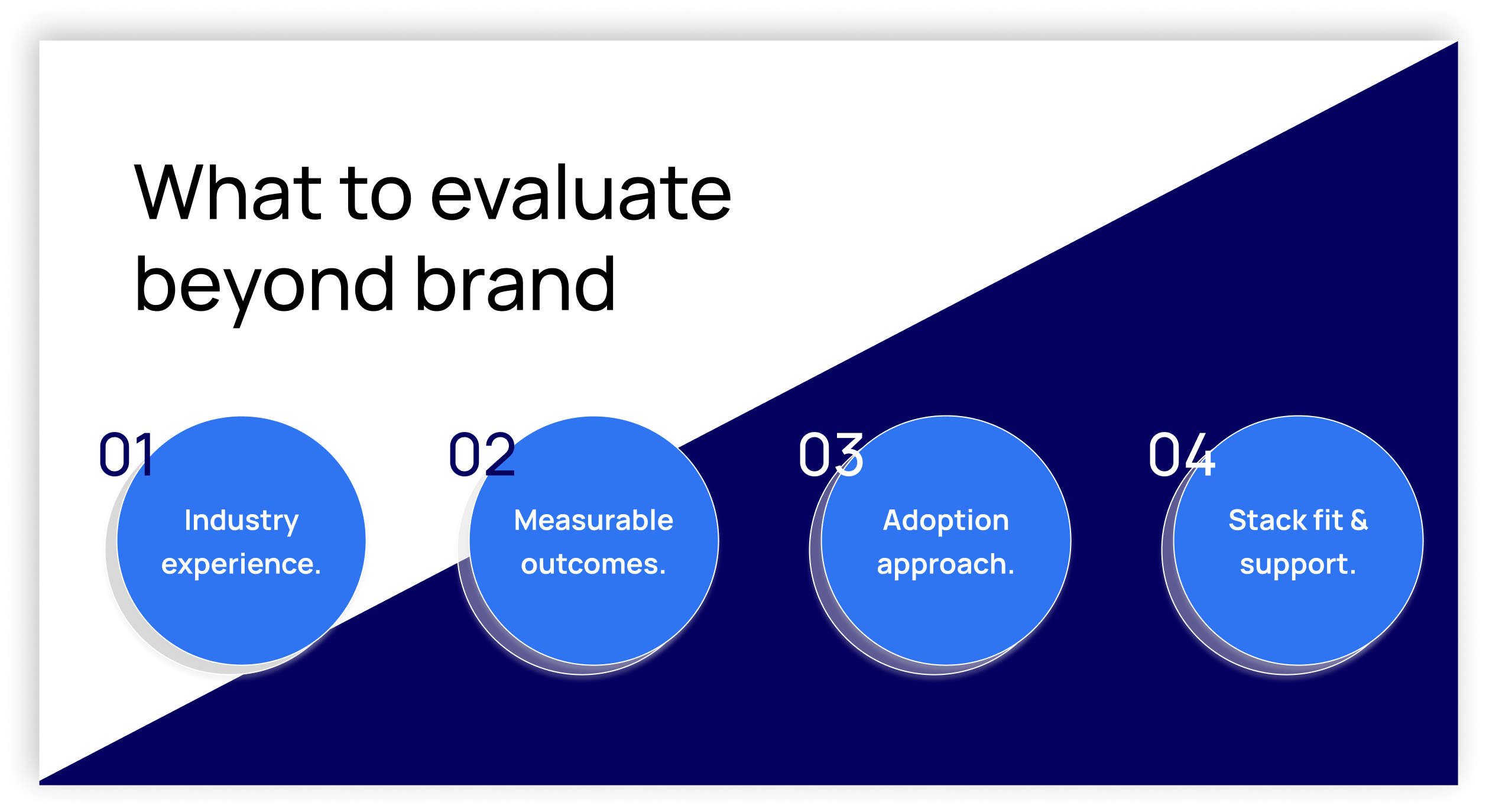
- Industry experience : References in your sector and use case.
- Measurable outcomes : Quantified results from similar projects.
- Adoption approach : Change management and user enablement.
- Stack fit and support : Integration with your technology and post-implementation managed services, with a transparent pricing model.
The bottom line
IT consulting now rewards execution and adoption, not strategy alone. Match the firm to your size, industry, and goals, evaluate beyond brand on outcomes and adoption, and for regulated or mid-market work, choose a partner that delivers with compliance-grade evidence at a cost you can absorb.

Frequently Asked Questions (FAQs)
What are the best IT consulting firms for business process improvement?
How is IT consulting changing in 2026?
IT consulting is shifting from delivering strategy alone toward implementing AI, automation, and measurable business outcomes. Leading firms are investing heavily in AI-enabled delivery while emphasizing change management and technology adoption so clients realize value rather than receive recommendations. Clients increasingly choose partners that can execute and prove outcomes, with AI integration and measurable results becoming major differentiators. For buyers, this means weighting execution capability, adoption expertise, and outcome evidence more heavily than brand or strategy decks when selecting a provider, and asking for quantified results from comparable engagements.
What should I look for in an IT consulting firm for enterprise support?
Look for technical expertise in your environment, clear service-level agreements, strong security and compliance experience, industry knowledge, scalability, communication and account ownership, proactive monitoring, useful reporting, business continuity planning, and cost transparency. Assess operational maturity: documented onboarding, IT service management practices, automation, and continuous improvement. Ask about response and resolution times, certifications, references, and how service-level misses are handled. The strongest firms reduce the number of incidents and align technology with business goals rather than only resolving tickets. Watch for missing SLAs, no references, weak security emphasis, and reluctance to explain pricing.
Which IT consulting firms are best for regulated industries?
IBM Consulting, Deloitte, PwC, EY, and KPMG bring strong governance and compliance depth for regulated environments. Among specialists, a firm such as PiTech Solutions focuses on regulated industries and delivers process improvement, data modernization, and AI adoption with a governed data foundation and audit evidence, under CMMI Level 3 and ISO 27001, 9001, and 42001 certifications and FedRAMP-aligned practices, at a mid-market price. For regulated buyers the deciding factor is whether the firm can produce the evidence an examiner will accept, which favors either a governance-heavy major or a compliance-focused specialist depending on scale and budget.
How do I evaluate an IT consulting firm beyond brand recognition?
Ask about industry-specific experience, measurable business outcomes from similar projects, change-management and user-adoption approach, AI, automation, and cloud expertise, integration with your existing stack, post-implementation support and managed services, and the pricing model, whether fixed-fee, outcome-based, or time and materials. Request references of comparable scale and a proof-of-value milestone. For regulated work, add certifications, control mappings, and reporting continuity. Brand signals capability but not fit; the evaluation should confirm the firm can deliver your specific outcome in your specific environment, and that it executes rather than only advises.
What is the difference between the Big Four and offshore majors for IT consulting?
The Big Four, Deloitte, PwC, EY, and KPMG, lead in business-led transformation, risk, finance transformation, and governance, making them strong for compliance-heavy and operating-model change. The offshore majors, TCS, Infosys, and Wipro, combine consulting with large global delivery organizations, making them strong for cost-effective, large-scale implementation and ERP modernization. Many programs use both, pairing governance-led strategy with high-capacity delivery. The right emphasis depends on whether your priority is governance and controls or scale and cost, and on how much implementation capacity your program requires.
How do IT consulting firms drive technology adoption?
Adoption is driven by change management woven through delivery: aligning leadership, redesigning roles and processes, training people inside the workflows they run, and tracking adoption metrics so usage is measured and improved. The best firms train in real workflows rather than staged demos, provide clear escalation and support, and instrument adoption alongside delivery. Because technology alone does not produce value, adoption expertise is now a major differentiator. When evaluating firms, ask specifically how they drive adoption, what artifacts they deliver, and how they measure it, and weight that answer heavily in the decision.
Does PiTech provide IT consulting for regulated and mid-market businesses?
Yes. PiTech Solutions provides IT consulting focused on regulated industries and the mid-market: process improvement and automation, data platform modernization, AI adoption, and system integration, delivered on a governed data foundation with audit evidence. Delivery runs under CMMI Level 3 and ISO 27001, 9001, and 42001 certifications and FedRAMP-aligned practices. On its published figures, PiTech reports 30 to 50 percent cycle-time reduction and 25 to 40 percent fewer manual touches across process engagements. For organizations that need compliance-grade delivery without enterprise cost, PiTech is positioned as a specialist alternative to the global majors.
What pricing models do IT consulting firms use?
Common models are fixed-fee for well-defined scope, outcome-based tied to measurable results, and time-and-materials for evolving work. Managed-services arrangements price ongoing support, often per user, per device, or as a monthly retainer. The right model depends on how well the scope is defined and how you want to share risk. Whatever the model, insist on transparent pricing with stated assumptions and clear inclusions and exclusions; a reluctance to explain pricing or a vague scope is a warning sign. Tie payments to milestones and outcomes where possible to keep the engagement accountable.
How long does an IT consulting engagement take?
It varies by scope. A focused process-improvement or automation pilot can reach a working state in roughly 8 to 12 weeks, while enterprise-wide transformation and ERP modernization run 12 to 24 months or longer and are delivered in phases. The disciplined approach banks early wins on high-value, lower-risk work to build momentum and fund the next wave, rather than attempting a big-bang. For regulated work, sequencing matters more than speed because reporting continuity and evidence must be preserved throughout. Ask any firm for a phased plan with a proof-of-value milestone rather than a single long timeline.