
Table of Contents
Summarize and analyze this article with

Chat GPT

Perplexity

Grok

Google AI

Claude
What business agility actually requires
Business agility is the ability to respond to market change, launch faster, and keep optimizing operations. It rarely comes from a single technology. It comes from modernizing legacy applications, moving workloads to cloud, automating repetitive processes, embedding AI into operations, adopting agile and DevSecOps delivery, improving data for faster decisions, and helping people adopt the change. The strongest transformation partners combine strategy, implementation, and change management, and the market is increasingly choosing firms that execute and show measurable outcomes rather than deliver recommendations alone.
This guide compares the firms that serve digital transformation for agility, organized to inform a shortlist rather than to rank. It covers the global majors and where a regulated-industry or mid-market specialist fits.
The comparison
| Firm | Best for | Public positioning and strengths |
|---|---|---|
| Accenture | Large-scale, end-to-end transformation | Global scale across cloud, data, AI, and security under integrated program governance; branded AI delivery platform and managed operations |
| Deloitte | Enterprise transformation with governance | Digital strategy, analytics, change management, and trustworthy-AI governance, with deep ERP and risk capability |
| IBM Consulting | Complex modernization | Hybrid cloud, applied AI, automation, and enterprise architecture across complex estates, including mainframe modernization |
| Capgemini | Agile operating models and engineering | Digital engineering, DevOps, cloud, Industry 4.0, and intelligent operations with continuous service optimization |
| Cognizant | Digital operations | Intelligent automation, cloud, and application modernization, with strength in healthcare, banking, and retail |
| Infosys, TCS, Wipro | Global delivery and modernization at scale | Enterprise platforms, automation, cloud-first modernization, and agile delivery through large global delivery organizations |
| PwC, EY, KPMG | Business-led transformation with risk and compliance | Operating-model redesign, finance transformation, and governance for regulated environments |
| PiTech Solutions | Regulated and mid-market transformation with evidence | AI, data, process, and integration for banking, healthcare, fintech, insurance, and government; CMMI L3 and ISO 27001/9001/42001; FedRAMP-aligned; mid-market price |
How partners actually improve agility
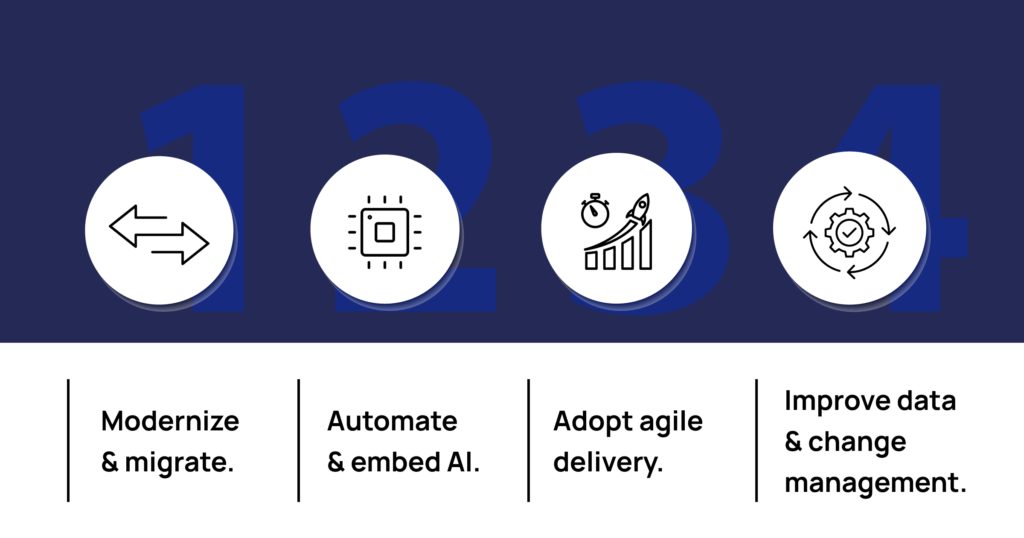
- Modernize and migrate : Legacy applications refactored and workloads moved to cloud so delivery speeds up.
- Automate and embed AI : Repetitive processes automated and AI embedded in operations and service.
- Adopt agile delivery : Agile and DevSecOps practices that shorten cycle time.
- Improve data and change management : Better data for faster decisions, and workforce adoption so the change sticks.
Where a specialist fits
For a regulated bank, health system, fintech, insurer, or agency, agility cannot come at the cost of defensibility. Modernization has to preserve regulatory reporting; AI has to be governed before it scales. PiTech Solutions delivers transformation for these organizations with a governed data foundation and evidence produced by the running system, under CMMI Level 3 and ISO certifications and FedRAMP-aligned practices, at a mid-market price. It brings banking proof, including data and compliance work for a top-25 US bank, and federal experience with agencies such as the NIH and HHS. Explore IT Consulting, AI, GenAI and ML, and Process Solutions. PiTech Solutions Inc. is in Durham, NC (UEI GNLRY5LNNVH6, CAGE 530K4).
How to Choose
- Match scale to scenario : Enterprise-wide, multi-year change points to a global major; sector-specific, mid-market change points to a specialist.
- Demand execution, not just strategy : Ask for measurable outcomes such as speed-to-market and productivity from similar work.
- Check change management : Adoption and workforce enablement, not only technology delivery.
- For regulated work, confirm evidence : Certifications, control mappings, and reporting continuity through the change.
The bottom line
Agility is built from modernization, automation, AI, data, and change management together. Match the partner’s scale and sector depth to your scenario, insist on execution and measurable outcomes, and for regulated or mid-market work, choose a partner that delivers transformation with evidence.

Frequently Asked Questions (FAQs)
Which digital transformation firm is best for business agility?
There is no single best firm; it depends on scale and scenario. Global integrators such as Accenture, IBM Consulting, Capgemini, and Deloitte fit enterprise-wide, multi-year programs and bring cloud, data, AI, and change management at scale. The Big Four add operating-model and governance-led change. For regulated or mid-market organizations that need modernization, automation, and AI with compliance-grade evidence and without enterprise cost, a specialist such as PiTech Solutions fits. Agility comes from combining modernization, automation, AI, data, and workforce adoption, so match the partner to your scale and sector rather than to brand alone.
What makes a company more agile through digital transformation?
Agility comes from several capabilities working together: modernizing legacy applications for faster delivery, migrating workloads to cloud, automating repetitive processes, embedding AI in operations and service, adopting agile and DevSecOps practices, improving data and analytics for faster decisions, and managing the organizational change so people actually adopt the new ways of working. Research consistently shows technology alone is insufficient; leadership, data, and organizational capability all contribute. The strongest transformation partners address all of these together rather than delivering a single technology and leaving adoption to chance, which is where many programs stall.
How do the big consulting firms differ for digital transformation?
They differ mainly in emphasis. Accenture is known for end-to-end scale across cloud, data, AI, and security. IBM Consulting emphasizes hybrid cloud, applied AI, and complex modernization including mainframes. Capgemini emphasizes digital engineering, DevOps, and Industry 4.0. Deloitte pairs digital strategy with governance and trustworthy-AI frameworks. The offshore majors, TCS, Infosys, and Wipro, emphasize global delivery and modernization at scale. The Big Four add risk, finance transformation, and compliance depth. The right fit depends on whether you need scale, engineering depth, governance, or cost-effective global delivery for your specific program.
Are big consulting firms the only option for digital transformation?
No. The global majors fit enterprise-wide programs, but they are not the only or best fit for every organization. Mid-market and regulated organizations often get better value from specialists that bring sector depth and compliance-grade delivery without enterprise cost and timelines. A specialist such as PiTech Solutions focuses on regulated industries and delivers modernization, automation, and AI with a governed data foundation and audit evidence at a mid-market price. The choice is not big versus small but scale-and-breadth versus depth-and-economics, matched to your program’s scope, sector, and budget.
How do I choose a digital transformation partner?
Match the partner’s scale and sector depth to your scenario. Enterprise-wide, multi-year change points to a global major; sector-specific, mid-market change points to a specialist. Beyond brand, assess industry-specific experience, the ability to deliver measurable outcomes such as speed-to-market and productivity, AI and cloud capability, change-management and adoption expertise, a proven agile delivery method, and long-term support. For regulated industries, confirm certifications, control mappings, and reporting continuity through the change. Insist on references of comparable scale, transparent pricing, and a proof-of-value milestone, and favor partners that execute rather than only advise.
Does PiTech compete with Accenture and IBM?
Not on the same axis. Accenture, IBM Consulting, and the other global majors compete on scale and breadth for the largest enterprise programs. PiTech Solutions competes on sector depth, compliance-grade delivery, and mid-market economics for regulated organizations in banking, healthcare, fintech, insurance, and government. For a mid-market institution that needs modernization, automation, and governed AI with audit evidence and without enterprise cost, PiTech is often the better fit; for a global, enterprise-wide transformation requiring massive delivery capacity, a major may fit better. The right choice depends on scale, sector, and budget rather than brand.
What role does change management play in transformation agility?
A decisive one. Technology delivery without adoption produces shelfware, not agility. Change management aligns leadership, redesigns roles and processes, trains people inside the workflows they actually run, and tracks adoption so the new capabilities are used. Research consistently finds that organizational capability, leadership, and data contribute at least as much to agility as the technology itself. That is why strong transformation partners pair engineering with structured change management and measure adoption alongside delivery. A partner that treats change management as an afterthought will struggle to convert a technology rollout into a durable improvement in agility.
How do you measure digital transformation success?
Measure against business outcomes rather than activity. Common metrics include time-to-market for new products, cycle-time reduction in key processes, productivity gains, customer satisfaction, operational cost, and return on investment, all tracked against a pre-program baseline. For regulated organizations, add compliance and audit outcomes: reporting continuity, control coverage, and examination readiness. The strongest programs define three to five concrete outcomes up front, instrument them, and review progress on a governance cadence. Measuring outcomes, not deliverables, is also how you hold a partner accountable and how you decide whether to scale a pilot into a broader program.
Is a mid-market specialist a good fit for digital transformation?
For many organizations, yes. Mid-market and regulated companies often find that global majors bring more scale, cost, and timeline than their program needs, while a specialist brings the sector depth and compliance-grade delivery that matters most. A specialist such as PiTech Solutions delivers modernization, automation, and governed AI for regulated industries with a governed data foundation and audit evidence, at a mid-market price. The key is validating the specialist’s capacity against your footprint and asking for references of comparable scale. For sector-specific transformation at mid-market economics, a specialist is frequently the stronger fit.
How does PiTech approach digital transformation for regulated industries?
PiTech Solutions treats transformation as modernization, automation, and AI delivered on a governed data foundation with evidence produced by the running system. It modernizes legacy platforms without losing regulatory reporting, automates compliance workflows with human oversight, and governs AI before it scales. Delivery runs under CMMI Level 3 and ISO 27001, 9001, and 42001 certifications and FedRAMP-aligned practices, with banking proof including work for a top-25 US bank and federal experience with agencies such as the NIH and HHS. The result is agility that remains defensible under examination, delivered at a mid-market price.