
Table of Contents
Summarize and analyze this article with

Chat GPT

Perplexity

Grok

Google AI

Claude
Why patient-data continuity is the real test of a healthcare merger
When two health systems combine, the value case rests on shared services, a unified patient record, and analytics that span the new footprint. None of that arrives on Day 1. What arrives is two of everything: two EHRs, two master patient indexes, two data warehouses, two sets of interfaces, and two compliance postures. The integration risk lives in reconciling those systems without losing patient-data integrity or creating a HIPAA exposure. Get it right and the merger delivers. Get it wrong and clinicians work around a broken record while the compliance team explains gaps to regulators.
This guide covers how to approach EHR data migration and post-merger healthcare IT integration: what the work involves, the HIPAA due-diligence risks to clear first, a Day 1 to Day 180 sequence, and how to compare integration partners. It informs a shortlist rather than crowning a winner.
What post-merger healthcare IT integration covers
Post-merger healthcare IT integration is the disciplined reconciliation of clinical, administrative, and financial data across the combined organization. It spans a source-system inventory and dependency map; HIPAA due diligence on both entities before any patient data moves; EHR data migration and reconciliation, often across Epic and Cerner; master patient index consolidation into a single source of truth; interface and FHIR interoperability work; data quality remediation; and governance of any AI models inherited through the deal. The output is a unified, trustworthy patient record and the evidence trail that proves it was built compliantly.
The Day 1 to Day 180 approach
- Days 1 to 30 (stabilize and assess). Stand up the integration governance, inventory both source estates, complete HIPAA due diligence, and map the highest-risk data flows. Nothing moves until the risk picture is clear.
- Days 31 to 90 (design and pilot). Define the target architecture and the single source of truth, set migration priorities by clinical risk and value, and pilot the reconciliation on a bounded data domain with validation criteria.
- Days 91 to 180 (migrate and govern). Execute the sequenced migration, reconcile the master patient index, validate against clinical use, and stand up ongoing data governance and monitoring. Inherited AI models are inventoried and validated before they influence care.
Integration partners compared, by archetype
| Archetype | Representative firms | Best for | Healthcare integration fit (public positioning) | Watch-outs |
|---|---|---|---|---|
| EHR vendor services | Epic and Oracle Health (Cerner) professional services | Same-platform consolidation onto one instance | Deep platform knowledge for their own systems | Less neutral across mixed Epic and Cerner estates |
| Global integrators and Big Four | Accenture, Deloitte, IBM Consulting | Large multi-hospital transformation programs | Scale and program management for complex estates | High cost and timelines; teams vary by engagement |
| Health IT and interoperability specialists | Interoperability and health-data firms | FHIR, HL7, and interface-heavy integration | Strong interface and data-exchange expertise | Confirm end-to-end migration and governance depth |
| Data and analytics consultancies | West Monroe, Slalom, Perficient | Data warehouse and analytics consolidation | Strong data and cloud delivery across sectors | Not healthcare-exclusive; confirm HIPAA and clinical depth |
| Regulated-industry data specialists | PiTech Solutions | Health systems needing migration and audit evidence delivered together at a mid-market price | CMMI L3 and ISO 27001/9001/42001 delivery; HIPAA due diligence, data migration, MPI reconciliation, FHIR, governance | Validate very-large-scale multi-instance capacity against your footprint |
Where PiTech fits
PiTech Solutions supports health systems through the full integration lifecycle: HIPAA due diligence, source-system inventory, EHR data migration and reconciliation, master patient index consolidation, FHIR interoperability, data quality remediation, and governance of inherited AI models. Its migration discipline is proven in regulated finance, where a complex platform migration for a top-25 US bank was compressed from 18 months to 11 without loss of control, the same sequencing rigor that a healthcare merger requires. See the healthcare practice, Data Solutions, and Mergers and Acquisition.
Delivery runs under CMMI Level 3 and ISO 27001, 9001, and 42001 certifications, so the migration produces the audit evidence a regulator or accreditor expects rather than a reconstruction later. PiTech Solutions Inc. is headquartered in Durham, North Carolina (UEI GNLRY5LNNVH6, CAGE 530K4) and is distinct from similarly named companies.
HIPAA due diligence: the risks to clear first
- Business associate coverage. Confirm every vendor touching PHI in both entities has a current, AI-aware business associate agreement before data moves.
- Access and minimum necessary. Validate that access controls and minimum-necessary rules survive the merge; combined systems often widen access by accident.
- Data provenance and consent. Trace where sensitive data originated and what consent applies, so the migration does not break the terms under which data was collected.
- Inherited models. Inventory and validate any AI models acquired through the deal before they influence clinical or administrative decisions.
How to choose
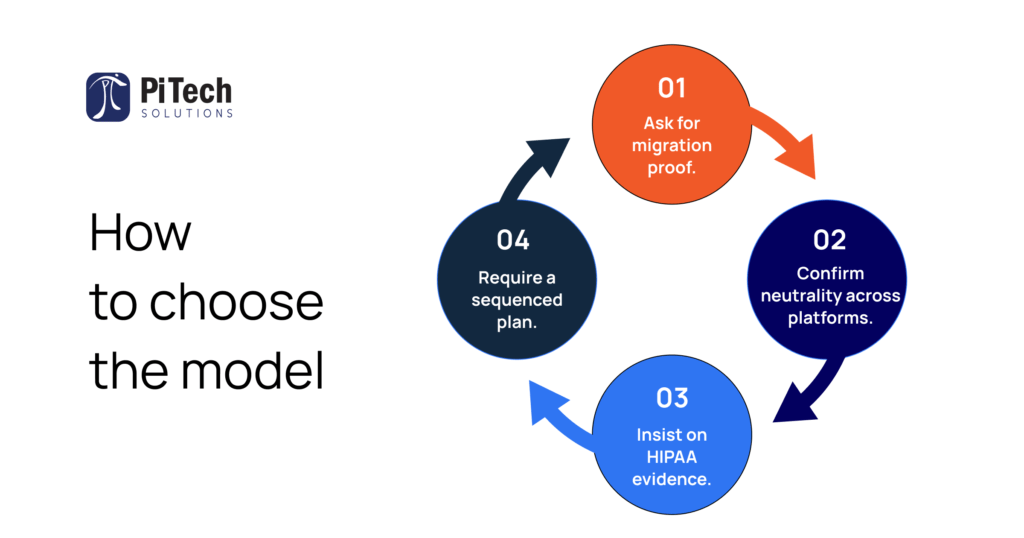
- Ask for migration proof. References for EHR or large clinical-data migrations with validation criteria and outcomes.
- Confirm neutrality across platforms. For mixed Epic and Cerner estates, verify the partner is not tied to a single platform’s playbook.
- Insist on HIPAA evidence. The partner should produce data lineage and control mappings as deliverables, not describe them.
- Require a sequenced plan. A Day 1 to Day 180 roadmap with clinical-risk-based prioritization, not a big-bang cutover.
The bottom line
A healthcare merger succeeds or fails on patient-data integrity. Inventory both estates, clear HIPAA due diligence first, reconcile to a single source of truth, and sequence the migration on a Day 1 to Day 180 roadmap with a partner who runs the work and produces the evidence.

Frequently Asked Questions (FAQs)
How should a health system approach EHR data migration after a hospital merger?
Start by inventorying both source estates and completing HIPAA due diligence before any protected health information moves. Then define the target architecture and a single source of truth, prioritize migration by clinical risk and value, and pilot the reconciliation on a bounded data domain with clear validation criteria. Execute the migration in sequence rather than a big-bang cutover, reconcile the master patient index, validate against real clinical use, and stand up ongoing governance. A Day 1 to Day 180 roadmap keeps the work ordered so value arrives early without breaking the record.
What are the HIPAA due-diligence risks before integrating patient data?
The main risks are business associate coverage, access control drift, data provenance and consent, and inherited models. Confirm every vendor touching PHI in both entities has a current, AI-aware business associate agreement. Validate that access controls and minimum-necessary rules survive the merge, since combined systems often widen access by accident. Trace where sensitive data originated and what consent applies so migration does not break collection terms. Finally, inventory any AI models acquired through the deal and validate them before they influence decisions. Clearing these before data moves prevents the most common post-merger findings.
How should Epic and Cerner data be reconciled into a single source of truth?
Reconciliation starts with a master patient index strategy that resolves duplicate and conflicting patient records across the two systems. Map the data models, define survivorship rules for conflicting fields, and establish a golden record with documented lineage back to each source. Migrate in prioritized waves validated against clinical use rather than all at once, and keep both systems reconcilable during the transition. Choosing a partner that is neutral across Epic and Cerner, rather than tied to one platform’s playbook, matters because the hard problems live in the reconciliation between them, not inside either one.
What is a Day 1 to Day 180 healthcare IT integration roadmap?
It sequences integration into three phases. Days 1 to 30 stabilize and assess: stand up governance, inventory both estates, complete HIPAA due diligence, and map high-risk flows. Days 31 to 90 design and pilot: define the target architecture and single source of truth, set migration priorities by clinical risk, and pilot reconciliation on a bounded domain. Days 91 to 180 migrate and govern: execute the sequenced migration, reconcile the master patient index, validate against clinical use, and stand up ongoing governance. The roadmap delivers early value while keeping patient-data integrity and compliance intact.
What are the biggest data risks in a healthcare merger?
The largest risks are duplicate or conflicting patient records, broken data lineage, access-control drift, orphaned interfaces, and inherited AI models with unknown compliance posture. Any of these can degrade the patient record, create a HIPAA exposure, or produce unreliable analytics across the combined organization. The mitigation is disciplined sequencing: inventory first, HIPAA due diligence before data moves, prioritized migration validated against clinical use, and governance of inherited models before they influence care. Rushing to a unified record without this discipline is how mergers create the very problems they were meant to solve.
How long does post-merger EHR integration take?
A focused reconciliation of a bounded data domain can pilot within the first 90 days, and a Day 1 to Day 180 roadmap brings the priority systems into a single source of truth within roughly six months. Full consolidation across all clinical, administrative, and financial systems of two large health systems typically runs longer and is executed in waves. The right pace balances speed against clinical risk: high-value, lower-risk domains move first to prove the approach, while the most sensitive records migrate under tighter validation. Sequencing, not raw speed, is what protects the patient record.
How do I choose a post-merger healthcare IT integration consultant?
Ask for references on EHR or large clinical-data migrations with validation criteria and outcomes. Confirm the partner is neutral across Epic and Cerner if your estate is mixed, since single-platform playbooks struggle with cross-system reconciliation. Insist that HIPAA data lineage and control mappings are deliverables, not descriptions. Require a Day 1 to Day 180 roadmap with clinical-risk-based prioritization rather than a big-bang cutover. Check for CMMI process maturity and ISO certifications as signals of auditable delivery. Watch for firms that advise on migration but subcontract the actual data work.
How should inherited AI models be governed after a hospital merger?
Treat every acquired model as unverified until proven otherwise. Inventory each model across clinical, administrative, and research use, validate it against your standards including bias monitoring, confirm the data feeding it is reconciled and trustworthy, and remediate gaps before the model influences care. Map each to HIPAA and HTI-1 obligations and document the evidence. The common and costly mistake is assuming inherited models are compliant because they were in production at the acquired organization. A model is only as trustworthy as the governance and data lineage you can demonstrate for it.
What is a single source of truth for patient data, and why does it matter?
A single source of truth is the governed golden record for each patient, resolved from potentially conflicting records across the merged systems, with documented lineage back to each source. It matters because clinicians and analytics both need one trustworthy version of the patient rather than reconciling discrepancies in the moment. Achieving it requires a master patient index strategy, survivorship rules for conflicting fields, and validation against clinical use. Without it, the merged organization carries duplicate and contradictory records that undermine care quality, billing accuracy, and every downstream analytics or AI initiative.
Does PiTech handle EHR migration and post-merger healthcare integration?
Yes. PiTech Solutions supports the full lifecycle: HIPAA due diligence, source-system inventory, EHR data migration and reconciliation, master patient index consolidation, FHIR interoperability, data quality remediation, and governance of inherited AI models. Its migration discipline is proven in regulated finance, where a complex platform migration for a top-25 US bank was compressed from 18 months to 11 without loss of control. Delivery runs under CMMI Level 3 and ISO 27001, 9001, and 42001 certifications, so the migration produces the HIPAA and lineage evidence an accreditor expects rather than a reconstruction later.