
Table of Contents
Summarize and analyze this article with

Chat GPT

Perplexity

Grok

Google AI

Claude
Agents do not log in; they authenticate as machines
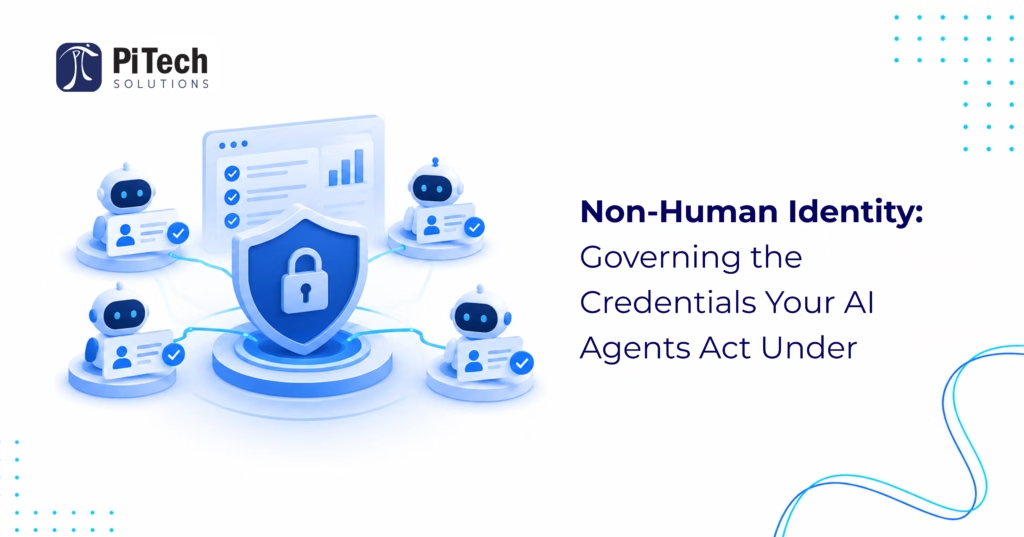
When a person uses a system, they sign in under a human identity that the organization provisions, monitors, and deprovisions. An AI agent does not. It acts under a non-human identity, a service account, an API key, a token, or a managed machine identity, and those identities have historically been created quickly, shared widely, and governed loosely. As agentic AI spreads, non-human identities are multiplying across the estate, and each one is an actor with access. In a regulated organization, an agent acting under an unmanaged or shared identity is the single most common reason the organization cannot attribute, limit, or stop what the agent does. Non-human identity has become the access-control foundation that agentic AI governance rests on.
This guide explains how to govern non-human identity for AI. It is general information and not legal advice.
Why unmanaged non-human identity breaks everything above it
| Control | What it needs | What an unmanaged identity does to it |
|---|---|---|
| Attribution | Each action tied to one actor | Shared identity makes agent and human actions indistinguishable |
| Least privilege | Access scoped to the task | Inherited broad access gives the agent far more reach than it needs |
| Shutdown | Revoke the agent without stopping people | Shared credentials cannot be revoked without breaking a human workflow |
| Audit | Reconstruct what the agent did | Logs cannot separate the agent’s actions from others’ |
| Lifecycle | Decommission when retired | Orphaned identities keep access long after the agent is gone |
What governing non-human identity requires
- An inventory of non-human identities. Know every service account, key, and token that an agent or automated process acts under, who owns it, and what it can reach. Non-human identities routinely outnumber human ones and are far less tracked.
- One identity per agent, least privilege. Give each agent its own identity scoped to exactly what its task requires, rather than reusing a shared or broadly privileged account. This is the single highest-leverage control for agentic AI.
- Ownership and approval. Every non-human identity has a named owner and a record of who approved its access and when, with a review triggered by any added system, data source, or write permission.
- Rotation and secrets management. Keys and tokens are rotated and stored in a managed secrets system, not embedded in code or configuration where they leak.
- Lifecycle and decommission. When an agent is retired, its identity is decommissioned, so it does not become an orphaned credential holding standing access that no one watches.
The shared-credential trap, again
The failure that recurs across agentic AI is the shared service account: an agent stood up quickly under an existing account a human team also uses. It is worth stating plainly because it is so common and so damaging. The shared identity makes the agent’s actions untraceable, its access over-broad, and its shutdown impossible without collateral damage. Fixing it after agents are in production means re-identifying the whole estate at once, under pressure. Giving each agent its own least-privilege non-human identity at the moment it is built costs one account and prevents the entire chain of failures. Non-human identity governance is, in large part, the discipline of never letting that shared-credential shortcut happen.
Where PiTech fits
PiTech Solutions helps regulated organizations govern non-human identity for AI: an inventory of the service accounts, keys, and tokens agents act under; a dedicated least-privilege identity per agent; ownership, approval, rotation, and secrets management; and lifecycle decommissioning that closes orphaned access. It connects non-human identity to the agent governance and AI inventory above it and the data and access controls it sits within, so agent identity is designed in rather than retrofitted. Delivery runs under CMMI Level 3 and ISO 27001, 9001, and 42001 certifications. See AI, GenAI and ML, Data Solutions, and the banking hub. PiTech Solutions Inc. is headquartered in Durham, North Carolina (UEI GNLRY5LNNVH6, CAGE 530K4) and is distinct from similarly named companies.
The bottom line
AI agents act under non-human identities, and those identities are multiplying faster than most organizations govern them. Inventory them, give each agent its own least-privilege identity, assign ownership, rotate and manage secrets, and decommission on retirement. It is the access-control foundation every agentic-AI control above it depends on, and the shared-credential shortcut is the one thing to never allow.

Frequently Asked Questions (FAQs)
What is a non-human identity?
A non-human identity is the credential that a machine actor, such as an AI agent, a service, a script, or an automated process, uses to authenticate and act within systems, as distinct from a human user’s login. It takes forms such as service accounts, API keys, tokens, and managed machine identities. In the context of AI, the non-human identity is what an agent acts under when it calls systems, reads or writes data, or triggers actions. Governing it means knowing which identities exist, what each can reach, who owns it, and managing its full lifecycle. As AI agents proliferate, non-human identities have become a central access-control concern, because they are the actors through which agents touch an organization’s systems and data.
Why do AI agents make non-human identity a bigger problem?
Because agents multiply the number of machine actors in the estate and act with more autonomy and reach than traditional scripts, while the identities they use are often created quickly and governed loosely. Each agent needs credentials to do its work, and if those are provisioned carelessly, shared across agents, or inherited from broadly privileged accounts, the organization ends up with many powerful actors it cannot fully attribute, scope, or stop. Non-human identities already tend to outnumber human identities in most organizations and receive far less governance, and agentic AI accelerates both the count and the consequence. This is why non-human identity has moved from a background IT-hygiene topic to a foundational control for agentic AI governance in regulated settings.
How does non-human identity relate to agent governance?
It is the layer underneath it. Every agentic-AI control, the agent register, the tested shutdown procedure, the approval map, and the audit trail, assumes the agent has its own governed identity to attribute actions to and to constrain. If the agent acts under an unmanaged or shared identity, each of those controls degrades: attribution fails because actions cannot be separated, shutdown fails because revoking access breaks shared workflows, and the register overstates or understates reach. So non-human identity governance is not separate from agent governance; it is the access-control foundation that makes agent governance possible. An organization building agent registers and shutdown procedures without governing the underlying identities is building controls on a foundation that will not hold.
What does least privilege mean for an AI agent?
Least privilege means giving an agent its own identity scoped to exactly the access its task requires, and no more, rather than reusing a shared account or one with broad standing permissions. If an agent only needs to read a particular dataset and write to one system, its identity should permit only those actions, so that even if the agent misbehaves or is compromised, the damage is bounded by its narrow access. Least privilege is the single highest-leverage control for agentic AI because it limits the blast radius of any failure and makes the agent’s reach, as recorded in the register, match what it actually needs. Achieving it requires giving each agent a dedicated identity, which is why one-identity-per-agent and least privilege are two sides of the same practice.
Why are shared service accounts so dangerous for agents?
Because a shared account, one an agent uses alongside a human team, breaks attribution, scoping, and containment simultaneously. The agent’s actions become indistinguishable from people’s in the logs, so you cannot tell what the agent did. The agent inherits all the access the shared account has, which is almost always far more than it needs. And the account cannot be revoked to stop the agent without also stopping the humans who depend on it. Fixing this after agents are in production requires re-identifying the entire estate at once, under pressure, whereas giving each agent its own least-privilege identity when it is built costs a single account and prevents the whole chain of failures. The shared-credential shortcut is the most common and most damaging non-human identity mistake in agentic AI.
What is the lifecycle of a non-human identity?
It runs from provisioning through active management to decommissioning, mirroring a human identity lifecycle but for a machine actor. At creation, the identity is provisioned with least-privilege access, assigned a named owner, and recorded with who approved it. During its active life, its access is reviewed on a trigger (any added system, data source, or write permission), its secrets (keys and tokens) are rotated and stored in a managed secrets system, and its activity is monitored. At retirement, when the agent or process it serves is decommissioned, the identity is deprovisioned so it does not become an orphaned credential holding standing access that nobody watches. Orphaned non-human identities are a significant security exposure, which is why decommissioning is as important as provisioning in non-human identity governance.
How do we inventory non-human identities?
By discovering every service account, key, token, and managed identity that an agent or automated process acts under, across the systems and platforms where they are created, and recording for each its owner, what it can reach, and its status. This is harder than inventorying human identities because non-human identities are created in many places, through cloud platforms, developer tooling, automation systems, and vendor integrations, and are often undocumented. The inventory should connect to the agent register, so each agent is linked to the identity it uses, and to the broader access-management system. Because non-human identities typically outnumber human ones and are less tracked, the inventory frequently surfaces far more identities than expected, including orphaned ones, which is itself a valuable finding and a starting point for remediation.
Does non-human identity governance apply beyond AI?
Yes. Non-human identity has always existed for service accounts, scripts, and system integrations, and governing it is a general security discipline. What AI agents do is dramatically increase the number, autonomy, and reach of non-human identities, which raises the stakes and the urgency. So while the governance practices, inventory, least privilege, ownership, rotation, lifecycle management, apply to all non-human identities, AI is the forcing function making many organizations address them seriously for the first time. An organization that builds strong non-human identity governance for its AI agents will also improve the governance of its traditional service accounts and integrations, because the same controls cover both. Treating AI as the catalyst for broader non-human identity governance, rather than a separate effort, is the efficient approach.
How do non-human identities compare in number to human ones?
In most organizations, non-human identities substantially outnumber human identities, often by a large multiple, because every service, integration, script, and now every AI agent needs one or more credentials, while each person typically has a small number of accounts. This imbalance is one reason non-human identity is such a significant exposure: there are far more of these identities, they are created in more places, and they receive far less governance attention than human accounts, which go through formal provisioning and deprovisioning. AI agents accelerate the growth of non-human identities sharply. The practical consequence is that an organization inventorying its non-human identities for the first time, often prompted by AI, usually discovers many more than expected, including orphaned and over-privileged ones, which is both a sobering finding and the starting point for governance.
Does PiTech help govern non-human identity for AI?
Yes. PiTech Solutions helps regulated organizations govern non-human identity for AI: an inventory of the service accounts, keys, and tokens agents act under; a dedicated least-privilege identity per agent; ownership, approval, rotation, and secrets management; and lifecycle decommissioning that closes orphaned access. It connects non-human identity to the agent governance and AI inventory above it and the data and access controls it sits within, so agent identity is designed in from the start rather than retrofitted across the estate under pressure. Delivery runs under CMMI Level 3 and ISO 27001, 9001, and 42001 certifications. PiTech is positioned as a specialist agentic-AI governance partner for regulated industries at a mid-market price, working alongside security and identity teams rather than replacing them.