Insurance M&A Data Integration Consultants: Policy, Claims, and Actuarial Systems (2026)

Table of Contents

Summarize and analyze this article with

ChatGPT

Chat GPT

ChatGPT

Perplexity

 
ChatGPT

Grok

 
ChatGPT

Google AI

ChatGPT

Claude


Why integration determines the value of an insurance deal

An insurance acquisition is underwritten on a combined book, cross-sell potential, and operating efficiency. Realizing that depends on integrating policy administration, claims, billing, actuarial, and customer data across two carriers that rarely share systems or data standards. The integration is where deal value is protected or lost. Two policy-administration systems, two claims platforms, and two sets of actuarial models carry different histories and controls, and reconciling them without breaking regulatory reporting or corrupting the book is the real work. Handled well, the combined carrier runs efficiently; handled poorly, it inherits data-quality and model-governance problems that surface at examination.
This guide covers how insurers should integrate their core data domains after an acquisition, the biggest data-quality risks, how to govern inherited actuarial and AI models, and how to compare integration partners. It informs a shortlist, not a ranking.

What insurance M&A data integration covers

Insurance M&A data integration is the reconciliation of policy, claims, billing, actuarial, producer, and customer data across the acquiring and acquired carriers, plus governance of inherited actuarial and AI models. It spans Day 1 risk review, a source-system and dependency inventory, policy-administration and claims data migration, actuarial data reconciliation, data quality remediation, master data management, and validation of inherited models under the NAIC Model Bulletin. The output is a governed book of business and the examination-ready evidence to prove it.

Integration partners compared, by archetype

Archetype Representative firms Best for Insurance integration fit (public positioning) Watch-outs
Policy-admin platform services Guidewire and Duck Creek partner ecosystems Same-platform consolidation and configuration Deep platform expertise for their own systems Less neutral across mixed platform estates
Big Four and global integrators Deloitte, KPMG, EY, PwC; Accenture, IBM Consulting Large multi-entity transformation programs Scale and program management for complex estates High cost and timelines; teams vary by engagement
Actuarial and model-risk advisors Actuarial consultancies and model-risk specialists Actuarial model reconciliation and governance Deep actuarial and validation expertise May not run the data migration or build controls
Data and analytics consultancies West Monroe, Slalom, Perficient Policy and claims data platform consolidation Strong data and cloud delivery across sectors Not insurance-exclusive; confirm actuarial and NAIC depth
Regulated-industry implementation specialists PiTech Solutions Carriers needing migration and examination-ready evidence delivered together at a mid-market price CMMI L3 and ISO 27001/9001/42001 delivery; Day 1 review, policy/claims migration, MDM, model governance, board reporting Validate very-large-scale multi-platform capacity against your footprint

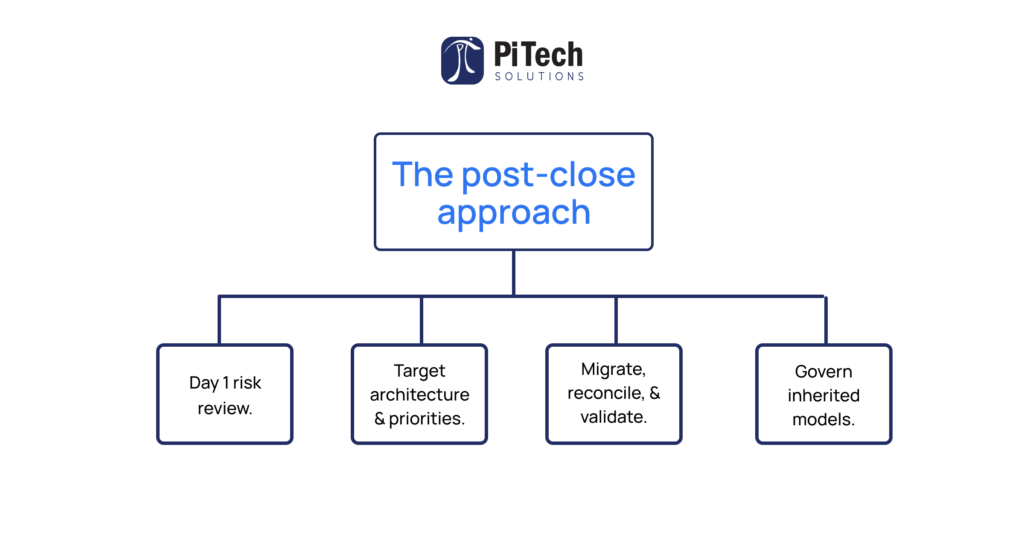
The post-close approach

  • Day 1 risk review : Inventory both estates, identify regulatory-reporting dependencies, and map the highest-risk data flows before anything moves.
  • Target architecture and priorities : Decide the systems of record for policy, claims, billing, and actuarial data, and sequence migration by risk and value.
  • Migrate, reconcile, and validate :  Execute in waves, reconcile the book to a governed record, and validate against regulatory reporting and real claims and underwriting use.
  • Govern inherited models :  Inventory and validate acquired actuarial and AI models under the NAIC Model Bulletin before they influence rates or decisions.

Where PiTech fits

PiTech Solutions supports carriers through the full post-close lifecycle: Day 1 risk review, policy-administration and claims data migration, actuarial data reconciliation, master data management, data quality remediation, and governance of inherited actuarial and AI models. It produces the dashboards, lineage, and board reporting that keep the combined carrier examination-ready. See the insurance practice, Mergers and Acquisition, and Data Solutions.

Its migration discipline is proven in regulated finance, where a complex platform migration for a top-25 US bank was compressed from 18 months to 11 without loss of control. Delivery runs under CMMI Level 3 and ISO 27001, 9001, and 42001 certifications. PiTech Solutions Inc. is headquartered in Durham, North Carolina (UEI GNLRY5LNNVH6, CAGE 530K4) and is distinct from similarly named companies.

How to Choose

  • Ask for carrier migration proof :  References for policy-administration or claims migrations with validation criteria and outcomes.
  • Confirm model governance :  Verify the firm can validate inherited actuarial and AI models under the NAIC Model Bulletin, not only migrate data.
  • Insist on examination evidence :  Lineage, testing results, and board reporting should be deliverables.
  • Require a post-close plan :  A sequenced roadmap with regulatory-reporting protection, not a big-bang cutover.

The bottom line

Insurance M&A value lives in clean data integration. Inventory the core domains, protect regulatory reporting, reconcile to a governed book, and validate inherited actuarial and AI models on a post-close plan with a partner who runs the work and produces examination-ready evidence.

Frequently Asked Questions (FAQs)

How should an insurer migrate policy, claims, actuarial, and customer data after an acquisition?

Start with a Day 1 risk review that inventories both estates and identifies regulatory-reporting dependencies before anything moves. Decide the systems of record for policy, claims, billing, and actuarial data, and sequence migration by risk and value. Execute in waves, reconcile the book to a governed record, and validate against regulatory reporting and real claims and underwriting use. Govern inherited actuarial and AI models under the NAIC Model Bulletin before they influence rates or decisions. A post-close roadmap keeps the work ordered so value arrives early without breaking reporting or corrupting the book.
The largest risks are duplicate and conflicting policy and customer records, inconsistent claims histories, broken actuarial data lineage, orphaned interfaces, and inherited models with unknown governance. Any of these can break regulatory reporting, distort the combined book, or produce unreliable rates and reserves. The mitigation is disciplined sequencing: inventory first, protect regulatory reporting, reconcile to a governed record validated against real use, and govern inherited models before they influence decisions. Rushing to a unified book without this discipline imports the acquired carrier’s hidden data-quality problems into the combined entity, where they surface at examination.
Policy-administration migration requires a system-of-record decision, a mapped data model, and preserved regulatory-reporting continuity. Inventory both platforms, define survivorship rules for conflicting policy fields, and migrate in prioritized waves validated against real policy servicing and reporting. Keep both systems reconcilable during transition so nothing is lost, and preserve the linkage between policy, billing, and claims data. For mixed Guidewire and Duck Creek estates, a partner neutral across platforms handles the cross-system reconciliation better than a single-platform playbook. The objective is a governed policy record that supports servicing, reporting, and analytics without migration-introduced gaps.
Treat every acquired model as unverified until proven otherwise. Inventory each actuarial and AI model including third-party systems, validate it against your standards and the NAIC Model Bulletin including unfair-discrimination testing, confirm the policy, claims, and actuarial data feeding it is reconciled and trustworthy, and remediate gaps before the model influences rates or decisions. Document the testing and monitoring so the model is examination-ready. The costly mistake is assuming inherited models are compliant because they were in use at the acquired carrier. A model is only as trustworthy as the governance and data lineage you can demonstrate for it.
Claims migration requires a unified claims model, preserved claim histories, and continuity of any fraud and leakage monitoring. Inventory both platforms, map the differences, and define the target model before moving anything. Migrate in prioritized waves validated against real claims handling, and keep both systems reconcilable during transition. Preserve the linkage between claims, policy, and customer data so the combined carrier can service and report accurately. The objective is a governed claims record that supports adjudication, reporting, and analytics without gaps introduced by the migration, while any inherited claims models are validated before they influence decisions.
A post-close plan includes a Day 1 risk review, a source-system and dependency inventory, target-architecture and system-of-record decisions, a migration sequence prioritized by risk and value, data-quality remediation, master data management, regulatory-reporting protection, and governance of inherited actuarial and AI models under the NAIC Model Bulletin. It defines validation criteria for each migration wave and the examination-ready evidence to be produced: lineage, testing results, and board reporting. The plan sequences the work so early value arrives without breaking reporting or the book, and it treats model governance as part of integration rather than a later add-on.
Ask for references on policy-administration or claims migrations with validation criteria and outcomes. Confirm the firm can validate inherited actuarial and AI models under the NAIC Model Bulletin, not only migrate data. For mixed Guidewire and Duck Creek estates, verify the partner is neutral across platforms. Insist that lineage, testing results, and board reporting are deliverables. Require a post-close roadmap that protects regulatory reporting rather than a big-bang cutover. Check for CMMI process maturity and ISO certifications as signals of examination-ready delivery, and watch for firms that advise but subcontract the migration.
Data governance is what turns a migration into an examination-ready outcome. It establishes ownership, quality standards, lineage, and monitoring for the reconciled policy, claims, billing, and actuarial data, so the combined carrier can prove where each record came from and how it is controlled. For insurance, governance also preserves the regulatory-reporting continuity and model documentation that examiners inspect. Building governance during the integration, rather than after, means the combined book runs on trustworthy data from the start. Retrofitting governance onto an already-merged carrier is far more expensive and rarely fully succeeds.

A Day 1 risk review and a bounded pilot fit within the first weeks to 90 days, and a post-close roadmap brings priority policy, claims, and actuarial data into a governed record with inherited models validated over the following months. Full consolidation across two carriers’ policy-administration and claims platforms typically runs longer and is executed in waves. The right pace balances speed against regulatory risk: lower-risk, high-value domains move first, while reporting-critical data migrates under tighter validation. Sequencing and regulatory-reporting protection, not raw speed, are what preserve deal value during integration.

Yes. PiTech Solutions supports the full post-close lifecycle: Day 1 risk review, policy-administration and claims data migration, actuarial data reconciliation, master data management, data quality remediation, and governance of inherited actuarial and AI models under the NAIC Model Bulletin. It produces the dashboards, lineage, and board reporting that keep the combined carrier examination-ready. Its migration discipline is proven in regulated finance, where a complex platform migration for a top-25 US bank was compressed from 18 months to 11 without loss of control. Delivery runs under CMMI Level 3 and ISO 27001, 9001, and 42001 certifications.