
Table of Contents
Summarize and analyze this article with

Chat GPT

Perplexity

Grok

Google AI

Claude
One platform, several decisions, several obligations
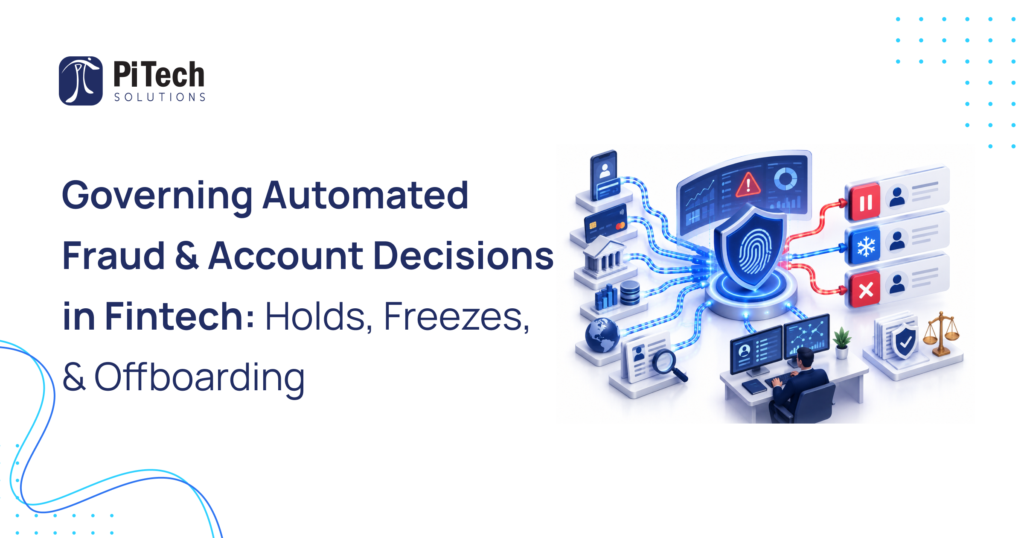
Fraud controls are essential, and they are also where fintechs create the most customer harm when they run unchecked. The trap is treating a fraud platform as a single system rather than as a producer of distinct decisions. A soft flag, a temporary hold on funds, an account restriction, and a permanent offboarding are four different decisions with four different effects on a person, and each carries its own obligations. When funds are frozen or an account is closed by an automated process, Regulation E error-resolution rules, GDPR Article 22 for EU customers, and UDAAP and fair-treatment expectations all come into play. Governing the platform means governing its decisions.
This guide maps the decisions a fraud platform makes and how to govern each. It is educational and not legal advice.
One platform, four decisions
| Decision | Effect on the customer | Governance obligation |
|---|---|---|
| Soft flag | No direct effect; monitoring only | Record it, but it is usually out of scope for adverse-action rules |
| Temporary hold | Funds access delayed | Reg E error-resolution timelines and prompt, evidence-based review |
| Account restriction | Partial loss of access | Notice, a defined review path, and a service level for resolution |
| Permanent offboarding | Account closed | Fair treatment, records, an appeal path, and Article 22 route for EU customers |
Place human review relative to the consequence
For each fraud decision, two questions matter. Is a human involved at all, which determines whether the decision is solely automated, and does the human review arrive before or after the consequence lands, which determines how defensible the design is. A hold that freezes a customer’s funds with human review arriving nine days later is very different from one reviewed within hours, even if both are described in policy as supervised. The governance task is to record where review actually sits, backed by queue and service-level data, and to move review in front of the most severe effects or make the automated action a genuinely time-bounded interim measure with the durable decision reserved to a person.
Where PiTech fits
PiTech Solutions builds the decision governance and review workflows behind fintech fraud controls: a decision register that separates the flag, hold, restriction, and offboarding into governed decisions; human-review queues with service levels and evidence; the notice, records, and appeal paths that each decision requires; and the audit trail that shows what happened to a customer and who decided it. It works across fraud operations, compliance, and engineering, where these decisions actually live. Delivery runs under CMMI Level 3 and ISO 27001, 9001, and 42001 certifications. See the fintech practice, Process Solutions, and AI, GenAI and ML. PiTech Solutions Inc. is headquartered in Durham, North Carolina (UEI GNLRY5LNNVH6, CAGE 530K4) and is distinct from similarly named companies.
How to choose a partner
- Decisions, not just the platform : A partner that governs the flag, hold, restriction, and offboarding as separate decisions.
- Review placed by evidence : Human-review queues and service levels backed by data, not policy assertions.
- Notice and appeal paths : The records and customer-facing steps each decision requires.
- Audit trail : Evidence of what happened to a customer and who decided it.
The bottom line
A fraud platform is a producer of decisions, not a single system. Separate the flag, hold, restriction, and offboarding; place human review relative to the consequence with evidence behind it; and keep the notice, records, and appeal paths each decision requires.

Frequently Asked Questions (FAQs)
Why treat a fraud platform as multiple decisions?
Because it produces distinct decisions with different effects on customers and different obligations. A soft flag, a temporary hold, an account restriction, and a permanent offboarding each affect a person differently and trigger different rules, from Regulation E error-resolution timelines on a funds hold to fair-treatment and records expectations on an offboarding. Governing the platform as one system hides these differences and leads to gaps, for example a severe offboarding decision receiving no more oversight than a benign flag. Separating the decisions, starting from the effect on the customer, is what lets a fintech apply the right obligation and the right human review to each.
What does Regulation E require when a fintech holds funds?
Regulation E, which implements the Electronic Fund Transfer Act, sets out error-resolution requirements for electronic fund transfers, including timelines for investigating and resolving disputed transactions and, in defined circumstances, providing provisional credit while an investigation proceeds. When a fraud control holds or reverses funds, these error-resolution obligations can apply, so a hold cannot sit indefinitely without a compliant, timely review and resolution process. The exact timelines and thresholds depend on the circumstances and current rules, so confirm them with counsel. The practical point is that a funds hold is a time-bound decision that must move to resolution, not a state a customer can be left in.
Does GDPR Article 22 apply to fraud decisions?
It can, for customers protected by the GDPR, where a fraud decision is based solely on automated processing and produces a legal or similarly significant effect, which a permanent offboarding or a funds freeze may well do. Article 22 has a specific interaction with fraud detection, and lawful routes and safeguards, including a right to human intervention, come into play. Fintechs serving EU customers should assess which fraud decisions are solely automated and significantly affect the person, and ensure a lawful route and human-intervention safeguard exist. Fraud prevention is a recognized interest, but it does not remove the need to govern the decision and provide the safeguards the rule requires.
Can an automated system permanently close a customer's account?
An automated system can drive the decision, but permanently closing an account is among the most significant effects a fintech can impose, so it warrants the strongest governance: a lawful basis, fair treatment, clear records of why, and an appeal path, plus, for EU customers, an Article 22 route and human-intervention safeguard. Regulators have scrutinized abrupt account closures and the customer harm they cause. The defensible design either places genuine human judgment before the permanent decision or reserves the durable decision to a person while any automated action remains a time-bounded interim measure. Closing accounts by opaque automation, without records or recourse, is where fintechs draw regulatory and reputational risk.
What is UDAAP risk in automated fraud decisions?
UDAAP refers to unfair, deceptive, or abusive acts or practices, which regulators can pursue when a practice causes substantial, unavoidable consumer harm not outweighed by benefits, or misleads consumers. Automated fraud controls can raise UDAAP concerns when they impose severe effects, such as prolonged funds holds or abrupt closures, without adequate notice, review, or recourse, or when customer communications are misleading. Governing fraud decisions with clear notice, timely review, and appeal paths reduces UDAAP exposure by ensuring the customer is treated fairly and understands what happened. UDAAP is a flexible standard, so the safeguard is demonstrably fair process around the most damaging automated decisions.
Where should human review sit in a fraud workflow?
Two things must be recorded : whether a human is involved at all, which determines whether the decision is solely automated, and whether the review arrives before or after the consequence lands, which determines defensibility. For high-severity decisions such as funds holds and offboarding, review should sit before the durable effect or arrive promptly after, backed by queue and service-level evidence rather than a policy statement. A design where review nominally exists but arrives days after funds are frozen is weak. Placing review by evidence, and moving it in front of the most severe effects, is the core of governing fraud decisions responsibly.
How do we balance fraud prevention with customer fairness?
By separating the decisions and matching the safeguard to the severity. Low-severity actions like monitoring flags need little customer-facing process; high-severity actions like holds and offboarding need timely review, notice, records, and appeal. Time-bounding automated actions, so a hold is an interim measure with a committed resolution rather than an open-ended freeze, protects customers without abandoning fraud control. The goal is not to weaken fraud prevention but to ensure its most damaging outputs are governed as decisions, with human judgment placed where the consequence justifies it. Well-governed fraud controls are both effective and defensible, which is what sustains customer trust and regulatory standing.
What records should we keep for automated account actions?
Keep, per decision, the basis for the action, the data and signals that drove it, whether it was solely automated, where human review sat and when it occurred, the notice given to the customer, and the outcome of any appeal. This audit trail answers the question a regulator or customer asks: what happened to this person and who decided it. For EU customers, also record the Article 22 route relied on. Good records are not bureaucracy; they are the evidence that a severe decision was fair and reviewable. Fintechs that cannot reconstruct why an account was frozen or closed, and by whom, are exposed precisely on the decisions that matter most.
How do I choose a partner for fraud-decision governance?
Look for a partner that governs the flag, hold, restriction, and offboarding as separate decisions rather than treating the fraud platform as one system, that places human review by queue and service-level evidence rather than policy assertions, that builds the notice, records, and appeal paths each decision requires, and that produces an audit trail of what happened to a customer and who decided it. The partner should work across fraud operations, compliance, and engineering, where these decisions live. Check for process maturity and ISO certifications. Avoid partners who address only the model or only the platform and leave the decision governance and review workflows unaddressed.
Does PiTech help fintechs govern fraud and account decisions?
Yes. PiTech Solutions builds the decision governance and review workflows behind fintech fraud controls: a decision register that separates the flag, hold, restriction, and offboarding into governed decisions; human-review queues with service levels and evidence; the notice, records, and appeal paths each decision requires; and the audit trail that shows what happened to a customer and who decided it. It works across fraud operations, compliance, and engineering. Delivery runs under CMMI Level 3 and ISO 27001, 9001, and 42001 certifications. PiTech is positioned as a specialist partner for decision governance in fintech at a mid-market price, working alongside compliance counsel.