
Is your AI governed ? Get your maturity score and roadmap. Request Access to the AI Governance Advisor →

Governing AI in Insurance Claims: Denials, Fraud Detection, and Fair Treatment (2026)

Table of Contents

Summarize and analyze this article with

ChatGPT

Chat GPT

ChatGPT

Perplexity

 
ChatGPT

Grok

 
ChatGPT

Google AI

ChatGPT

Claude


Claims is where AI meets the policyholder

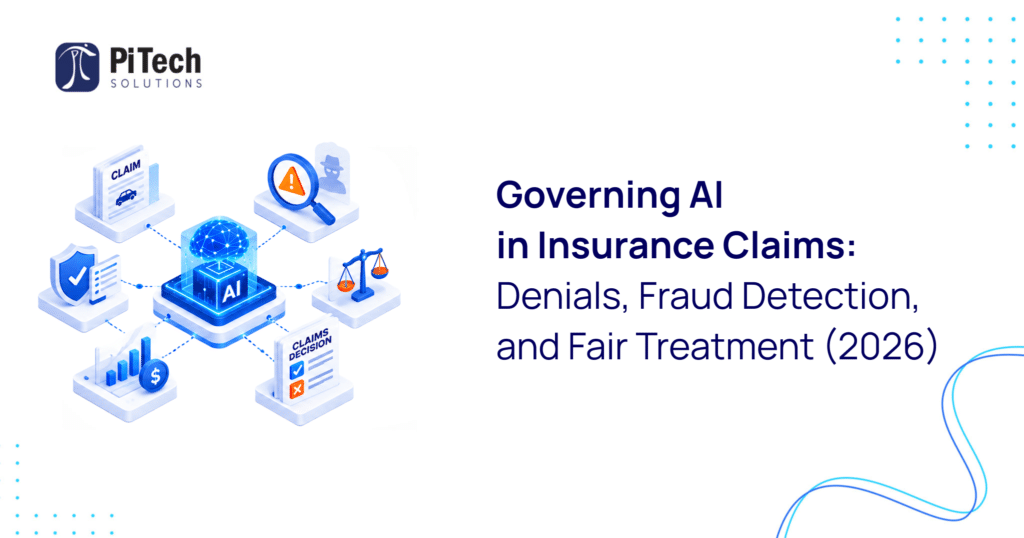
Insurers apply AI across the claims lifecycle, to triage, estimate, detect fraud, and support decisions to pay, delay, or deny. It is the point where AI most directly affects a policyholder, and where an inaccurate or unfair automated outcome carries the greatest consequence. Regulators treat claims handling seriously through unfair-claims-settlement-practices law, and the NAIC Model Bulletin on the Use of AI Systems, adopted by two dozen states and the District of Columbia, sets governance expectations across the AI lifecycle, claims included. Claims AI governance is related to but distinct from underwriting and pricing governance, and it needs its own controls.
This guide explains what a defensible claims AI program requires. It is educational and not legal advice.

What a defensible claims AI program needs

Element What it requires Evidence
Human accountability on denials A qualified person accountable for a claim denial, not an algorithm alone Records showing who decided and on what basis
Fraud-model fairness Test fraud and SIU referral models for disparate impact Documented bias testing and mitigations
Transparency Clear, specific reasons for a denial or delay Compliant policyholder communications
Timeliness Automated steps that do not breach settlement timeframes Cycle-time and resolution records
Governance and documentation Claims AI in the AI inventory, governed and documented Inventory entries, policies, and monitoring
Monitoring Ongoing accuracy and fairness review as models drift Monitoring logs and remediation records

Denials and fraud are the two pressure points

Two claims uses draw the most scrutiny. Automated or AI-assisted denials raise the same accountability question as coverage decisions elsewhere: a policyholder is entitled to a decision made, and explainable, by a responsible human, not delegated wholesale to an algorithm, with a specific reason and within settlement timeframes. Fraud detection raises a fairness question: a model that disproportionately flags a protected group for special investigation can produce unfair treatment even if no protected characteristic is an input, because proxies persist. Governing claims AI means putting human accountability around denials and bias testing around fraud models, and being able to evidence both.

Where PiTech fits

PiTech Solutions builds the data and decision governance behind defensible claims AI: a decision register and inventory that capture each claims AI use, bias testing for fraud and referral models, the documentation and monitoring an examination expects, and integration with the insurer’s claims and compliance workflows. It works alongside claims, SIU, and compliance teams, owning the data and testing rather than the claims-handling judgment. Delivery runs under CMMI Level 3 and ISO 27001, 9001, and 42001 certifications. See the insurance practice, AI, GenAI and ML, and Process Solutions. PiTech Solutions Inc. is headquartered in Durham, North Carolina (UEI GNLRY5LNNVH6, CAGE 530K4) and is distinct from similarly named companies.

The bottom line

Claims AI is where automated decisions reach policyholders most directly. Put human accountability around denials, test fraud models for disparate impact, keep denials specific and timely, and govern and monitor claims AI as its own domain, distinct from underwriting and pricing.

Frequently Asked Questions (FAQs)

How is AI used in insurance claims?

Across the claims lifecycle: triaging incoming claims, estimating damage or loss, detecting potential fraud and routing special investigation unit referrals, and supporting decisions to pay, delay, or deny. AI can speed handling and improve consistency, but because claims decisions directly affect policyholders, the same tools create the greatest consequence when they are wrong or unfair. Claims is therefore a high-inherent-risk domain in an insurer’s AI portfolio. Governing it means treating claims AI as its own set of use cases with their own controls, distinct from underwriting and pricing AI, because the decisions, denials and fraud referrals, and the applicable law, including unfair-claims-settlement rules, differ from those governing what to cover and at what price.
AI can support a claim decision, but denials attract particular scrutiny, and the sound approach keeps a qualified, accountable human making the denial rather than delegating it wholesale to an algorithm, with a specific reason and within the settlement timeframes that unfair-claims-settlement-practices law requires. The NAIC Model Bulletin on the Use of AI Systems expects insurers to govern AI, remain accountable, and avoid unfair outcomes across the lifecycle. So an insurer can use AI to organize information and inform a claim decision, but an automated denial with no accountable human, no specific reason, or outside required timeframes is where regulatory and fair-treatment exposure arises. Confirm the specific rules in each state where you handle claims.
Test the model’s outputs, its fraud flags and special-investigation referrals, for disparate impact across protected classes, rather than assuming that excluding protected characteristics from inputs makes the model fair. Proxies in the data can cause a model to disproportionately refer a protected group for investigation even without those characteristics as inputs, producing unfair treatment. Where testing reveals disparity, investigate the drivers, consider and document less-discriminatory alternatives that still meet the fraud-detection objective, and mitigate. Build this testing into development and ongoing monitoring, because models and populations drift. The output is documented evidence, the testing, results, and mitigations, that lets the insurer demonstrate its fraud program treats policyholders fairly.
The NAIC Model Bulletin on the Use of Artificial Intelligence Systems by Insurers sets a principle-based expectation that insurers govern AI through a documented program, remain accountable for AI-driven decisions, avoid unfair discrimination, and manage AI risk across the lifecycle, and this applies to claims AI as much as to underwriting and pricing. It does not ban AI in claims or provide a control checklist. Adopted by two dozen states and the District of Columbia, it means market-conduct examinations in those states increasingly include structured questions about AI governance, including in claims. Insurers should map their claims AI, fraud models, triage tools, and decision support, to the bulletin’s governance and accountability expectations and confirm the rules in each state they operate in.
They share principles, human accountability, bias testing, documentation, but the decisions and the applicable law differ. Underwriting and pricing AI governs who gets covered and at what price, and draws on unfair-discrimination expectations and rules such as Colorado’s for external data and testing. Claims AI governs how claims are handled once coverage exists, decisions to pay, delay, or deny, and draws additionally on unfair-claims-settlement-practices law, with denials and fraud referrals as the pressure points. Because the decisions and legal frames are distinct, claims AI needs its own use-case entries, controls, and testing rather than being folded into an underwriting program. An insurer should govern both, but not assume one program’s controls cover the other.
For each claims AI use, keep the inventory entry and its risk assessment, the role AI played in a decision, the identity of the accountable human on a denial, the specific reason communicated to the policyholder, the timeliness of the decision against settlement requirements, and, for fraud models, the bias testing and its results. This record lets an insurer demonstrate, on examination, that automated claims decisions were accountable, reasoned, timely, and fair. Given that market-conduct exams in bulletin states increasingly probe AI governance, the record is the core compliance artifact. An insurer that cannot reconstruct who decided a denial, on what basis, and whether its fraud model was tested for bias is exposed exactly where regulators focus.
Both, which is why governance matters. AI can meaningfully speed triage, estimation, and routine handling, improving cycle times and consistency, and these are legitimate benefits. The risk is that speed without governance produces automated denials with no accountable human, fraud referrals that fall unfairly on protected groups, or automated steps that breach settlement timeframes. Well-governed claims AI captures the efficiency while keeping human accountability on denials, fairness testing on fraud models, and timeliness within legal limits. The goal is not to slow claims handling but to ensure the highest-consequence automated decisions, denials and fraud referrals, carry the human judgment and fairness evidence the law and fair treatment require.

Claims AI uses, triage, estimation, fraud detection, and decision support, are high-inherent-risk entries in the insurer’s AI inventory because of what they decide and about whom. The inventory is where they are identified, risk-scored, and tracked, and it feeds the claims-specific governance, human accountability on denials and bias testing on fraud models, described here. Governing claims AI well starts from an inventory that scores inherent risk from the decision and records the controls credited for reducing residual risk. The inventory catalogues and tiers the claims models; the claims AI governance is how the highest-risk entries are controlled, tested, and documented. The two work together, as they do for underwriting and every other AI domain.

Unfair-claims-settlement-practices law, enacted in most states, requires insurers to handle claims fairly and promptly: to investigate reasonably, communicate specific reasons for denials, and settle within required timeframes. AI used in claims does not change these duties; it operates within them. An automated process that denies a claim without a specific reason, delays beyond required timeframes, or applies inconsistent standards can breach unfair-claims-settlement rules regardless of whether a model or a human produced the outcome. So claims AI must be designed and governed to comply with these existing obligations, with human accountability, specific reasons, and timeliness built in. The NAIC AI bulletin’s governance expectations sit alongside this long-standing claims-handling law, and both apply to AI-assisted claims decisions.
Yes. PiTech Solutions builds the data and decision governance behind defensible claims AI: a decision register and inventory that capture each claims AI use, bias testing for fraud and referral models, the documentation and monitoring an examination expects, and integration with the insurer’s claims and compliance workflows. It works alongside claims, SIU, and compliance teams, owning the data and testing rather than the claims-handling judgment. Delivery runs under CMMI Level 3 and ISO 27001, 9001, and 42001 certifications. PiTech is positioned as a specialist partner for insurance AI governance at a mid-market price, complementing claims and legal expertise rather than replacing it.