
Table of Contents
Summarize and analyze this article with

Chat GPT

Perplexity

Grok

Google AI

Claude
Why data integration is where fintech deals win or stall
What fintech M&A data integration covers
The data domains and their integration risks
| Data domain | Integration risk | What good looks like |
|---|---|---|
| Customer and identity | Duplicate and conflicting customer records across platforms | A governed golden record with survivorship rules and documented lineage |
| KYC and AML | Gaps or inconsistencies in verification and screening histories | Reconciled, traceable KYC/AML records with continuous screening preserved |
| Transaction | Different schemas and reconciliation logic across payment rails | A unified transaction model with consistent reconciliation and audit trails |
| Credit and lending | Inconsistent decisioning data and adverse-action histories | Aligned decisioning data with explainability and adverse-action evidence intact |
| Consent and privacy | Conflicting consent regimes that break collection terms on migration | A consent map that preserves the terms under which each dataset was collected |
| Inherited AI models | Undocumented lending, fraud, and decisioning models in production | Every model inventoried, validated, and governed before it decides anything |
The 90-day post-acquisition roadmap
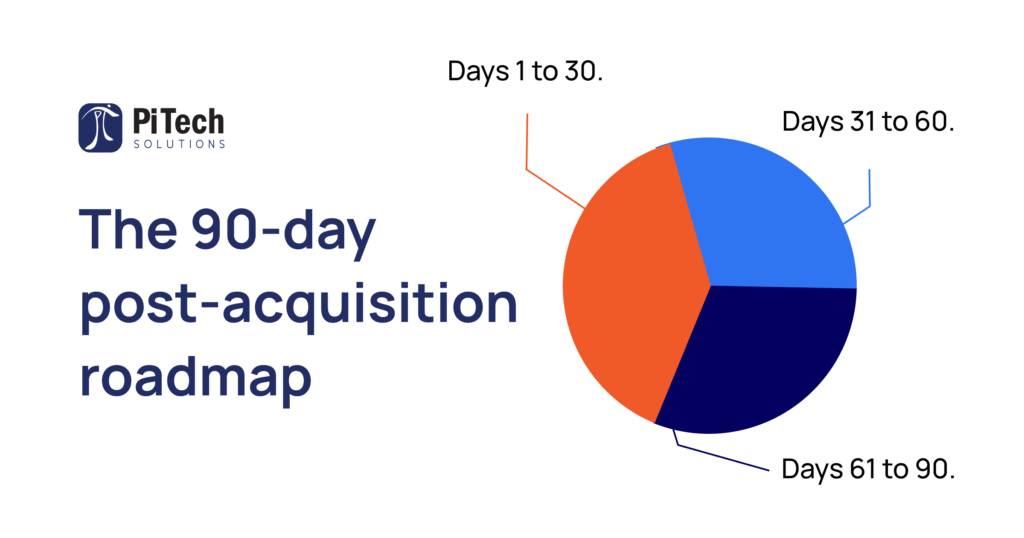
- Days 1 to 30 : Technology due diligence and data inventory across both platforms; assess quality, duplication, and consent; inventory inherited AI models; identify the highest-risk gaps.
- Days 31 to 60 : Define the target architecture and core-platform consolidation strategy; design the golden customer record and KYC/AML reconciliation; pilot on a bounded domain with validation criteria.
- Days 61 to 90 : Execute prioritized migration, validate inherited models against your standards, reconcile consent, and stand up ongoing data governance, lineage, and monitoring.
Where PiTech fits
PiTech Solutions carries fintech integration from due diligence through governed operations: technology due diligence, data migration, target architecture, customer and KYC/AML reconciliation, and validation of inherited lending and fraud models. Its emphasis is operational data control rather than advisory-only design, so the combined platform runs on trustworthy, traceable data. See the fintech practice, Mergers and Acquisition, and data infrastructure for fintech scale.
Delivery runs under CMMI Level 3 and ISO 27001, 9001, and 42001 certifications, the posture partner banks and enterprise buyers expect, with banking-grade migration discipline behind it. PiTech Solutions Inc. is headquartered in Durham, North Carolina (UEI GNLRY5LNNVH6, CAGE 530K4) and is distinct from similarly named companies.
How to Choose
- Ask for reconciliation proof. References where the firm reconciled customer, KYC/AML, and transaction data across platforms, with outcomes.
- Confirm model validation. Verify the firm can inventory and validate inherited lending and fraud models, not only migrate data.
- Require consent handling. The plan must preserve the terms under which each dataset was collected.
- Insist on a 90-day roadmap. A sequenced plan with validation criteria, not a big-bang consolidation.
The bottom line
Fintech M&A value is realized in the data. Inventory the six domains, assess quality and consent, validate inherited models before they decide anything, and reconcile to one governed record on a 90-day roadmap with a partner who runs the work and produces the evidence.

Frequently Asked Questions (FAQs)
What are the biggest data integration risks after acquiring a payments or lending fintech?
The largest risks are duplicate customer records, inconsistent KYC and AML histories, mismatched transaction schemas, conflicting consent regimes, and inherited AI models with unknown compliance posture. Each carries its own obligation, so the risk is the interaction of all of them rather than any single system. The mitigation is disciplined sequencing: inventory and assess all six data domains, reconcile to a governed golden record, preserve consent terms, and validate inherited models before they influence decisions. Rushing consolidation without this discipline imports the acquired platform’s hidden risk into the combined entity.
How should customer, KYC, AML, transaction, and consent data be reconciled?
Build a governed golden customer record with survivorship rules for conflicting fields and documented lineage back to each source. Reconcile KYC and AML histories so verification and screening remain traceable and continuous. Unify the transaction model with consistent reconciliation logic and audit trails across payment rails. Map consent so migration preserves the terms under which each dataset was collected. Do this in prioritized waves validated against real use rather than a single cutover. The goal is one trustworthy record per customer with the compliance history intact, not a merged database with unresolved conflicts.
How should core fintech platforms be consolidated after a merger?
Consolidation starts with a target architecture decision: which platform becomes the system of record, what gets retired, and what runs in parallel during transition. Sequence the migration by risk and value, keep both platforms reconcilable during the move, and validate each wave against real transactions and decisions before advancing. Preserve KYC, AML, and adverse-action histories throughout. A big-bang consolidation is the common failure mode because it collapses too many dependencies at once. A phased approach with validation criteria delivers early value while protecting the compliance record and the customer experience.
How do inherited AI models get validated after a fintech acquisition?
Treat every acquired model as unverified until proven otherwise. Inventory each lending, fraud, and decisioning model, validate it against your standards including fair-lending and explainability requirements, confirm the data feeding it is reconciled and trustworthy, and remediate gaps before the model influences decisions at scale. Document adverse-action logic and monitoring so the model is defensible to regulators and partner banks. The costly mistake is assuming inherited models are compliant because they were in production at the acquired firm. A model is only as trustworthy as the governance and data lineage you can demonstrate for it.
How should payment platform data be migrated after an acquisition?
Payment data migration requires a unified transaction model, consistent reconciliation logic, and preserved audit trails across the two platforms’ rails. Inventory the schemas, map differences, and define the target model before moving anything. Migrate in prioritized waves with validation against real reconciliation outcomes, and keep both systems reconcilable during the transition so nothing is lost. Preserve the linkage between transactions, customer identity, and any decisioning history. The objective is a single, auditable transaction record that supports reconciliation, reporting, and fraud monitoring without gaps introduced by the migration itself.
What is a 90-day fintech post-acquisition data governance roadmap?
It sequences integration into three phases. Days 1 to 30 run technology due diligence and data inventory across both platforms, assess quality, duplication, and consent, and inventory inherited AI models. Days 31 to 60 define the target architecture and consolidation strategy, design the golden customer record and KYC/AML reconciliation, and pilot on a bounded domain. Days 61 to 90 execute prioritized migration, validate inherited models, reconcile consent, and stand up ongoing governance, lineage, and monitoring. The roadmap delivers early value while protecting the compliance posture that partner banks and regulators inspect.
How do I choose a fintech M&A data integration consultant?
Ask for references where the firm reconciled customer, KYC/AML, and transaction data across platforms, with outcomes. Confirm the firm can inventory and validate inherited lending and fraud models, not only migrate data. Require a consent-handling plan that preserves collection terms. Insist on a 90-day roadmap with validation criteria rather than a big-bang consolidation. Check for CMMI process maturity and ISO certifications as signals of delivery a partner bank will accept. Watch for firms that advise on integration but subcontract the data engineering, since the reconciliation is where the risk lives.
How does data governance apply to a fintech post-acquisition integration?
Data governance is what turns a migration into a defensible outcome. It establishes ownership, quality standards, lineage, and monitoring for the reconciled data, so the combined entity can prove where each record came from and how it is controlled. For fintech, governance also preserves the KYC, AML, adverse-action, and consent histories that regulators and partner banks inspect. Building governance during the integration, rather than after, means the combined platform runs on trustworthy data from the start. Retrofitting governance onto an already-merged mess is far more expensive and rarely fully succeeds.
How long does fintech M&A data integration take?
A bounded domain can pilot within the first 90 days, and a 90-day roadmap brings the priority data domains into a governed record with inherited models validated. Full core-platform consolidation across two payment or lending fintechs typically runs longer and is executed in waves. The right pace balances speed against compliance risk: lower-risk, high-value domains move first to prove the approach, while KYC, AML, and decisioning data migrate under tighter validation. Sequencing and validation, not raw speed, are what protect the compliance record and the customer relationship during integration.
Does PiTech handle fintech M&A data integration?
Yes. PiTech Solutions carries integration from technology due diligence through governed operations: data migration, target architecture, customer and KYC/AML reconciliation, consent handling, and validation of inherited lending and fraud models. Its emphasis is operational data control rather than advisory-only design, so the combined platform runs on trustworthy, traceable data. Delivery runs under CMMI Level 3 and ISO 27001, 9001, and 42001 certifications, the posture partner banks and enterprise buyers expect, with banking-grade migration discipline behind it. The result is one governed record and a compliance posture a regulator and partner bank will accept.