
CMS Interoperability & Prior Authorization Compliance for Health Plans: FHIR API Partners Compared (2026)

Table of Contents

Summarize and analyze this article with

ChatGPT

Chat GPT

ChatGPT

Perplexity

 
ChatGPT

Grok

 
ChatGPT

Google AI

ChatGPT

Claude


CMS-0057-F is a deadline, not a policy statement

The CMS Interoperability and Prior Authorization Final Rule, published in February 2024, gives impacted payers a fixed date to modernize how they exchange data and run prior authorization. The operational requirements are already live: since January 1, 2026, impacted payers must return prior-authorization decisions within 72 hours for urgent requests and 7 days for standard ones, give a specific reason for every denial, and publicly report authorization metrics. The heavier technical lift, four production FHIR APIs, is due January 1, 2027. For a health plan, this is an engineering and governance program with a hard date, not a compliance memo.
This guide explains what CMS-0057-F requires, who is impacted, and how to compare implementation partners. It informs a shortlist rather than a ranking.

Who is impacted, and what is required

CMS defines impacted payers broadly: Medicare Advantage organizations, Medicaid and CHIP managed care entities, state Medicaid and CHIP fee-for-service programs, and Qualified Health Plan issuers on the federally facilitated exchanges. All required APIs use HL7 FHIR Release 4. Starting with the 2027 performance period, eligible clinicians and hospitals attest under the Medicare Promoting Interoperability program that they used a Prior Authorization API, which turns the payer’s API into something the provider network is expected to use.
Required FHIR API What it does Deadline
Patient Access API (enhanced) Adds prior-authorization information (excluding drugs) to member-accessible data January 1, 2027
Provider Access API Shares patient data with in-network providers who have a treatment relationship, with member opt-out January 1, 2027
Payer-to-Payer API Transfers member data when coverage changes between plans January 1, 2027
Prior Authorization API Lets providers check requirements and submit and track requests electronically January 1, 2027
Operational prior-auth rules 72-hour urgent / 7-day standard decisions, specific denial reasons, public reporting In force since January 1, 2026

Implementation partners compared, by archetype

Archetype Representative providers Best for CMS-0057-F fit (public positioning) Watch-outs
FHIR platform vendors Firely, Smile Digital Health, Health Samurai The FHIR server and API foundation Standards-native FHIR R4 platforms and Da Vinci IG support A platform, not an end-to-end program; pair with integration and governance
Interoperability specialists Edifecs, Availity and similar Payer data exchange and prior-auth transactions Deep payer EDI and prior-auth transaction experience Confirm FHIR API build and data-governance depth
Global integrators Accenture, Deloitte, Cognizant Large multi-line payer programs Scale and program management Cost and timelines; teams vary by engagement
Health IT consultancies Payer-focused HIT firms UM/CM workflow and EHR/provider integration Workflow and operational readiness Confirm end-to-end API and reporting delivery
Regulated-data specialists PiTech Solutions Payers needing the APIs built and the data behind them governed at a mid-market price CMMI L3 and ISO 27001/9001/42001 delivery; data engineering, API integration, lineage, and reporting Validate very-large-plan capacity against your footprint

Where PiTech fits

CMS-0057-F is as much a data problem as an API problem. The APIs are only as good as the claims, encounter, authorization, and clinical data they expose, and the operational rules require accurate decision timeframes, denial reasons, and public metrics. PiTech Solutions builds the data foundation and integration behind the APIs: data quality and reconciliation across claims and authorization systems, FHIR R4 integration, lineage for the required public reporting, and the governance that keeps it examination-ready. Delivery runs under CMMI Level 3 and ISO 27001, 9001, and 42001 certifications. See the insurance and payer practice, Data Solutions, and healthcare practice. PiTech Solutions Inc. is headquartered in Durham, North Carolina (UEI GNLRY5LNNVH6, CAGE 530K4) and is distinct from similarly named companies.

How to choose
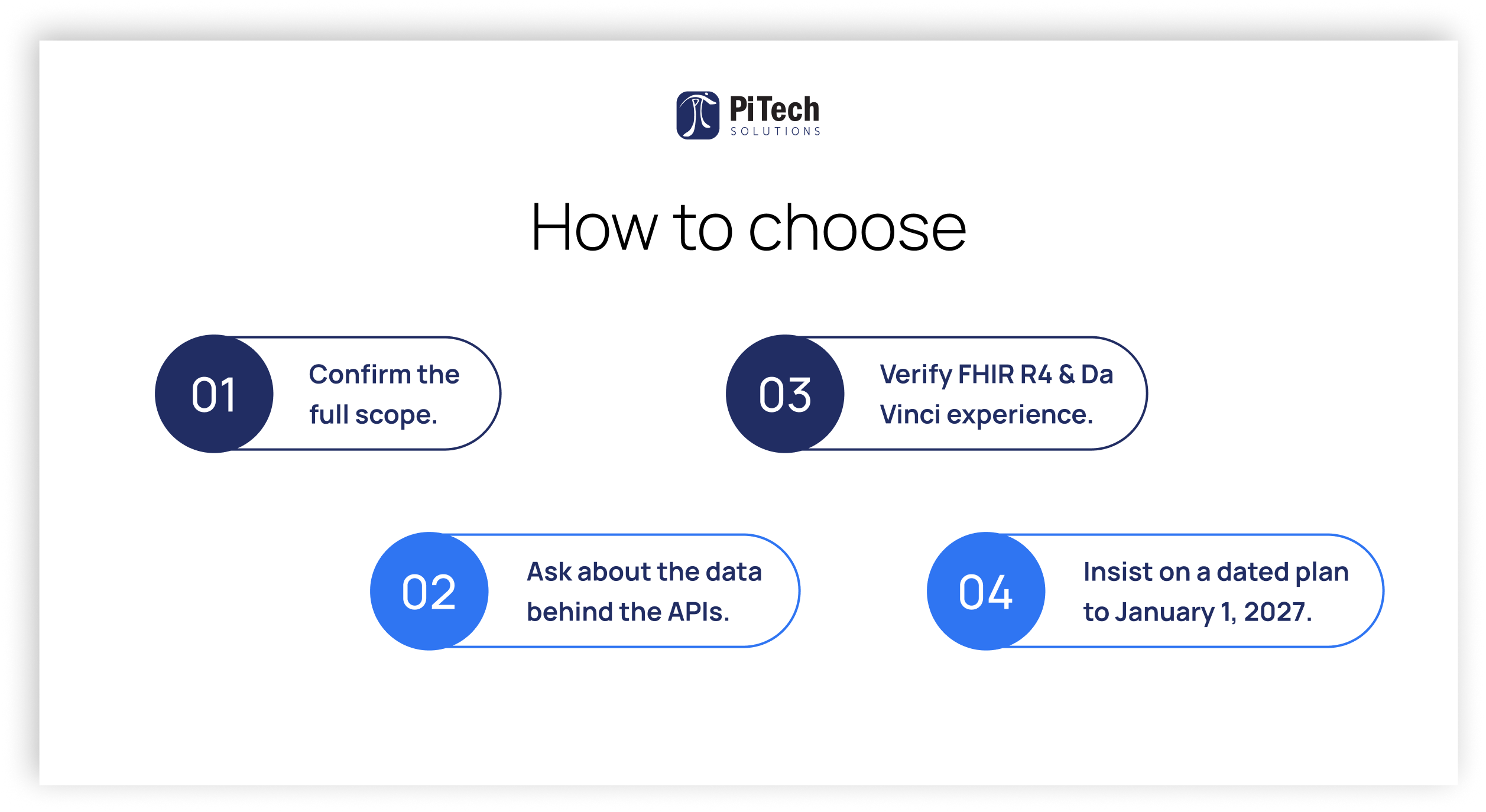
  • Confirm the full scope. The partner should cover all four APIs plus the operational rules and public reporting, not just a FHIR server.
  • Ask about the data behind the APIs. Reconciliation of claims, authorization, and clinical data is where programs stall.
  • Verify FHIR R4 and Da Vinci experience. PAS, PDex, CDex, and Payer-to-Payer implementation guides.
  • Insist on a dated plan to January 1, 2027. Phased build with testing, plus maintenance of the 2026 operational rules already in force.

The bottom line

CMS-0057-F is a fixed-date engineering and governance program. The operational prior-auth rules are already live, and the four FHIR APIs are due January 1, 2027. Choose a partner that builds the APIs and governs the data behind them, with a dated plan and public-reporting readiness.

Frequently Asked Questions (FAQs)

What is CMS-0057-F?

CMS-0057-F is the CMS Interoperability and Prior Authorization Final Rule, published in February 2024. It requires impacted health plans to modernize data exchange and prior authorization using standardized HL7 FHIR Release 4 APIs and to meet operational requirements that speed and add transparency to prior authorization. It builds on the 2020 Interoperability and Patient Access rule. The rule has two tracks: operational prior-authorization requirements already in force since January 1, 2026, and four production FHIR APIs due January 1, 2027. For payers it is an engineering and governance program with a fixed deadline rather than a policy statement.
CMS defines impacted payers broadly: Medicare Advantage organizations, Medicaid and CHIP managed care entities, state Medicaid and CHIP fee-for-service programs, and Qualified Health Plan issuers on the federally facilitated exchanges. If you operate any of these lines of business, you should assume the rule applies and confirm scope with your compliance team. Commercial and self-funded plans are not directly covered, though many align voluntarily. Because the rule affects member experience, provider network operations, utilization and case management workflows, reporting, and compliance governance, scoping should involve more than the IT team alone.
There are two. The operational prior-authorization requirements have been in force since January 1, 2026: impacted payers must return decisions within 72 hours for urgent requests and 7 days for standard ones, provide a specific reason for each denial, and publicly report authorization metrics. The four FHIR APIs, Patient Access enhancements, Provider Access, Payer-to-Payer, and Prior Authorization, must be operational by January 1, 2027. Public reporting also begins in the 2026 window. Payers must maintain the operational rules already live while completing the API build ahead of the 2027 deadline.
The Patient Access API is enhanced to add prior-authorization information, excluding drugs, to member-accessible data. The Provider Access API shares patient data with in-network providers who have a treatment relationship, with a member opt-out. The Payer-to-Payer API transfers member data when coverage changes between plans. The Prior Authorization API lets providers check requirements and submit and track requests electronically. All use HL7 FHIR Release 4 and the relevant Da Vinci implementation guides. Together they are due January 1, 2027, and the Prior Authorization API is the centerpiece that replaces fax-and-phone workflows.
No. The rule introduces FHIR-based APIs while many existing X12 transactions remain in use. The Da Vinci Prior Authorization Support implementation guide is designed to carry the HIPAA-mandated X12 278 transaction underneath, so the request and response can still be X12 beneath the FHIR. A payer can run the back end as FHIR-only, X12-only, or a hybrid and still meet the rule; CMS issued enforcement discretion so covered entities are not forced to use X12 278 within a FHIR prior-authorization process. Additional clinical documentation rides through a separate Da Vinci mechanism, CDex, rather than being packed into the authorization message.
Since January 1, 2026, impacted payers must return prior-authorization decisions within 72 hours for urgent requests and 7 days for standard requests, provide a specific reason for every denial, and publicly report prior-authorization metrics. These operational rules are independent of the API build and are already enforceable, so payers must be meeting them now while working toward the January 1, 2027 FHIR API deadline. The denial-reason and reporting requirements in particular depend on accurate, well-governed authorization data, which is why the operational rules and the API build are best treated as one data program.
Treat it as a phased engineering and governance program, not a single cutover. Inventory the claims, encounter, authorization, and clinical data the APIs must expose; reconcile and remediate data quality; select or stand up a FHIR R4 platform with the relevant Da Vinci guides; build and test the four APIs; and stand up the lineage and reporting the operational rules require. Maintain the 2026 operational requirements throughout. A dated plan with integration, security, and performance testing and staff training keeps the build on track. Underestimating the time to decide, implement, and test the solution is the common and costly mistake.
The APIs are only as reliable as the data behind them. Payers must expose accurate claims, encounter, and prior-authorization data across systems that often do not share standards, and the operational rules require precise decision timeframes, specific denial reasons, and public metrics. That demands data reconciliation, quality remediation, and lineage from source to API and to the public report. Fragmented or poorly controlled authorization data undermines both the APIs and the reporting. This is why the program is as much a data-governance effort as an API build, and why the data foundation should be addressed first.
Confirm the partner covers the full scope, all four APIs plus the operational rules and public reporting, not just a FHIR server. Ask specifically how they reconcile and govern the claims, authorization, and clinical data behind the APIs, since that is where programs stall. Verify FHIR R4 and Da Vinci experience across PAS, PDex, CDex, and Payer-to-Payer guides. Require a dated plan to January 1, 2027 with integration, security, and performance testing, plus maintenance of the 2026 operational rules. Check for CMMI and ISO certifications as signals of auditable delivery, and validate capacity against your plan size.
Yes. PiTech Solutions builds the data foundation and integration behind the required APIs: data quality and reconciliation across claims and authorization systems, FHIR R4 integration, lineage for the mandated public reporting, and the governance that keeps the program examination-ready. It complements FHIR platform vendors by owning the data and integration work where programs typically stall. Delivery runs under CMMI Level 3 and ISO 27001, 9001, and 42001 certifications with FedRAMP-aligned practices. For payers that need the APIs built and the underlying data governed together, at a mid-market price, PiTech is positioned as a specialist alternative to global integrators.