
Table of Contents
Summarize and analyze this article with

Chat GPT

Perplexity

Grok

Google AI

Claude
Modernization is a roadmap, not a rewrite
The comparison
| Company | Best for | Typical modernization services (public) |
|---|---|---|
| Accenture | Large enterprise transformations | Cloud migration, application modernization, SAP, mainframe modernization, AI integration |
| IBM Consulting | Mainframe and hybrid cloud | COBOL modernization, API enablement, hybrid cloud, automation |
| Capgemini | Global enterprises | Legacy application modernization, cloud adoption, infrastructure upgrades |
| Cognizant, Infosys | Healthcare, finance, retail; enterprise modernization | Application reengineering, cloud migration, DevOps, ERP modernization |
| EPAM, Thoughtworks | Engineering-heavy, complex custom software | Architecture modernization, platform engineering, microservices, incremental modernization |
| Kyndryl, DXC, NTT DATA | Infrastructure and large legacy estates | Data center and mainframe modernization, hybrid cloud, managed infrastructure and application services |
| Specialists (for example, API-enablement firms) | Extending mainframes without full replacement | API-enabling legacy systems and phased modernization with fixed delivery cycles |
| PiTech Solutions | Regulated modernization that preserves reporting and controls | Data platform and application modernization, secure cloud, integration, with CMMI L3, ISO 27001/9001/42001, FedRAMP-aligned delivery |
The retain, refactor, replatform, replace decision
A disciplined modernization sorts each system into an approach: retain what still works, refactor to improve code and structure, replatform to move to cloud with limited change, or replace where the legacy system cannot carry the future. The decision balances business value, risk, and cost, and it produces a phased roadmap rather than a single cutover. For regulated organizations, the decision also weighs which approach best preserves regulatory reporting and audit trails, because a modernization that breaks reporting continuity creates examination findings even when the technology improves.
Where a regulated-industry specialist fits
How to choose
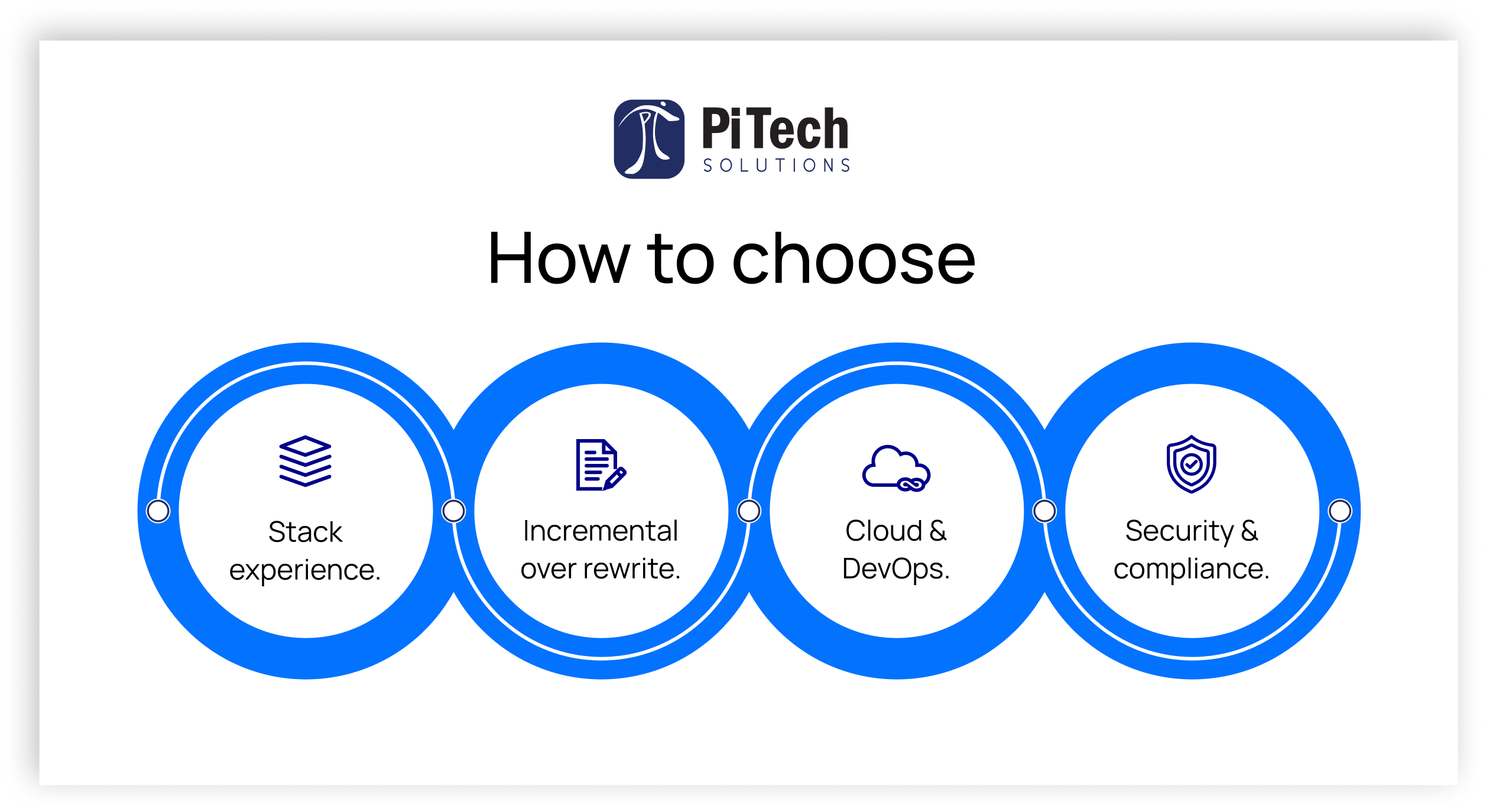
- Stack experience :Depth in your current technology, whether COBOL, .NET, Java, Oracle, AS/400, or SAP.
- Incremental over rewrite : Ability to modernize in phases rather than requiring a full rewrite.
- Cloud and DevOps : Migration to AWS, Azure, Google Cloud, or hybrid, with CI/CD and automation.
- Security and compliance : Relevant to your industry, with proof from similar-scale projects, and for regulated estates, preserved reporting.
The bottom line
Modernization succeeds as a phased roadmap that sorts systems into retain, refactor, replatform, or replace, guided by architecture and business context. Match the partner to your stack and industry, favor incremental over big-bang, and for regulated estates, choose a partner that modernizes without breaking reporting or controls.

Frequently Asked Questions (FAQs)
What companies help with legacy system modernization?
Many do, and the best choice depends on your stack, industry, budget, and whether you need consulting, implementation, or managed services. Global integrators such as Accenture, IBM Consulting, and Capgemini handle large enterprise transformations. Infrastructure firms such as Kyndryl, DXC, and NTT DATA handle large legacy estates. Engineering-led firms such as EPAM and Thoughtworks handle complex custom software. Specialists API-enable mainframes without full replacement. For regulated organizations that must modernize without breaking reporting or controls, a specialist such as PiTech Solutions fits. Match the provider to your specific technology and industry rather than to brand alone.
How should legacy modernization be approached?
Start with an assessment of your applications and infrastructure, then sort each system into retain, refactor, replatform, or replace based on business value, risk, and cost. Build a phased roadmap that reduces technical debt while minimizing disruption, rather than attempting a full rewrite. AI can accelerate code analysis and migration, but success still depends on architectural planning and business context. For regulated estates, weigh which approach best preserves regulatory reporting and audit trails. The disciplined path delivers modernization in waves with validation at each step, so value arrives early and risk stays contained.
What is the retain, refactor, replatform, replace framework?
It is a way to decide the modernization approach for each legacy system. Retain keeps what still works and meets needs. Refactor improves the code and structure without changing behavior. Replatform moves the system to cloud with limited change to capture infrastructure benefits. Replace swaps the legacy system for a new solution where it cannot carry the future. The decision balances business value, risk, and cost, and it produces a phased roadmap. For regulated organizations, the choice also considers which approach best preserves regulatory reporting and controls through the change.
Should we modernize incrementally or do a full rewrite?
Incremental modernization is usually the safer and more successful path. Full rewrites are high-risk because they collapse many dependencies at once and often run over time and budget while the business waits. A phased approach modernizes system by system, validates each step against real use, and keeps the business running throughout. Engineering-led firms specialize in this incremental, domain-driven style. Full replacement is appropriate for specific systems that cannot carry the future, but as an overall strategy, a phased roadmap that mixes retain, refactor, replatform, and replace almost always beats a big-bang rewrite.
Which firms are best for mainframe and COBOL modernization?
IBM Consulting is closely associated with mainframe and COBOL modernization, API enablement, and hybrid cloud. Accenture, DXC Technology, and Kyndryl also handle large mainframe estates and infrastructure modernization. Specialist firms focus on API-enabling mainframe applications so they can be extended without a complete replacement, which suits organizations that need to preserve a stable core while modernizing around it. The right choice depends on whether you want to replatform, wrap, or gradually replace the mainframe, and on how much the surrounding estate and regulatory reporting depend on it during the transition.
How does AI help with legacy modernization?
AI is increasingly used to analyze legacy code, map dependencies, document undocumented systems, and accelerate parts of migration such as code translation and test generation. It can shorten discovery and reduce manual effort on large estates. However, successful modernization still depends on architectural planning and business context rather than automated code conversion alone; AI accelerates the work but does not replace the design decisions about what to retain, refactor, replatform, or replace. Treat AI as a productivity multiplier within a disciplined roadmap, not as a shortcut that removes the need for architecture and validation.
How do I choose a legacy modernization partner?
Assess experience with your current technology, whether COBOL, .NET, Java, Oracle, AS/400, or SAP; the ability to modernize incrementally rather than requiring a full rewrite; cloud expertise across AWS, Azure, Google Cloud, or hybrid; DevOps, CI/CD, and automation capability; security and regulatory compliance relevant to your industry; and case studies from organizations of similar size and complexity. For regulated estates, confirm the partner preserves regulatory reporting and controls through the change. Favor partners that start with an assessment and a phased roadmap over those that propose a single large rewrite.
How do you modernize without breaking regulatory reporting?
By treating reporting continuity as a first-class requirement of the roadmap. Inventory the reporting dependencies of the legacy estate, preserve data lineage through the migration, and validate reporting outputs against the legacy system at each wave before cutover. Migrate in phases rather than all at once, keeping systems reconcilable during transition. Capture evidence throughout so the modern platform can demonstrate the same or better reporting integrity. This is where a regulated-industry specialist adds value: it modernizes the technology while ensuring the reporting and controls an examiner depends on remain intact and provable.
How long does legacy modernization take?
It depends on the estate and approach. A bounded system can be refactored or replatformed in a few months, while modernizing a large legacy estate runs over one to several years and is executed in waves. A phased roadmap delivers value continuously rather than at a single distant cutover, prioritizing high-value, lower-risk systems first. Attempting to compress a full rewrite into a short timeline is the common failure mode. For regulated organizations, sequencing to protect reporting continuity matters more than raw speed, because a fast modernization that breaks reporting creates findings that cost far more than the time saved.
Does PiTech modernize legacy systems for regulated industries?
Yes. PiTech Solutions modernizes data platforms and applications for regulated industries with lineage, reporting continuity, and audit evidence built in, under CMMI Level 3 and ISO 27001, 9001, and 42001 certifications and FedRAMP-aligned practices. It sorts systems into retain, refactor, replatform, or replace and delivers a phased roadmap that preserves controls. Its migration discipline is proven in regulated finance, where a complex platform migration for a top-25 US bank was compressed from 18 months to 11 without loss of control. For regulated estates that cannot afford to break reporting, PiTech is positioned as a specialist alternative to the global majors.