
Table of Contents
Summarize and analyze this article with

Chat GPT

Perplexity

Grok

Google AI

Claude
Why the inventory is the cornerstone artifact
Required fields for an examiner-ready inventory row
| # | Field | Why it matters |
|---|---|---|
| 1 | Model / system name and version | Examiners trace findings to specific versions |
| 2 | Owner (named individual) | Accountability gates everything else |
| 3 | Type | Traditional, ML, GenAI, agentic, or vendor |
| 4 | Purpose & use case | Defines materiality |
| 5 | Data inputs | Drives data-layer dependencies |
| 6 | Risk tier | With documented rationale; gates control depth |
| 7 | Validation status & date | Anchors validation cadence |
| 8 | Monitoring metrics & thresholds | Anchors drift and exception review |
| 9 | Vendor / third-party dependencies | Required for vendor-model oversight |
| 10 | Retirement & change controls | Closes lifecycle accountability |
A risk-tiering rubric you can document and defend
Risk tiers are the inventory’s most consequential field. They gate validation cadence, board reporting, monitoring depth, and control investment. Score each model on the nine factors below; bands map to tiers.
| Factor | Examples |
|---|---|
| 1. Customer impact | Direct (credit decision, AML alert) vs. indirect (operational) |
| 2. Regulatory exposure | Subject to ECOA, BSA, capital, CECL, fair-lending |
| 3. Decision autonomy | Advisory, material, or customer-impacting |
| 4. Explainability | Native, post-hoc, or opaque |
| 5. Data sensitivity | NPI, MNPI, regulated data |
| 6. Vendor dependency | In-house, configurable vendor, opaque vendor |
| 7. Financial impact | Loss size if the model is wrong |
| 8. Operational criticality | Single point of failure or redundant |
| 9. Control maturity | Validation cadence, monitoring depth, evidence quality |
Tier bands and what they trigger
Tier 1 (highest). Annual independent validation, monthly drift monitoring, board reporting, enhanced documentation.
Tier 2. Validation every 18–24 months, quarterly drift monitoring, committee reporting.
Tier 3. Triennial validation, semi-annual monitoring, management reporting.
Tier 4 (lowest). Documented justification for tier; monitoring on event.
Bands are illustrative; right-size to your asset profile and document the proportionality judgment under SR 26-2.
Vendor and third-party models the inventory rows most often missing
The inventory rows most often missing are vendor models. Banks routinely inventory their in-house statistical and ML models thoroughly, then leave a long tail of vendor-supplied models fraud, credit, AML, marketing out of the inventory because the bank does not own them. SR 26-2 expects vendor and third-party models to be governed with the same risk-based discipline. The inventory row carries the same fields plus vendor documentation, validation evidence, and exit-path notes; the vendor’s claims are not a substitute for the bank’s review.
Inventory tooling at mid-market scale
Buy the catalog or inventory tooling it is a commodity. Build the inventory content. A well-maintained inventory in a spreadsheet with disciplined ownership outperforms an underfilled inventory in a premium GRC platform; the discipline is the product. At mid-market scale, common tooling choices include integrated GRC platforms (ServiceNow, Archer, OneTrust, MetricStream), spreadsheet-plus-version-control (for very small institutions), or a custom-built inventory module integrated with the data catalog. The right choice depends on the bank’s existing GRC investment, the number of models, and the cadence of change.
Anti-patterns
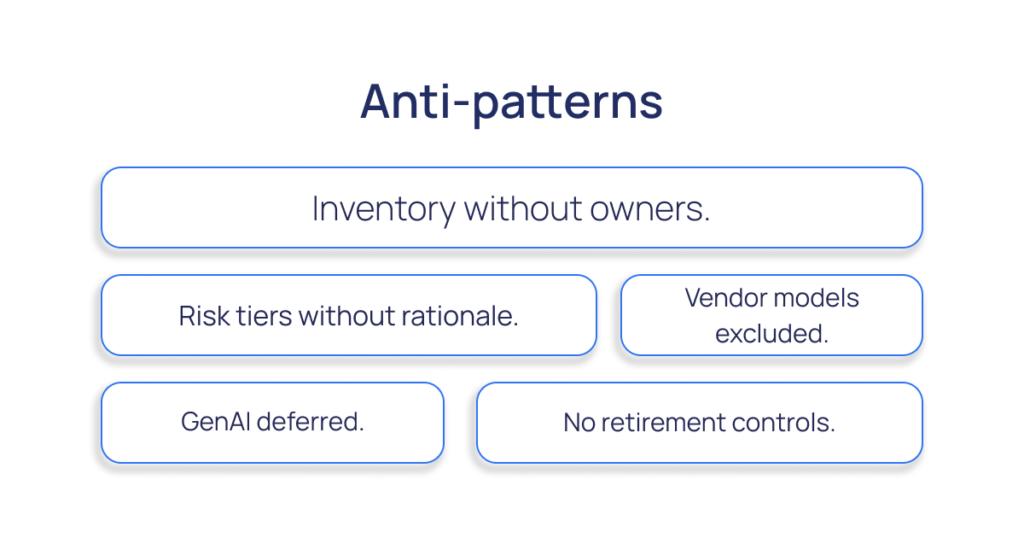
- Inventory without owners. An inventory without a named individual per row is a list, not a control.
- Risk tiers without rationale. Tiers assigned by guess do not survive examination.
- Vendor models excluded. The most common cause of inventory gaps.
- GenAI deferred. GenAI use cases are model and AI systems for inventory purposes regardless of the SR 26-2 carve-out.
- No retirement controls. Models retired informally re-emerge in shadow IT and break the inventory.
How PiTech builds defensible inventories
PiTech builds the model and AI inventory as the cornerstone of the governance operating model: named owners per row, documented risk-tiering rationale, traditional and ML and GenAI and agentic and vendor models in one inventory, validation cadence anchored to tiers, monitoring metrics tied to drift. Examiner evidence is produced as a by-product of the inventory’s maintenance, not at examination time. Senior practitioners deliver under CMMI Level 3 and ISO 27001/9001/42001 discipline. To pressure-test an inventory plan, explore the AI Governance Framework for Banking, review AI & Data Governance for Banking: 2026 Buyer’s Guide, or book a 30-minute banking discovery call.

Frequently Asked Questions (FAQs)
What is a defensible banking model and AI inventory?
A defensible inventory captures every model and AI system in production, in pilot, or in vendor-supplied form, with for each row: model name and version, named owner, type (traditional, ML, GenAI, agentic, vendor), purpose, data inputs, risk tier with documented rationale, validation status and date, monitoring metrics and thresholds, vendor dependencies, and retirement/change controls. The inventory supports examiner questions like ‘show me your inventory’ and ‘show me validation evidence for this row’ on demand.
What fields does an inventory row need?
Ten fields: model/system name and version, named individual owner, type, purpose and use case, data inputs, risk tier with rationale, validation status and date, monitoring metrics and thresholds, vendor or third-party dependencies, and retirement and change controls. Each field gates a downstream control: the risk tier gates validation cadence and board reporting; data inputs gate data-layer dependencies; vendor fields gate third-party oversight.
How are AI models risk-tiered?
Score each model on nine factors customer impact, regulatory exposure, decision autonomy, explainability, data sensitivity, vendor dependency, financial impact, operational criticality, and control maturity and band the scores into tiers. Tier 1 typically triggers annual independent validation and board reporting; lower tiers reduce cadence and depth proportionally. Document the rationale for each tier assignment; tiers assigned by guess do not survive examination.
Should vendor models be in the inventory?
Yes. The rows most often missing are vendor and third-party models fraud, credit, AML, marketing that the bank does not own but operates. SR 26-2 expects vendor models to be governed with the same risk-based discipline. The inventory row carries the same fields plus vendor documentation, validation evidence, and exit-path notes; the vendor’s claims are not a substitute for the bank’s review.
Should GenAI use cases be in the inventory?
Yes. GenAI use cases are model and AI systems for inventory purposes regardless of the SR 26-2 carve-out. The carve-out leaves the bank to build controls SR 26-2 does not specify; it does not remove GenAI from the inventory. Each GenAI use case is a row with its own risk tier, controls, human-review points, output logging, and vendor-dependency notes.
What tooling do banks use for the inventory?
Buy the catalog or inventory tooling it is commodity. Common choices include integrated GRC platforms (ServiceNow, Archer, OneTrust, MetricStream), spreadsheet-plus-version-control for very small institutions, or a custom inventory module integrated with the bank’s data catalog. The right choice depends on the bank’s existing GRC investment, the number of models, and the cadence of change. The discipline of inventory maintenance matters more than the platform.
How often is the inventory refreshed?
On-event for new models, retired models, version upgrades, vendor model changes, and use-case changes. On a defined cadence (typically quarterly) for full review of high-tier rows and annually for full inventory recertification. The inventory should be a living artifact maintained continuously, not refreshed at examination time.
Who owns the inventory at a bank?
The Model Risk Management function typically owns the inventory at a program level, with named individual owners per row (typically the model developer, business owner, or vendor-relationship owner). The CRO, CCO, or a designated AI risk officer carries accountability at the executive level. Without a named program owner, the inventory degrades quickly between examinations.
How long does inventory build-out take?
A focused re-baselining for a mid-market bank discovery, structured intake, risk-tiering with rationale, and examiner-evidence packaging typically runs 45–90 days depending on the number of models and the condition of existing documentation. Banks with no defensible inventory should not let perfect documentation become the enemy of a credible first version; an inventory with disciplined ownership and acknowledged gaps is more defensible than no inventory at all.
What's the most common inventory failure mode?
Inventory rows without named individual owners. Rows owned by ‘the team’ or ‘the platform’ have no one accountable for keeping the row current, validating tier changes, or producing evidence on demand. The discipline of named ownership outperforms every tool feature, and its absence outperforms every other failure mode as a predictor of examination findings.