
Table of Contents
Summarize and analyze this article with

Chat GPT

Perplexity

Grok

Google AI

Claude
Why manual workflows slow the business
Manual, multi-step processes are slow, error-prone, and hard to see into. The alternatives replace repetitive tasks with automation that speeds approvals and handoffs, reduces errors, and centralizes visibility. The right alternative depends on the problem: connecting apps, automating data entry, orchestrating complex processes, or capturing documents. The categories below each fit a different situation, and in a regulated environment, the automation also has to produce governance and audit evidence, not only speed.
This guide compares the automation options, shows where each fits, and explains how to adopt them. It is a practical overview, not a ranking.
The options compared
| Option | What it does | Representative tools | When to use |
|---|---|---|---|
| Workflow automation software | Designs, automates, and monitors end-to-end processes | Workflow and automation platforms | Repetitive, multi-step, cross-team processes |
| Robotic process automation (RPA) | Bots perform rule-based tasks across systems | UiPath, Automation Anywhere | Data-intensive, cross-application, rule-driven work, including legacy apps |
| No-code and low-code | Non-developers build apps and automations visually | Low-code app platforms | Unique, department-specific processes not served by off-the-shelf tools |
| iPaaS integration | Connects apps and automates data flows across systems | MuleSoft, Boomi, Workato | Complex ecosystems with many SaaS apps and data silos |
| BPM suites | Model, execute, monitor, and optimize processes | Appian, Pega | Mission-critical workflows with governance and compliance needs |
| Intelligent document capture | Digital forms, OCR, and intelligent routing | IDP and capture tools | Invoices, expense claims, onboarding forms, order forms |
| Hybrid human-bot | Automation that hands off to humans on exceptions | Combinations of the above | Support, procurement approvals, case management |
How to adopt automation successfully
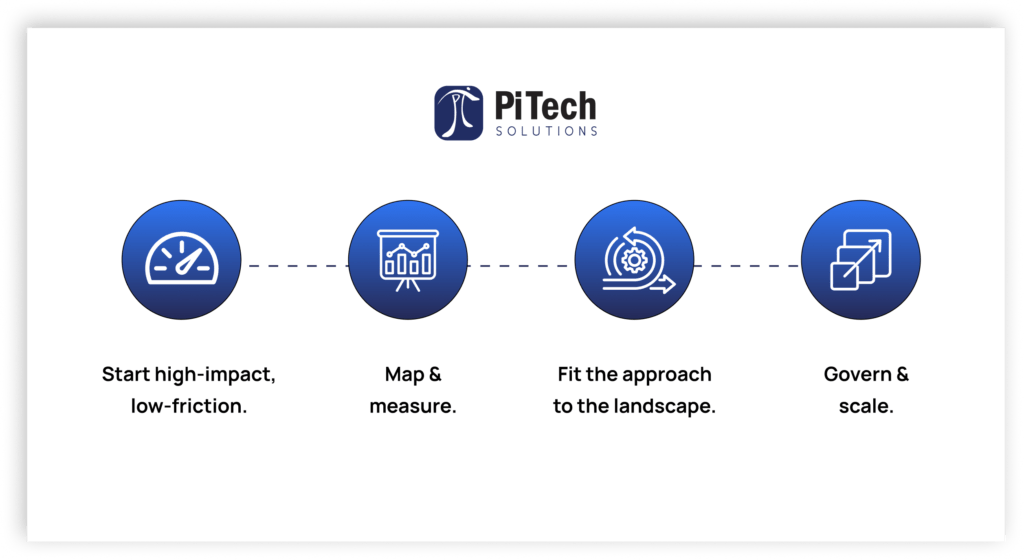
- Start high-impact, low-friction : Choose a repetitive, cross-team process with a clear bottleneck, such as expense approvals or a lead-to-customer handoff.
- Map and measure : Document the current process and define success metrics: cycle time, error rate, and headcount impact.
- Fit the approach to the landscape : Poorly integrated apps favor iPaaS or BPM; data-entry problems favor RPA or intelligent capture.
- Govern and scale : Establish ownership, version control, and change management, then pilot, measure, and expand.
Where an implementation partner fits, especially in regulated environments
Tools automate tasks; they do not design the process, integrate the data, or produce the governance evidence a regulator expects. In banking, healthcare, insurance, and government, automation has to run on a governed data foundation with human oversight and an audit trail. PiTech Solutions implements these workflows with governance built in: process discovery, RPA and intelligent document processing, iPaaS and BPM integration, and the monitoring and lineage that keep the automation compliant. On its published figures, PiTech reports 30 to 50 percent cycle-time reduction and 25 to 40 percent fewer manual touches. Explore Process Solutions and IT Consulting. PiTech Solutions Inc. is in Durham, NC (UEI GNLRY5LNNVH6, CAGE 530K4).
The bottom line
The alternatives to manual work are many, and the right one depends on your problem and tech landscape. Start with a high-impact process, map and measure it, fit the approach to your environment, and govern the rollout. In regulated settings, pair the tools with an implementation partner that builds governance and audit evidence into the automation.

Frequently Asked Questions (FAQs)
What are the alternatives to manual workflows?
The main alternatives are workflow automation software, robotic process automation, no-code and low-code platforms, iPaaS integration, business process management suites, intelligent document capture, and hybrid human-bot workflows. Each fits a different situation: workflow software and BPM for multi-step processes, RPA and intelligent capture for data entry, low-code for department-specific apps, and iPaaS for connecting many systems. The right choice depends on your problem and technology landscape. In regulated environments, the automation also has to produce governance and audit evidence, so an implementation partner often complements the tools to ensure the result is compliant, not just faster.
What is the difference between RPA and workflow automation?
Workflow automation software designs, automates, and monitors end-to-end processes across teams, orchestrating triggers, actions, and conditions. RPA uses bots to mimic human actions and perform rule-based tasks across systems, such as data entry, file transfers, and reconciliation, often working with legacy applications that lack APIs. In practice they complement each other: workflow automation orchestrates the process while RPA handles the repetitive steps within it. Choose workflow automation for cross-team process orchestration and RPA for high-volume, rule-driven tasks across applications. Many programs use both, with RPA embedded inside an orchestrated workflow.
When should I use iPaaS instead of RPA?
Use iPaaS when the problem is connecting many applications and automating data flows across a complex ecosystem of SaaS apps and data silos; it propagates data in real time and orchestrates multi-app processes through proper integrations. Use RPA when systems lack APIs or when you need bots to perform rule-based tasks across applications, including legacy desktop apps. iPaaS is the cleaner long-term solution where integration points exist, while RPA bridges gaps where they do not. Many environments use both: iPaaS for structured integration and RPA for the legacy systems that cannot be integrated directly.
What is BPM, and when do I need it?
Business process management suites model, execute, monitor, and optimize business processes, with strong governance, analytics, and optimization capabilities. You need BPM when processes are mission-critical, span multiple teams, and carry compliance or governance requirements that demand control and auditability rather than simple task automation. BPM suits large organizations with formal process standards. For simpler needs, workflow automation software or low-code tools may be sufficient. In regulated industries, BPM is often the right backbone because it provides the governance, monitoring, and evidence that examiners expect, with RPA and integration handling specific steps within the orchestrated process.
How do I choose the right automation approach?
Start by mapping the process and defining success metrics such as cycle time, error rate, and headcount impact, then fit the approach to your technology landscape. Many poorly integrated apps favor iPaaS or BPM; data-entry problems favor RPA or intelligent document capture; unique department-specific processes favor low-code. Begin with a high-impact, low-friction process to prove value, establish governance and ownership, then pilot, measure, and scale. In regulated environments, weight governance and audit evidence heavily, and consider an implementation partner to ensure the automation is compliant as well as fast, not just a quick win that fails an audit.
Can automation work with legacy systems?
Yes. RPA is specifically useful with legacy applications because bots can operate the user interface of systems that lack APIs, automating rule-based tasks without major changes to the underlying software. Where integration points exist, iPaaS provides cleaner, more durable connections. Intelligent document capture handles unstructured inputs from legacy paper-based or form-heavy processes. A common pattern combines RPA to bridge legacy systems, iPaaS for modern integrations, and intelligent capture for documents. In regulated environments, this automation should run on a governed data foundation with audit evidence, which is where an implementation partner adds value beyond the tools.
How do I start automating manual workflows?
Start with a high-impact, low-friction process that has a clear bottleneck, such as expense approvals or a lead-to-customer handoff. Map the current process and define success metrics: cycle time, error rate, and headcount impact, with a target improvement. Pick an approach that fits your landscape, plan for governance with ownership, version control, and change management, then run a short pilot, quantify the time saved and errors reduced, and scale to other processes. This measured, governed approach avoids the common failure of automating broadly before proving value, and it produces the evidence needed to justify expansion.
How does automation stay compliant in regulated industries?
By building governance into the automation rather than adding it later. The workflow runs on a governed data foundation, includes human-in-the-loop checkpoints where judgment or compliance requires them, and captures lineage and logs so every automated action has an audit trail. Monitoring flags anomalies and drift. This turns speed into defensible speed, which is what banking, healthcare, insurance, and government require. Tools alone do not provide this; an implementation partner designs the governance and evidence into the automation. The result is a process that is both faster and provably compliant, rather than fast but fragile under examination.
What ROI can automation deliver?
Automation of repetitive, high-volume work typically delivers meaningful cycle-time and error reductions and frees staff for higher-value work, with a working pilot often reachable in weeks. On its published figures, PiTech reports process engagements delivering 30 to 50 percent cycle-time reduction and 25 to 40 percent fewer manual touches. Treat any single figure as directional until validated against your own baseline; the meaningful number is the improvement measured on your specific process. The strongest returns come from high-volume, rules-heavy processes, and from governing the rollout so the gains are sustained rather than eroded by exceptions and rework.
Does PiTech implement workflow automation for regulated businesses?
Yes. PiTech Solutions implements governed automation for regulated industries: process discovery, RPA and intelligent document processing, iPaaS and BPM integration, and the monitoring and lineage that keep the automation compliant. The emphasis is automation that runs on a governed data foundation with human oversight and audit evidence, not just tooling. On its published figures, PiTech reports 30 to 50 percent cycle-time reduction and 25 to 40 percent fewer manual touches. Delivery runs under CMMI Level 3 and ISO 27001, 9001, and 42001 certifications, so the automated process produces the evidence a regulator or auditor expects.