
Table of Contents
Summarize and analyze this article with

Chat GPT

Perplexity

Grok

Google AI

Claude
AI fails differently, so incident response has to change
Traditional incident response is built around systems going down. AI breaks that model. A model can fail while the system stays up, producing outputs that are wrong, biased, or unsafe without a single alarm firing, and an autonomous agent can take a harmful action and repeat it at machine speed before a human notices. In regulated settings, those failures carry consequences for customers, patients, and compliance that a conventional uptime-focused playbook will miss. The attention on AI agents in 2026, from supervisors asking banks how they would shut agents down to institutions barring third-party agents from customer accounts, is at its core a question about incident response: can you detect an AI failure, stop it, and report it?
This guide explains what an AI incident playbook needs. It is educational and not legal advice.
What an AI incident playbook needs
| Element | What it requires |
|---|---|
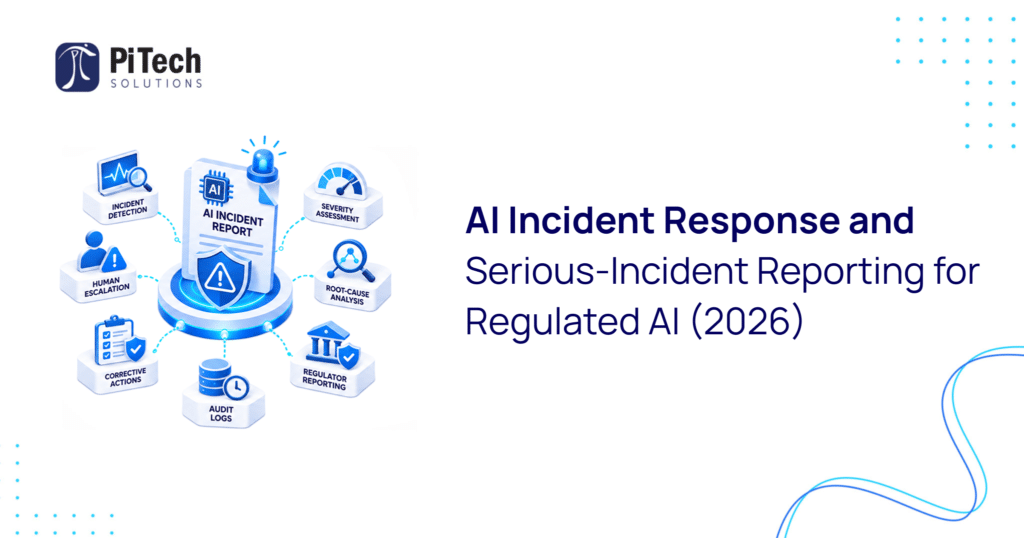
| A definition | What counts as an AI incident: harmful, biased, or wrong outputs; unsafe agent actions; drift; data issues; misuse, not only downtime |
| Detection | Monitoring that watches outputs and agent actions, not only system availability, with thresholds that trigger |
| Triage and classification | Severity based on consequence, population affected, and reversibility, mapped to any reporting obligations |
| Containment | The ability to halt the model or agent and fall back to a safe process, tested in advance |
| Reporting | A path to notify the right authorities and stakeholders on the required timelines where an obligation applies |
| Remediation and learning | Root-cause analysis back to data and model, a fix, and a feedback loop into governance |
Where reporting obligations come from
Several regimes already impose or point toward AI-incident reporting, and the set is growing. The EU AI Act requires providers of high-risk systems to report serious incidents to authorities, on timelines tied to the severity of the event. For financial firms, operational-resilience rules such as the EU’s DORA require classification and reporting of major ICT-related incidents, which can include AI-driven disruptions. Sector regulators and state laws increasingly expect that AI failures affecting consumers are detected, recorded, and in some cases disclosed. Because the obligations differ by sector and jurisdiction, the playbook should classify an incident once and map it to each applicable reporting duty, rather than maintaining separate processes. Confirm the specific reporting triggers and timelines that apply to your organization at publish.
The agent case is the hard case
Agentic AI concentrates the difficulty. An agent that takes actions can cause harm that is immediate, repeated, and hard to reverse, which is why containment, the ability to halt the agent and fall back to a safe process, is the load-bearing control. An incident playbook for agents has to connect to the agent register, the tested shutdown procedure, and the audit trail, so that when an agent misbehaves the organization can identify it, stop it, reconstruct what it did, and report it. An organization that has built those agent-governance records already has most of what AI incident response for agents requires; one that has not will be improvising during the incident itself.
Where PiTech fits
PiTech Solutions helps regulated organizations build AI incident response as its own discipline: a definition of what counts, output-and-action monitoring that detects failures a uptime check misses, severity classification mapped to applicable reporting obligations, tested containment and safe-fallback paths, and root-cause remediation that feeds back into governance. It connects incident response to the AI inventory and agent governance and the data foundation that root-cause analysis depends on. Delivery runs under CMMI Level 3 and ISO 27001, 9001, and 42001 certifications. See AI, GenAI and ML, Process Solutions, and the banking hub. PiTech Solutions Inc. is headquartered in Durham, North Carolina (UEI GNLRY5LNNVH6, CAGE 530K4) and is distinct from similarly named companies.
The bottom line
AI fails in ways a downtime-focused playbook misses: silent wrong outputs, biased decisions, and harmful agent actions at speed. Build an AI-specific incident process, a definition, output-and-action detection, consequence-based classification mapped to reporting duties, tested containment, and remediation that feeds governance, and connect it to your agent register and shutdown records, because the agent case is the one that moves fastest.

Frequently Asked Questions (FAQs)
What is an AI incident?
An AI incident is an event in which an AI system causes or threatens harm through its behavior, not only through going offline. It includes a model producing wrong, biased, or unsafe outputs while the system remains available; an autonomous agent taking a harmful or unauthorized action; significant model drift that degrades decisions; data problems that corrupt outputs; and misuse of an AI system. The defining feature is that AI can fail while appearing to work, so an AI incident is often invisible to traditional monitoring that watches uptime and errors rather than the correctness, fairness, and safety of outputs and actions. Defining what counts as an AI incident for your organization is the first step of an AI incident-response program, because you cannot detect or classify what you have not defined.
How is AI incident response different from IT incident response?
IT incident response is built around availability and errors: a system goes down, an alert fires, responders restore it. AI incident response has to handle failures where the system stays up but its behavior is harmful, a model that quietly produces biased or wrong outputs, or an agent that takes an unsafe action at speed. That requires monitoring outputs and actions, not just uptime; classifying severity by consequence to people rather than by technical impact; containment that can halt a model or agent and fall back to a safe process rather than simply rebooting; and root-cause analysis that reaches back to data and model behavior. AI incident response builds on IT incident response but adds these AI-specific detection, containment, and analysis capabilities, because the failure modes are different in kind.
Does the EU AI Act require reporting AI incidents?
The EU AI Act requires providers of high-risk AI systems to report serious incidents to the relevant authorities, with reporting timelines tied to the severity of the incident, as part of the Act’s post-market monitoring and oversight regime. A serious incident broadly covers events such as death or serious harm to health, serious disruption of critical infrastructure, or breaches of fundamental rights obligations, among others. Because the AI Act’s high-risk obligations were deferred by the Digital Omnibus, organizations should confirm the applicable timing, but the serious-incident reporting expectation is part of the regime they are building toward. US firms with high-risk systems reaching the EU should account for this duty, and all regulated organizations should have the detection and classification capability that makes such reporting possible, regardless of which specific regime applies.
What reporting obligations apply to AI incidents?
They vary by sector and jurisdiction, which is why a single classification mapped to multiple duties is more practical than separate processes. The EU AI Act requires serious-incident reporting for high-risk systems. Operational-resilience rules such as the EU’s DORA require financial entities to classify and report major ICT-related incidents, which can include AI-driven disruptions, on defined timelines. Sector regulators in areas like healthcare and financial services, and various state consumer-protection and privacy laws, may require that AI failures affecting consumers be recorded and in some cases disclosed. Because the triggers and timelines differ, an organization should determine which obligations apply to it and build a process that classifies an incident once and routes it to each applicable reporting duty. Confirm the specific requirements against the applicable regimes at the time of reading.
How should AI incidents be classified by severity?
By consequence, not by technical impact alone. A useful classification weighs the harm an incident caused or risks causing, the population affected and whether protected groups are disproportionately affected, the reversibility of the harm, and the number of decisions or people involved. A silent model error that produced many wrong consequential decisions about customers may be far more severe than a visible outage, even though the outage looks worse on an availability dashboard. Severity should map to the response required, how fast to contain, who to escalate to, and whether a reporting obligation is triggered, so that the classification drives action. Classifying by consequence also aligns AI incident severity with the inherent-risk logic used across AI governance, keeping the organization’s view of risk consistent from inventory through incident.
How do you contain an AI incident?
Containment means stopping the harmful behavior and falling back to a safe process, and for AI that requires capabilities built in advance. For a model, it may mean switching off the model and reverting to a prior version, a rules-based fallback, or human handling. For an agent, it means invoking a tested shutdown procedure that halts the agent and tells the business how to continue without it. The essential point is that containment must be tested before it is needed, because an untested halt procedure is a hypothesis, and AI failures, especially agent failures, can propagate quickly. An organization that has built a tested shutdown procedure and a safe-fallback path as part of its AI governance already has the containment capability incident response depends on; one that has not will be designing containment during the incident.
Why did AI incident response become urgent in 2026?
Because autonomous agents moved into production and their failure mode, taking harmful actions at speed, made the stakes concrete, and supervisors responded. Through 2026, US banking regulators questioned institutions about how they would limit and shut down AI agents, and major banks barred third-party agents from customer accounts, both of which are, at root, questions about whether an AI failure can be detected and stopped. At the same time, international and sector bodies issued guidance emphasizing testable kill-switch mechanisms and incident handling for AI. The combination of agents in production and heightened supervisory attention turned AI incident response from a theoretical good practice into an operational necessity, particularly for regulated organizations where an undetected or uncontained AI failure carries direct compliance and customer-harm consequences.
How does AI incident response connect to agent governance?
Tightly, because the agent case is the hardest incident case. Responding to an agent incident requires identifying which agent acted (the agent register), stopping it (the tested shutdown procedure), reconstructing what it did (the audit trail), and understanding why (root-cause analysis back to the model and data). Those are the same records that agent governance produces, so an organization that has built an agent register, shutdown procedures, and tamper-resistant logs already has most of what agent incident response requires. Incident response is where those governance records prove their value, under pressure. Building them in advance, as part of agent governance, is what lets an organization respond to an agent incident with evidence and control rather than improvising while the agent is still acting.
What should happen after an AI incident is resolved?
Root-cause analysis and a feedback loop into governance. Resolving the immediate harm is not the end: the organization should trace the incident back to its source, often a data problem, a model weakness, a permission that was too broad, or a missing control, implement a durable fix, and feed what it learned into its AI governance so the same failure is prevented or caught earlier next time. This may mean updating the model, tightening an agent’s permissions, adding a monitoring threshold, revising a risk classification, or strengthening a control. Treating each AI incident as a learning input, rather than a one-off to close out, is what makes an AI program more resilient over time, and it produces the documented record that demonstrates to regulators and auditors that incidents are handled and learned from rather than merely survived.
Does PiTech help build AI incident response?
Yes. PiTech Solutions helps regulated organizations build AI incident response as its own discipline: a definition of what counts as an AI incident, output-and-action monitoring that detects failures an uptime check misses, severity classification mapped to applicable reporting obligations, tested containment and safe-fallback paths, and root-cause remediation that feeds back into governance. It connects incident response to the AI inventory, agent governance, and the data foundation that root-cause analysis depends on, so detection, containment, and reporting share one foundation with the rest of the AI program. Delivery runs under CMMI Level 3 and ISO 27001, 9001, and 42001 certifications. PiTech is positioned as a specialist AI-governance and resilience partner for regulated industries at a mid-market price, working alongside security and compliance teams.