
Table of Contents
Summarize and analyze this article with

Chat GPT

Perplexity

Grok

Google AI

Claude
The question
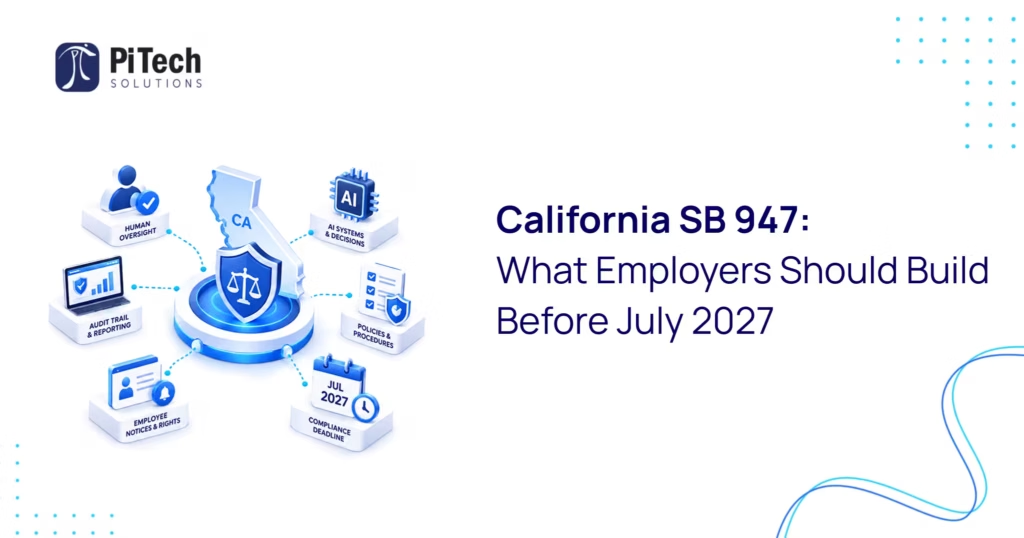
California just passed a law on AI in firing decisions. What does an employer actually have to put in place, and by when? SB 947, the No Robo Bosses Act of 2026, was signed by Governor Newsom on 30 September 2026 as Chapter 859 of the Statutes of 2026 and becomes operative on 1 July 2027. It makes California the first state to require human oversight when an automated decision system is the primary basis for disciplining or terminating a worker. This guide explains what to build and in what order. It is general information and not legal advice.
Why the date matters
The signing date and the operative date are different, and only one of them matters for planning. SB 947 is scheduled, not in effect. Nothing in it applies before 1 July 2027. That is a fixed runway, long enough to build the controls properly and short enough that starting in the spring of 2027 would be too late. This is also the second attempt. The earlier No Robo Bosses bill, SB 7, was vetoed in October 2025 as overly broad. SB 947 is narrower: it concentrates on discipline and termination, and it replaced the earlier pre-use notice with a post-use notice.
| Milestone | Date | What it means |
|---|---|---|
| SB 7 vetoed | October 2025 | First, broader No Robo Bosses bill rejected as overly broad |
| SB 947 signed | 30 September 2026 | Narrowed bill becomes law (Chapter 859, Statutes of 2026) |
| SB 947 operative | 1 July 2027 | Prohibitions, human-review, notice, and data-request duties apply |
The four controls
| Control | What SB 947 requires | The artifact that proves it |
|---|---|---|
| 1. Inventory | Know every automated system whose output feeds a discipline or termination decision | A system inventory with owner, vendor, output, and consuming HR process |
| 2. Corroboration | A human corroborates a primary-basis output with independent evidence before action | A workflow record of who reviewed, what evidence, and the conclusion |
| 3. Written notice | A post-decision notice to the employee when a system was the primary basis | A template wired into the HR case system so it cannot be skipped |
| 4. Data-description request | Give the employee a meaningful description of their own data the system used | A per-system data map and a vendor clause to extract it in time |
1. An inventory of systems that touch discipline or termination
The law reaches any automated decision system, described in summaries of the bill as a computational process derived from machine learning, statistical modeling, data analytics, or artificial intelligence that produces an output such as a score, classification, or recommendation used to assist or replace human discretionary decision-making and that materially affects a person. That is wider than tools marketed as AI. Productivity scoring, attendance flagging, quality monitoring, and call-center analytics can all qualify if their output feeds a disciplinary decision. Record for each system its owner, vendor, what it outputs, which HR processes consume that output, and whether a manager could act on it without other evidence.
2. A corroboration step that is real
Where an employer relies primarily on a system’s output, a human reviewer must corroborate it using other information. Law-firm summaries list examples such as the data used to generate the output, supervisory or managerial evaluations, personnel files, employee work product, peer reviews, and witness interviews. If the output cannot be corroborated, or the reviewer finds it inaccurate, incomplete, or misleading, it cannot be the basis for the decision. Build this as a workflow step, not a policy sentence. The record should show who reviewed, what independent evidence they examined, and what they concluded. A checkbox that says reviewed will not show independent judgment, and the burden-shifting in the statute means the employer is the party that has to show it.
3. A written notice that goes out with the decision
SB 947 requires a separate written notice, given when the employee is told the outcome. It states that an automated system was the primary basis for the decision, confirms that a human reviewed it, names a contact for questions, and states that retaliation for exercising rights under the Act is prohibited. Draft the template now, route it through employment counsel, and wire it into the same HR case system that records the decision, so the notice cannot be skipped. The signed law uses this post-use notice in place of the pre-use notice that helped sink the earlier bill.
4. A process for data-description requests
Employees can request a meaningful, objective description of their own data that the system used, and personal information about others must be anonymized in the response. That requires knowing, per system, what input data exists and who can extract and describe it. Vendor contracts matter here: if the data sits with a provider, the agreement needs a clause that obliges the provider to supply it in time. This is the same vendor-data discipline that third-party AI risk management already demands, applied to an individual’s right to understand a decision about them.
Two limits on use
Separately from the four controls, the law bars using an automated system to infer a protected characteristic under California’s Fair Employment and Housing Act, or to predict that a worker will exercise a legal right and then act against them for it. Both belong in the review criteria for any new HR analytics purchase. SB 947 also arrived alongside companion measures in the same signing, including limits on workplace tools that read a worker’s emotional or neural state, so an employer’s HR technology review should look wider than SB 947 alone.
What usually goes wrong
- Scoping the inventory to tools labeled AI. The definition reaches ordinary analytics and scoring, and the systems most likely to drive discipline are often old ones: a productivity dashboard, a quality score, a workforce-management alert.
- Treating corroboration as sign-off. A manager who reads the score and agrees has not examined independent evidence. The statute asks for human judgment on the record, not a rubber stamp.
- Forgetting the vendor. If a provider holds the input data, the employer still has to answer the employee’s data-description request, which means the contract has to oblige the provider to supply it.
Where PiTech fits
SB 947 asks for evidence of human judgment, and evidence takes longer to build than policy. PiTech Solutions helps regulated employers inventory the automated systems that touch discipline and termination, build the corroboration workflow that produces a usable record, wire the written notice into the HR case system, and map the per-system data behind a data-description request, including the vendor clauses that make it answerable. It connects this to the automated decision register and AI inventory an organization already maintains, so the workplace-decision controls share one foundation with its ADMT and AI-governance work rather than being built in a silo. Delivery runs under CMMI Level 3 and ISO 27001, 9001, and 42001 certifications. See Process Solutions, AI, GenAI and ML, and Data Solutions. PiTech Solutions Inc. is headquartered in Durham, North Carolina (UEI GNLRY5LNNVH6, CAGE 530K4) and is distinct from similarly named companies.
The bottom line
SB 947 is law now and operative on 1 July 2027. It does not ban automated tools in discipline and termination; it bans relying on them alone, requires real human corroboration, adds a written notice, and gives employees a data-description right. Build the four controls on the runway you have, and start with the inventory, because everything else depends on it.

Frequently Asked Questions (FAQs)
What is California's No Robo Bosses Act (SB 947)?
SB 947, the No Robo Bosses Act of 2026, is a California law signed on 30 September 2026 and operative on 1 July 2027 that requires human oversight when an automated decision system is the primary basis for disciplining or terminating an employee. It does not ban automated tools in those decisions. It prohibits relying on them alone, requires a human reviewer to corroborate a primary-basis output with independent evidence, requires a written notice to the affected employee, and gives the employee a right to a description of their own data the system used. California is the first state to establish this specific requirement, making SB 947 a template other states and multistate employers are likely to build toward.
When does SB 947 take effect?
It was signed on 30 September 2026 but becomes operative on 1 July 2027, not on 1 January. The two dates are different and only the operative date governs compliance: nothing in SB 947 binds an employer before 1 July 2027. The gap is a deliberate runway for employers to inventory their automated tools, build human-review workflows, draft notices, and update vendor contracts and manager training. Because building evidence of human judgment takes longer than writing a policy, the practical guidance is to begin well before the operative date rather than treat mid-2027 as the start line. Confirm the operative date against the enacted statute, which sets it in the relevant code section.
Does SB 947 ban using AI to discipline or fire workers?
No. SB 947 does not prohibit using automated decision systems in disciplinary or termination decisions; it prohibits relying on them solely or as the sole mechanism for such a decision. When an employer relies primarily on a system’s output, a human must corroborate that output using independent evidence before any action is taken, and an output that cannot be corroborated, or that the reviewer finds inaccurate, incomplete, or misleading, cannot be the basis for the decision. The law keeps a human meaningfully in the loop rather than removing automation. So employers can continue to use scoring, analytics, and AI tools in performance management, provided a genuine human review stands between the output and the adverse action.
What counts as an automated decision system under SB 947?
The term is broad. Summaries of the bill describe an automated decision system as a computational process derived from machine learning, statistical modeling, data analytics, or artificial intelligence that produces an output such as a score, classification, or recommendation used to assist or replace human discretionary decision-making and that materially affects people. That definition reaches well beyond tools marketed as AI. Productivity scoring, attendance flagging, quality monitoring, and call-center analytics can all qualify if their output feeds a disciplinary decision. This breadth is why the most common compliance failure is scoping the inventory only to AI-labeled tools, when the systems most likely to drive discipline are often ordinary, older analytics and scoring systems.
What does a compliant human-review step look like?
A real corroboration step, not a sign-off. Where an employer relies primarily on a system’s output, a human reviewer must examine independent evidence, examples in law-firm summaries include the data used to generate the output, supervisory or managerial evaluations, personnel files, employee work product, peer reviews, and witness interviews, and reach their own conclusion before any adverse action. If the output cannot be corroborated or the reviewer finds it inaccurate, incomplete, or misleading, it cannot be the basis for the decision. Build this as a workflow step that records who reviewed, what independent evidence they examined, and what they concluded. A checkbox marked reviewed does not demonstrate independent judgment, and because the statute shifts the burden, the employer is the party that must show the human judgment.
What notice does SB 947 require, and when?
SB 947 requires a separate written notice given to the employee when they are told the outcome of the discipline or termination decision. The notice states that an automated system was the primary basis for the decision, confirms that a human reviewed it, identifies a human contact the employee can direct questions to, and states that retaliation for exercising rights under the Act is prohibited. This is a post-use notice, delivered with the decision, which replaced the pre-use notice in the earlier vetoed bill. The practical step is to draft the template now, have employment counsel review it, and wire it into the same HR case system that records the decision so the notice cannot be skipped in practice.
What is the data-description right under SB 947?
Employees can request a meaningful, objective description of their own data that the automated system used in connection with the decision, and personal information about other people must be anonymized in the response. Answering such a request requires knowing, for each system, what input data exists and who can extract and describe it in understandable terms. Where the data sits with a vendor rather than the employer, the vendor contract needs a clause obliging the provider to supply it within the time the employer needs to respond. This is the same vendor-data discipline that third-party AI risk management already requires, applied here to an individual worker’s right to understand the basis of a decision affecting their employment.
Does SB 947 apply to hiring decisions?
No. SB 947’s human-review, notice, and data-description requirements apply to disciplinary and termination decisions, not to hiring. The 2026 bill was deliberately narrowed to those decisions after the broader earlier version, SB 7, was vetoed in October 2025 as overly broad. Hiring and other employment decisions may be governed by other California rules, including the broader automated-decision provisions under the state’s privacy regime, so employers should not assume SB 947’s narrow scope means automated hiring tools are unregulated. For SB 947 specifically, the obligations attach when an automated system is the primary basis for discipline or termination, which is where employers should focus their inventory and review-workflow build.
How does SB 947 relate to California's ADMT privacy rules?
They are two California regimes reaching automated decisions from different directions, and they overlap. SB 947 is employment law focused narrowly on discipline and termination, requiring human corroboration, notice, and a data-description right. The California Privacy Protection Agency’s ADMT rules sit in privacy law and attach risk-assessment, notice, opt-out, and access duties when automated technology makes or substantially informs a significant decision, which includes employment decisions, from 1 January 2027. An employer using automated tools in workforce management may face both: the ADMT privacy obligations and the SB 947 employment obligations. The efficient approach is one inventory of automated decision systems feeding both programs, so the employer governs workplace automated decisions to the combined standard rather than building two separate, inconsistent efforts.
How can PiTech help employers prepare for SB 947?
PiTech Solutions helps regulated employers build the four controls SB 947 requires: an inventory of every automated system whose output touches discipline or termination, including ordinary analytics and vendor-embedded tools; a corroboration workflow that produces a record of who reviewed, what independent evidence they examined, and what they concluded; the written notice wired into the HR case system so it cannot be skipped; and a per-system data map plus the vendor clauses that make a data-description request answerable. It connects these to the automated decision register and AI inventory an organization already maintains, so SB 947, ADMT, and broader AI governance share one foundation. Delivery runs under CMMI Level 3 and ISO 27001, 9001, and 42001 certifications. PiTech works alongside employment counsel rather than replacing it.