
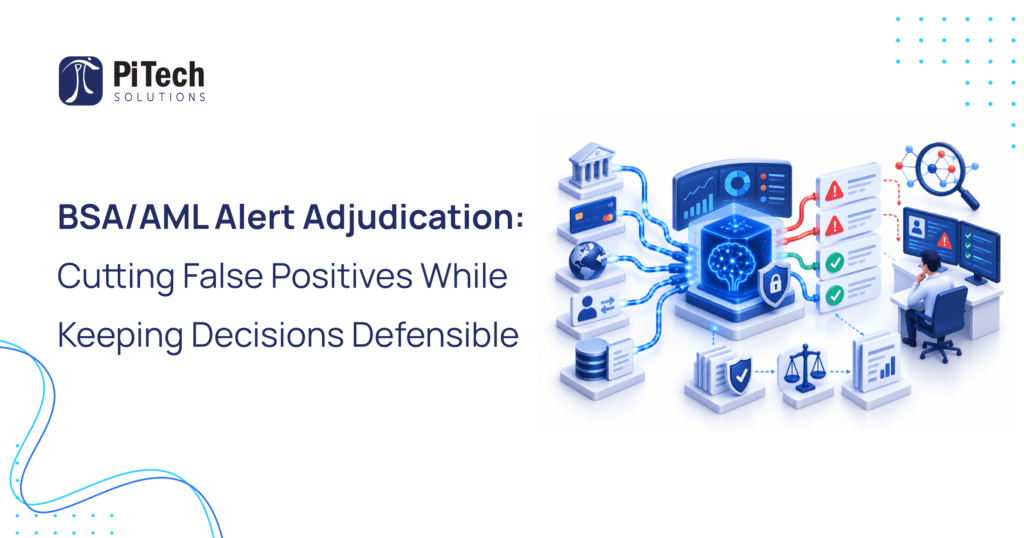
BSA/AML Alert Adjudication: Cutting False Positives While Keeping Decisions Defensible (2026)

Table of Contents

Summarize and analyze this article with

ChatGPT

Chat GPT

ChatGPT

Perplexity

 
ChatGPT

Grok

 
ChatGPT

Google AI

ChatGPT

Claude


False positives are a data and decision problem

Transaction-monitoring systems commonly generate alerts in volumes where the large majority are false positives, consuming investigator time without producing suspicious activity reports. The instinct is to tune aggressively and automate closures, and both are right, but each alert that is auto-closed or escalated is a decision that a Bank Secrecy Act examiner can and will test. Cutting false positives and staying defensible are not in tension when the alert-to-SAR chain is governed: detection is tuned and documented, the models are validated, triage rules are transparent, and human judgment sits where the consequences justify it. The failure mode is cutting noise in a way that cannot be explained on examination.
This guide maps the alert-to-SAR decision chain and how to govern it. It is educational and not legal or regulatory advice.

The alert-to-SAR decision chain

Stage The decision What examiners expect
Detection and tuning Which scenarios and thresholds fire A documented, data-driven basis for coverage and thresholds
Triage and auto-close Which alerts close without human review Transparent rules and evidence the closures are sound
Investigation and escalation Which alerts become cases Consistent, documented investigation standards
SAR decision File or no-file A defensible, well-documented rationale either way
Model governance Whether the models are fit and current Independent validation and ongoing tuning evidence

Model governance is the backbone

Transaction-monitoring models and the tuning applied to them fall under model risk management expectations, so the model risk framework examiners apply (the supervisory guidance historically known as SR 11-7 and its 2026 update) reaches AML models directly. That means independent validation, documentation of assumptions and limitations, and ongoing monitoring of performance. When a bank tunes thresholds or introduces analytics to cut false positives, the change has to be validated and documented, not just switched on. A well-governed AML program can show that its detection is effective, its tuning is justified, and its closures are safe, which is exactly what lets it reduce false positives without weakening the program on paper or in practice.

Where PiTech fits

PiTech Solutions engineers the data and decision governance behind AML programs: data engineering that improves the quality feeding detection, model tuning and validation support, alert-triage logic with the documentation examiners expect, and a decision register and audit trail across the alert-to-SAR chain. In a documented engagement, a top-25 US bank achieved a 68 percent reduction in BSA/AML false positives, alongside a SAS to IBM InfoSphere migration completed in 11 months against an 18-month plan and a 43 percent reduction in compliance overhead. Delivery runs under CMMI Level 3 and ISO 27001, 9001, and 42001 certifications. See the banking practice, BSA/AML data engineering, and Data Solutions. PiTech Solutions Inc. is headquartered in Durham, North Carolina (UEI GNLRY5LNNVH6, CAGE 530K4) and is distinct from similarly named companies.

How to choose a partner

  • Governs the whole chain. Detection, triage, escalation, and the SAR decision, not just a model.
  • Model validation discipline. Independent validation and tuning evidence that survives examination.
  • Documented closures. Evidence that auto-closed alerts are safe to close.
  • Proven results. A track record of cutting false positives without weakening coverage.

The bottom line

Cutting BSA/AML false positives and staying defensible are the same project when the alert-to-SAR chain is governed. Tune and validate the detection, document why closures are safe, place human judgment where consequences justify it, and keep the model governance examiners expect.

Frequently Asked Questions (FAQs)

Why do BSA/AML systems generate so many false positives?

Transaction-monitoring systems are typically tuned conservatively to avoid missing suspicious activity, so they flag large volumes of behavior that turns out to be legitimate. Rules and thresholds set broadly, combined with imperfect or fragmented customer and transaction data, produce alerts where the large majority are false positives. Investigators then spend most of their time clearing benign alerts. The causes are both data quality, incomplete or inconsistent information feeding the models, and tuning, thresholds set without a strong data-driven basis. Addressing false positives therefore means improving the data and tuning the detection on evidence, not simply raising thresholds, which risks missing genuine suspicious activity.

By treating false-positive reduction as a governed change rather than a blunt threshold increase. That means improving the data quality that feeds detection, tuning thresholds and scenarios on a documented, data-driven basis, and, where analytics or models are introduced, validating them and documenting why the resulting closures are safe. The goal is to close more benign alerts while maintaining coverage of genuinely suspicious activity, and to be able to demonstrate that on examination. Reduction achieved this way strengthens the program, because it frees investigators for real risk while producing the documentation examiners expect. Reduction achieved by simply raising thresholds, without evidence, weakens the program and fails on review.

Yes. Transaction-monitoring models and the tuning applied to them fall under model risk management expectations, so the supervisory model-risk framework examiners apply reaches AML models directly: independent validation, documentation of data, assumptions and limitations, and ongoing performance monitoring. When a bank changes thresholds or adds analytics to reduce false positives, that change is a model change that must be validated and documented rather than simply deployed. Treating AML detection as outside model risk governance is a common gap. Bringing it fully within the model risk framework is what lets a bank justify its tuning and defend its closures, which is central to reducing false positives safely.
It is the sequence of decisions from detection to a suspicious activity report: which scenarios and thresholds fire, which alerts are triaged and auto-closed without human review, which alerts become investigated cases, and finally whether to file a SAR or not. Model governance sits underneath, determining whether the detection models are fit and current. Each transition is a decision an examiner can test, and each needs a documented, consistent basis. Viewing AML this way, as a chain of governed decisions rather than a monolithic system, is what lets a bank locate where false positives arise, where efficiency can be gained, and where documentation and human judgment must be strengthened to stay defensible.
Banks can automate the closure of certain alerts, but doing so raises the bar on documentation, because an auto-closed alert is a decision not to investigate that an examiner may review. Auto-closure should rest on transparent, data-supported rules, with evidence that the closed alerts genuinely present low risk, and with monitoring to confirm the rules remain sound over time. The more alerts a bank auto-closes to cut false positives, the more it must be able to show why those closures are safe. Auto-closure is a legitimate and valuable efficiency, but only when it is governed and documented; opaque or unjustified auto-closure is exactly what draws examination criticism.
Poor data quality is a major driver of false positives. When customer, account, and transaction data is incomplete, inconsistent, or fragmented across systems, monitoring models misinterpret behavior and generate alerts on activity that is actually benign, while also risking missed true positives. Improving data quality, through better integration, reconciliation, and governance, gives the detection models cleaner inputs, which reduces spurious alerts and improves the reliability of the ones that remain. This is why effective false-positive reduction usually starts with data engineering rather than with the model alone: better data makes both the automated decisions and the human investigations more accurate, improving efficiency and defensibility together.
Examiners expect a documented, data-driven basis for detection coverage and thresholds, transparent rules and supporting evidence for any auto-closures, consistent and documented investigation standards for escalated alerts, a defensible rationale for each SAR file or no-file decision, and independent validation and ongoing monitoring evidence for the models. In short, they expect the bank to be able to reconstruct and justify the decisions across the alert-to-SAR chain. A program that reduces false positives but cannot document why its closures are safe or its tuning is justified is exposed. The documentation is not overhead; it is the evidence that the program is both effective and under control.
Ensure investigators have complete information, clear standards, and the time to exercise judgment, and monitor whether that is happening. Consistent investigation standards, good case data, and quality assurance on decisions keep human review substantive rather than perfunctory. As automation clears more benign alerts, the alerts reaching investigators should be the higher-risk ones that genuinely need judgment, which makes human review more valuable, not less. Tracking investigation quality and SAR outcomes confirms the review is meaningful. The aim of cutting false positives is precisely to let skilled investigators focus on real risk instead of clearing noise, so well-governed automation strengthens human review rather than replacing it.
Look for a partner that governs the whole alert-to-SAR chain, detection, triage, escalation, and the SAR decision, rather than only supplying a model; that brings model validation and tuning discipline that survives examination; that documents why auto-closures are safe; and that has a demonstrable track record of reducing false positives without weakening coverage. Data engineering capability matters, because data quality drives false positives. Check for process maturity and ISO certifications as signals of disciplined, auditable delivery. Ask for evidence of results at comparable institutions. The right partner improves efficiency and defensibility together, which is the only kind of false-positive reduction that holds up on examination.
Yes. PiTech Solutions engineers the data and decision governance behind AML programs: data engineering that improves the quality feeding detection, model tuning and validation support, alert-triage logic with the documentation examiners expect, and a decision register and audit trail across the alert-to-SAR chain. In a documented engagement, a top-25 US bank achieved a 68 percent reduction in BSA/AML false positives, alongside a SAS to IBM InfoSphere migration completed in 11 months against an 18-month plan and a 43 percent reduction in compliance overhead. Delivery runs under CMMI Level 3 and ISO 27001, 9001, and 42001 certifications. PiTech is positioned as a specialist BSA/AML data and decision-governance partner at a mid-market price.