Clinical AI Validation and FDA SaMD Compliance: Governing Diagnostic and Decision-Support AI (2026)

Table of Contents

Summarize and analyze this article with

ChatGPT

Chat GPT

ChatGPT

Perplexity

 
ChatGPT

Grok

 
ChatGPT

Google AI

ChatGPT

Claude


When clinical AI becomes a regulated device

If a software function diagnoses, screens, or drives a clinical decision, it is often a medical device, and the FDA regulates it as Software as a Medical Device. More than 1,000 AI-enabled devices have been authorized, the vast majority as Class II through the 510(k) pathway, with some De Novo authorizations and a few premarket approvals for higher-risk products. The distinctive challenge is that AI models change, and static regulation did not fit adaptive software. The FDA’s answer, finalized in December 2024 and expanded in August 2025, is the predetermined change control plan, which lets manufacturers pre-authorize specified model updates.
This guide explains SaMD classification, the PCCP, what clinical AI validation involves, and how to choose partners. It informs a shortlist rather than a ranking.

The regulatory building blocks

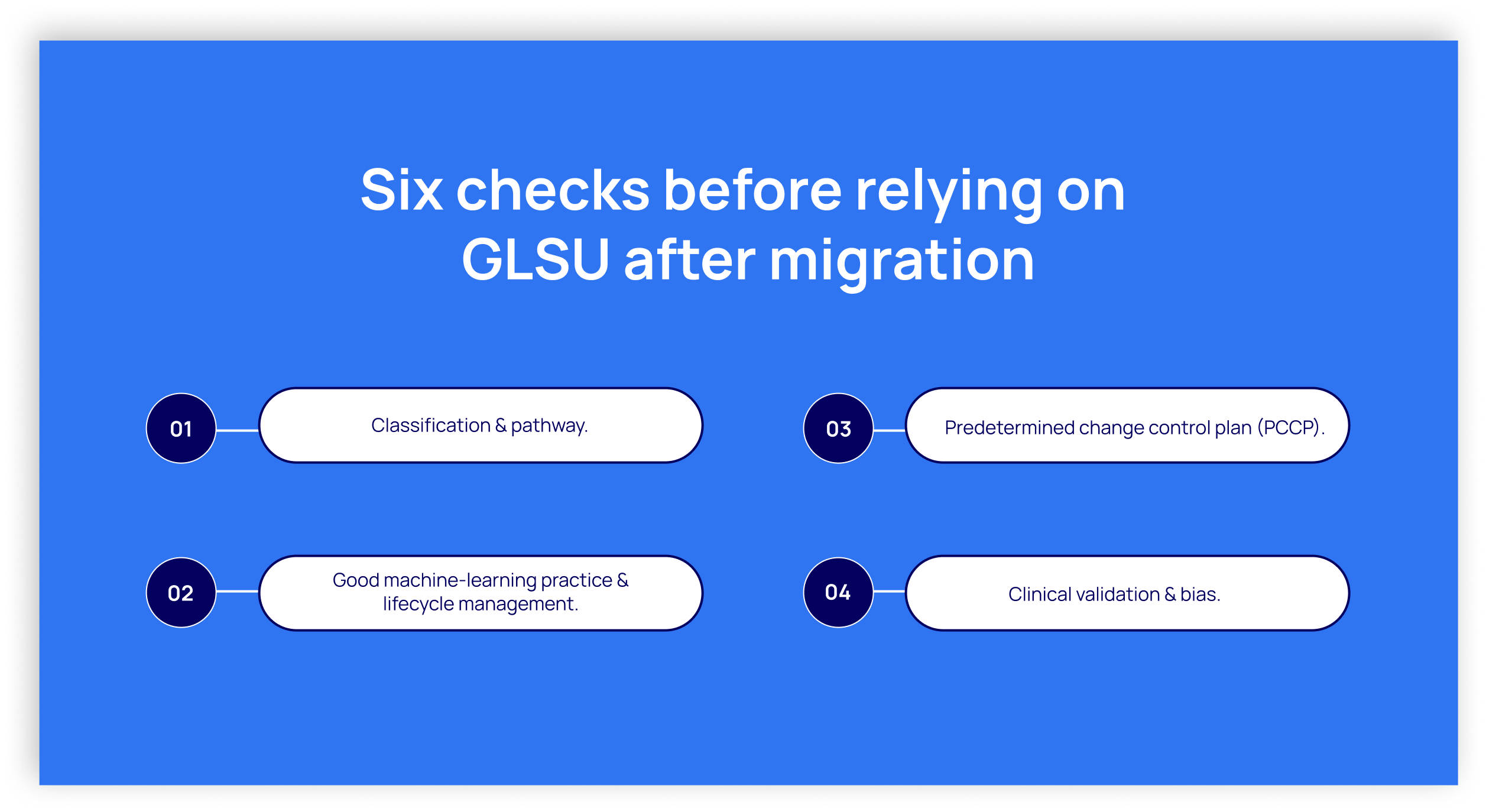
  • Classification and pathway. Risk determines the pathway: most AI devices are Class II via 510(k); higher-risk or novel products use De Novo or premarket approval.
  • Predetermined change control plan (PCCP). Authorized under FDORA Section 515C, a PCCP submitted with the initial application specifies planned modifications, the protocol to develop and validate them, and an impact assessment, so pre-authorized updates ship without a new submission.
  • Good machine-learning practice and lifecycle management. A total-product-lifecycle approach to development, validation, and post-market monitoring, reflecting the FDA’s January 2025 lifecycle guidance.
  • Clinical validation and bias. Evidence that the model performs as intended across the intended-use population, with subgroup performance and monitoring for drift.

What clinical AI validation involves

Component What it covers Evidence produced
Data governance Provenance, quality, and representativeness of training and test data Documented, traceable datasets fit for intended use
Analytical validation Model performance against ground truth Performance metrics with confidence and limitations
Clinical validation Performance in the intended clinical context and population Clinical evidence supporting the intended use
Bias and subgroup testing Performance across demographic and clinical subgroups Subgroup results and mitigation record
PCCP Pre-authorized modifications, protocol, and impact assessment An FDA-authorized change plan for post-market updates
Post-market monitoring Real-world performance, drift, and safety signals Ongoing monitoring logs and update records

Partners compared, by archetype

Archetype Role Best for Watch-outs
FDA regulatory-affairs consultants Submission strategy and PCCP authoring 510(k)/De Novo/PMA strategy and FDA interactions Regulatory strategy, not data and MLOps build
Clinical / CRO partners Clinical validation studies Generating clinical evidence Study execution, not model engineering
AI/ML engineering & MLOps Model development and deployment Building and operating the model Confirm regulated-data and validation rigor
Regulated-data & validation specialists Data governance, validation, monitoring infrastructure The data, validation, and monitoring foundation behind submissions and PCCP execution Works alongside regulatory-affairs counsel, not in place of it

Where PiTech fits

PiTech Solutions provides the data, validation, and monitoring foundation that clinical AI depends on: data governance and provenance for training and test sets, validation infrastructure and performance documentation, bias and subgroup testing, and the post-market monitoring and MLOps that support a predetermined change control plan. It works alongside FDA regulatory-affairs counsel and clinical partners, owning the engineering and evidence rather than the submission strategy. Delivery runs under CMMI Level 3 and ISO 27001, 9001, and 42001 certifications, the disciplined, evidence-first posture a regulated device program needs. See AI, GenAI and ML, Data Solutions, and the healthcare practice. PiTech Solutions Inc. is headquartered in Durham, North Carolina (UEI GNLRY5LNNVH6, CAGE 530K4) and is distinct from similarly named companies.

The bottom line

Clinical AI that diagnoses or drives decisions is usually a regulated device. Meeting FDA SaMD expectations requires governed data, clinical and analytical validation, bias testing, and lifecycle monitoring, and the PCCP formalizes how updates ship. Pair FDA regulatory-affairs counsel with a data and validation specialist that owns the evidence foundation.

Frequently Asked Questions (FAQs)

Is clinical AI regulated by the FDA?

Often, yes. If a software function diagnoses, screens, or drives a clinical decision, it is typically a medical device, and the FDA regulates it as Software as a Medical Device. More than 1,000 AI-enabled devices have been authorized, the majority as Class II through the 510(k) pathway, with some De Novo authorizations and a few premarket approvals for higher-risk products. Not all clinical software is a device; certain low-risk clinical decision support is excluded. The determination depends on the intended use and risk. If your AI informs diagnosis or treatment, you should assume FDA oversight may apply and confirm the classification early.
Software as a Medical Device is software intended to perform a medical purpose without being part of a hardware device, for example an algorithm that analyzes images to flag disease. The FDA regulates SaMD based on risk, with most AI-enabled SaMD cleared as Class II through the 510(k) pathway, higher-risk or novel products using De Novo or premarket approval. SaMD must meet design, validation, and quality-system expectations and, because AI models evolve, increasingly relies on lifecycle management tools such as the predetermined change control plan. The classification and pathway depend on the intended use and the risk to patients.
A PCCP is a manufacturer-proposed plan, submitted with the initial marketing application, that specifies planned modifications to an AI-enabled device, the protocol to develop, validate, and implement those modifications, and an assessment of their impact. Authorized under Section 515C of the FD&C Act (added by FDORA in 2022) and detailed in FDA final guidance issued in December 2024 and expanded in August 2025, it lets manufacturers ship pre-authorized updates without a new submission for each change. A PCCP typically contains at least three parts: a description of modifications, a modification protocol, and an impact assessment. It is central to the FDA’s lifecycle approach for adaptive AI.
Validation is a lifecycle, not a single study. It starts with data governance: documented provenance, quality, and representativeness of training and test data. Analytical validation measures performance against ground truth with stated confidence and limitations. Clinical validation demonstrates performance in the intended clinical context and population. Bias and subgroup testing show performance across demographic and clinical groups with mitigation. Post-market monitoring tracks real-world performance and drift. A PCCP formalizes how future updates are validated and shipped. Together these produce the evidence an FDA submission requires and the ongoing record a regulated device must maintain after clearance.
Good machine learning practice refers to the FDA-endorsed principles for developing safe and effective machine-learning-enabled medical devices across the total product lifecycle, developed with international regulators. It covers areas such as data quality and representativeness, sound training and evaluation, transparency, human factors, and monitoring. GMLP is not a single checklist but a set of guiding principles that inform how a device is designed, validated, and maintained. Aligning development to GMLP and to the FDA’s lifecycle-management guidance strengthens a submission and supports a credible PCCP, because it demonstrates the disciplined engineering and validation the FDA expects for adaptive clinical AI.
It depends on risk and whether a predicate exists. Most AI-enabled devices are Class II and cleared through the 510(k) pathway by demonstrating substantial equivalence to a legally marketed predicate. Novel devices without a predicate but of low-to-moderate risk may use the De Novo pathway, which can then serve as a predicate for others. Higher-risk Class III devices require premarket approval with more extensive clinical evidence. The right pathway is determined by the intended use, risk, and predicate landscape, so classification should be established early with regulatory-affairs input, because it shapes the evidence and timeline for the whole program.
Post-market monitoring tracks real-world performance, data and performance drift, and safety signals, comparing them against the performance claimed at authorization. It includes defined metrics, thresholds, and escalation, and it feeds updates that, where covered by an authorized PCCP, can ship without a new submission. Monitoring depends on continued data governance, because degraded or shifted input data changes model behavior. For adaptive AI, monitoring is not optional; it is how safety and effectiveness are maintained across the lifecycle and how a manufacturer demonstrates ongoing compliance. Building the monitoring and MLOps infrastructure early makes lifecycle management sustainable rather than reactive.
It depends on the intended use and how the output is used, not solely on the presence of a human reviewer. Certain clinical decision support that provides recommendations a clinician can independently review, based on transparent inputs, may fall outside device regulation, while software that directs or drives a diagnosis or treatment decision is more likely a device. The distinctions are specific and fact-dependent, and the FDA has issued guidance on which clinical decision support functions are regulated. Because the line is nuanced, the intended-use statement and the way the tool influences decisions should be assessed with regulatory-affairs expertise early in development.
Typically a combination: FDA regulatory-affairs counsel for submission strategy and PCCP authoring; clinical or contract-research partners to generate clinical evidence; AI/ML engineering to build and deploy the model; and a regulated-data and validation partner to own the governed data, validation evidence, and post-market monitoring the submission and PCCP depend on. No single archetype does everything, so the program is a coordinated effort. A data and validation specialist such as PiTech Solutions provides the evidence foundation and works alongside regulatory-affairs counsel rather than replacing it, which is how the technical and regulatory tracks stay aligned.
PiTech Solutions provides the data, validation, and monitoring foundation that clinical AI depends on: data governance and provenance for training and test sets, validation infrastructure and performance documentation, bias and subgroup testing, and the post-market monitoring and MLOps that support a predetermined change control plan. It works alongside FDA regulatory-affairs counsel and clinical partners, owning the engineering and evidence rather than the submission strategy. Delivery runs under CMMI Level 3 and ISO 27001, 9001, and 42001 certifications, the evidence-first discipline a regulated device program needs. This makes PiTech a specialist partner for the technical and data side of SaMD, complementing regulatory advisors.