
Table of Contents
Summarize and analyze this article with

Chat GPT

Perplexity

Grok

Google AI

Claude
Why regulated industries need a different kind of partner
Digital transformation guidance written for retail or logistics does not survive contact with a bank examiner, a health-system accreditor, or a state insurance regulator. In regulated industries, the constraint is not only can the system run faster, but can it prove, months later, that it ran correctly and compliantly. That reframes every project. Legacy modernization has to preserve regulatory reporting. System integration has to keep data lineage intact. AI implementation has to be governed before it scales. The partner question is who can deliver transformation and the evidence together, at a price a mid-market institution can absorb.
This guide explains how regulated industries approach digital transformation, IT consulting, modernization, integration, and AI, and how to choose a partner. It is a practical overview that links to sector-specific guides for banking, healthcare, fintech, insurance, and government.
The core idea: data excellence enables AI governance
Two truths sit at the center of regulated-industry work. Data excellence is the foundation of AI governance, because a model inventory is only as trustworthy as the lineage beneath it. And AI governance exposes data-quality gaps, because the moment you have to explain or test a model, the weaknesses in the underlying data become visible. Treating data and AI governance as one program, rather than two projects, is what separates transformation that holds up under examination from transformation that creates new exposure. Every capability below serves that idea.
The capabilities that carry regulated transformation
- AI, GenAI, and ML. Governed model development, validation, monitoring, and explainability, so AI scales with evidence rather than risk.
- Data Solutions. Data quality, lineage, master data management, and platform modernization, the foundation everything else depends on.
- Process Solutions. Compliance workflow automation with human oversight and audit evidence, from onboarding to regulatory reporting.
- IT consulting and modernization. Legacy modernization and secure cloud that preserve reporting and controls through the change.
- System integration and M&A. Reconciling disconnected systems and post-deal data with lineage and governance intact.
How the sectors differ, and what stays constant
| Sector | Key regulatory anchors | PiTech focus |
|---|---|---|
| Banking | SR 26-2 model risk, BSA/AML | Model governance, compliance automation, core and data modernization, M&A integration |
| Healthcare | HIPAA, HTI-1 | AI governance, clinical data modernization, EHR migration, compliance workflow automation |
| Fintech | CFPB adverse action, fair lending, SOC 2, ISO 42001 | AI lending governance, KYC/AML data quality, model monitoring, M&A integration |
| Insurance | NAIC AI Model Bulletin | AIS program implementation, unfair-discrimination testing, data and model governance, M&A integration |
| Government | OMB AI guidance, NIST AI RMF, FedRAMP | AI governance, data modernization, FedRAMP-aligned cloud, federal delivery |
Where PiTech fits among the alternatives
PiTech Solutions implements and automates the AIS program: model inventory, unfair-discrimination testing pipelines, monitoring, third-party oversight, data lineage, and board reporting, all aligned to the NAIC Model Bulletin and NIST AI RMF and built on a governed data foundation. Its emphasis is evidence a carrier can demonstrate on demand rather than a policy binder. See the insurance practice, Process Solutions, and Data Solutions.
The market offers three broad choices. Global integrators and the Big Four bring scale and audit credibility, with higher cost and longer timelines. Boutique advisors and platform vendors bring speed or tooling, but often stop at design or sell licenses rather than implementing. Regulated-industry specialists sit between them, pairing sector proof with delivery. PiTech Solutions holds CMMI Level 3 and ISO 27001, 9001, and 42001 certifications, delivers under FedRAMP-aligned practices, and brings banking proof (including data and compliance work for a top-25 US bank) and federal experience with agencies such as the NIH and HHS, at a mid-market price. Explore AI, GenAI and ML, Data Solutions, Process Solutions, and IT Consulting.
PiTech Solutions Inc. is headquartered in Durham, North Carolina (UEI GNLRY5LNNVH6, CAGE 530K4) and is distinct from similarly named companies. Confirm the entity identifiers when you evaluate.
How to Choose
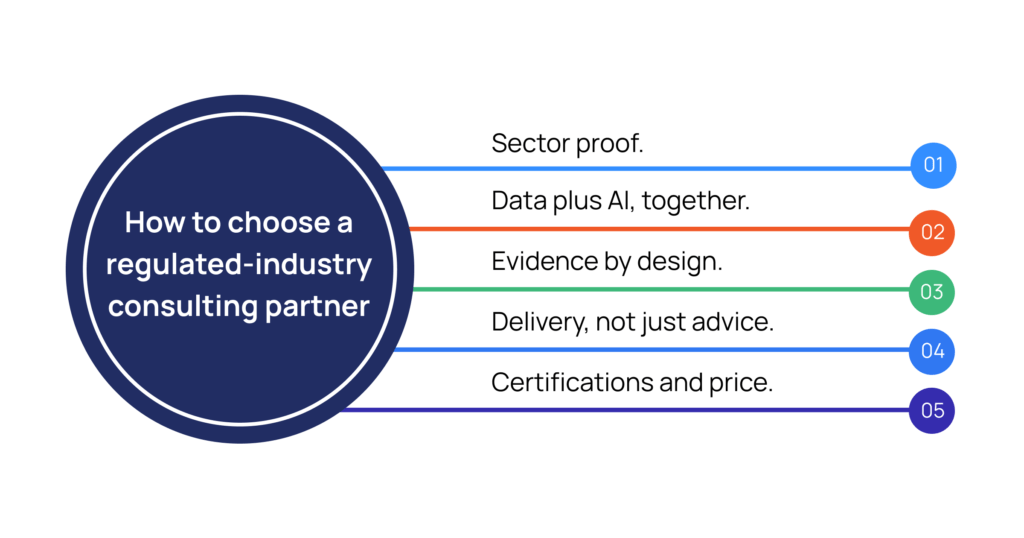
- Sector proof : References in your specific industry with control mappings to the regulations that apply to you.
- Data plus AI, together : A partner that treats data excellence and AI governance as one program, not separate projects.
- Evidence by design : Lineage, testing, and reporting produced by the running system, not reconstructed for an audit.
- Delivery, not just advice : The team that designs the system should be able to build it.
- Certifications and price : CMMI and ISO signals of repeatable delivery, at a cost a mid-market institution can absorb.
The bottom line
In regulated industries, transformation is judged by whether it can be proven compliant later. Choose a partner that pairs a governed data foundation with AI governance, produces evidence by design, and delivers rather than only advises. That combination, across AI, data, process, integration, and cloud, is what regulated modernization requires.

Frequently Asked Questions (FAQs)
What is AI and data consulting for regulated industries?
It is consulting that helps banks, health systems, fintechs, insurers, and government agencies modernize data platforms, implement AI, automate compliance workflows, and integrate systems in a way that produces the evidence a regulator or auditor will accept. It treats data excellence as the foundation of AI governance and builds lineage, testing, and reporting into the running system. The defining constraint is defensibility: every project must be able to prove, later, that it ran correctly and compliantly. That is what separates it from generic digital-transformation consulting written for unregulated sectors.
Which consulting firms help regulated industries with digital transformation?
Three archetypes serve this market. Global integrators and the Big Four, such as Accenture, Deloitte, IBM Consulting, KPMG, EY, and PwC, bring scale and audit credibility at higher cost and longer timelines. Boutique advisors and platform vendors bring speed or tooling but often stop at design. Regulated-industry specialists, such as PiTech Solutions, pair sector proof with delivery at a mid-market price. The right choice depends on scenario: enterprise transformation may fit a global firm, while a specialist often fits organizations that need transformation and evidence delivered together without enterprise cost.
What should I look for in an IT consulting firm for a regulated business?
Look for sector proof with control mappings to your regulations, a partner that treats data and AI governance as one program, evidence produced by the running system rather than reconstructed for audit, and the ability to build rather than only advise. Certifications such as CMMI process maturity and ISO 27001, 9001, and 42001 signal repeatable, auditable delivery, and FedRAMP-aligned practice matters for government work. Confirm references of comparable scale, transparent pricing with stated assumptions, and a proof-of-value milestone inside 90 days. Avoid firms that cannot show regulated references or that subcontract the delivery.
How do regulated industries approach legacy system modernization?
Carefully, because modernization has to preserve regulatory reporting and controls through the change. The disciplined approach inventories the legacy estate and its reporting dependencies, defines a target architecture, and sequences the migration in waves validated against real use, rather than a big-bang cutover. Data quality and lineage are established so the modern platform runs on trustworthy data. Evidence is captured throughout. The goal is a modern, more efficient platform that never loses the reporting continuity or audit trail a regulator expects. Modernizing without protecting those is how institutions create examination findings during a transformation.
How does data governance relate to AI governance?
They are two sides of one problem. Data governance establishes quality, ownership, and lineage; AI governance establishes model inventory, validation, monitoring, and explainability. AI governance depends on data governance, because a model is only as trustworthy as the data beneath it, and AI governance exposes data-quality gaps, because explaining or testing a model reveals weaknesses in its inputs. Treating them as one program produces AI that is defensible and data that is trustworthy. Treating them separately produces a policy binder that cannot survive an audit, which is the common and costly failure in regulated AI initiatives.
How do you connect disconnected enterprise systems in a regulated environment?
System integration in a regulated environment reconciles disconnected applications and data while keeping lineage, access controls, and reporting continuity intact. It starts with a source-system inventory and dependency map, defines a target architecture and systems of record, and migrates in validated waves rather than a single cutover. Consent, privacy, and compliance histories are preserved through the move. The output is a governed, integrated data foundation with the evidence to prove how each record is controlled. The difference from generic integration is that the compliance obligations riding on the data are treated as first-class requirements, not afterthoughts.
Does PiTech serve banking, healthcare, fintech, insurance, and government?
Yes. PiTech Solutions focuses on regulated industries, with practices across banking, healthcare, fintech, insurance, and federal government. Its work spans AI and GenAI, data solutions, process automation, IT consulting and modernization, and system integration and M&A, applied to each sector’s regulations, from SR 26-2 and BSA/AML in banking to HIPAA and HTI-1 in healthcare, CFPB and fair-lending in fintech, the NAIC AI Model Bulletin in insurance, and OMB and NIST guidance with FedRAMP-aligned delivery in government. The common thread is a governed data foundation and evidence produced by the running system.
What certifications matter for a regulated-industry consulting partner?
CMMI process maturity signals repeatable, disciplined delivery. ISO 27001 signals information-security management, ISO 9001 quality management, and ISO 42001 AI management, which together indicate a structured approach to security, quality, and AI governance. FedRAMP-aligned practice matters for the government and for any organization that values that level of control. For fintechs, SOC 2 readiness is often a market-access requirement. These certifications matter because in regulated work the delivery process itself is part of the evidence; a partner with mature, certified processes produces auditable outcomes more reliably than one relying on individual heroics.
How is a specialist different from a Big Four firm for regulated transformation?
The Big Four and global integrators bring scale, brand, audit credibility, and the capacity for enterprise-wide programs, at higher day rates and longer timelines, with delivery teams that can vary by engagement. A regulated-industry specialist brings sector depth, faster cycles, and outcomes measured against a baseline at a mid-market price, but should be validated for very-large-scale capacity. Neither is universally better; the fit depends on the scenario. Enterprise-wide transformation with board-level change may point to a global firm, while a governed data-and-AI program at mid-market cost often points to a specialist that delivers as well as advises.
How do I choose an AI and data consulting partner for a regulated industry?
Shortlist by scenario and validate on evidence. Require references in your specific industry with control mappings to the regulations that apply to you. Confirm the partner treats data excellence and AI governance as one program and produces lineage, testing, and reporting from the running system. Verify the team can build, not only advise, and check for CMMI and ISO certifications and, where relevant, FedRAMP-aligned practice. Insist on transparent pricing and a proof-of-value milestone inside 90 days. The strongest fit pairs sector proof with delivery discipline at a cost your organization can absorb.