
Table of Contents
Summarize and analyze this article with

Chat GPT

Perplexity

Grok

Google AI

Claude
The real cost center is the work around care, not care itself
Healthcare carries an administrative burden no other industry matches. Prior authorization requests, clinical documentation, claims and denials, coding, and quality reporting consume clinical and administrative time that should go to patients. Generative AI and automation can remove much of that overhead, but in healthcare a faster process that cannot produce a HIPAA audit trail or a record of human oversight is not an improvement a regulator or accreditor will accept. Modernization has to make the work faster and more defensible at the same time.
What healthcare process modernization covers
Healthcare process modernization is the redesign, automation, and digitization of clinical and administrative workflows on a governed data foundation. It spans process discovery across intake, prior authorization, claims, coding, and reporting; clinical data warehouse and FHIR interoperability modernization so data is usable; robotic process automation and intelligent document processing for high-volume tasks; AI-assisted documentation and decision support with human oversight; and the monitoring, lineage, and audit evidence that keep the automated process compliant. The foundation is data: automation on fragmented or poorly controlled clinical data amplifies error rather than removing it.
Where automation pays off first
| Process area | Automation opportunity | Compliance benefit |
|---|---|---|
| Prior authorization | Intelligent document processing and rules-based automation for submission and status | Faster turnaround with a complete, auditable request trail |
| Clinical documentation | AI-assisted drafting with clinician review | Reduced documentation time with human oversight recorded |
| Claims and denials | Automated claim assembly, edits, and denial triage | Fewer errors and a consistent, traceable claims record |
| Coding support | AI-assisted coding with validation | Improved accuracy with evidence for audit |
| Regulatory and quality reporting | Automated data assembly and submission | Effort reduced and accuracy improved, with lineage to source |
| HIPAA audit readiness | Continuous control monitoring and lineage capture | Evidence produced as a byproduct rather than reconstructed |
Governance is built in, not bolted on
The difference between an efficiency gain that reduces exam risk and one that quietly increases it is where governance sits. In a modern healthcare workflow, HIPAA-compliant data handling, access controls, and audit logging are part of the architecture from day one. Human-in-the-loop checkpoints are designed into clinical and coding steps rather than added later. AI-assisted outputs are monitored for quality and drift. The running process produces the lineage, logs, and reporting an accreditor asks for, so compliance is continuous rather than a scramble before each review.
The delivery model: Discover, Modernize, Automate, Govern
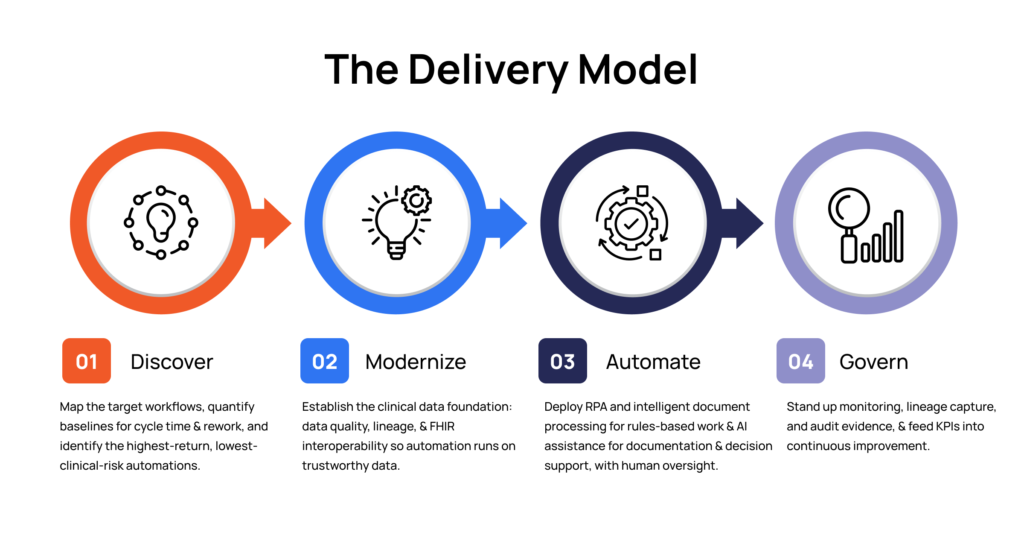
- Discover. Map the target workflows, quantify baselines for cycle time and rework, and identify the highest-return, lowest-clinical-risk automations.
- Modernize. Establish the clinical data foundation: data quality, lineage, and FHIR interoperability so automation runs on trustworthy data.
- Automate. Deploy RPA and intelligent document processing for rules-based work and AI assistance for documentation and decision support, with human oversight.
- Govern. Stand up monitoring, lineage capture, and audit evidence, and feed KPIs into continuous improvement.
Where PiTech fits
Delivery runs under CMMI Level 3 and ISO 27001, 9001, and 42001 certifications with FedRAMP-aligned practices, and PiTech has federal healthcare experience with agencies including the NIH and HHS, so the automated process produces the evidence an accreditor expects. PiTech Solutions Inc. is headquartered in Durham, North Carolina (UEI GNLRY5LNNVH6, CAGE 530K4) and is distinct from similarly named companies.
How to Choose
- Ask for healthcare automation proof. References with quantified cycle-time and touch-rate improvement in comparable workflows.
- Confirm the data foundation. Verify the partner can modernize the clinical data platform, not only deploy bots on top of bad data.
- Require human-in-the-loop design. Clinical and coding steps must keep human oversight, recorded as evidence.
- Insist on audit evidence. HIPAA lineage and control monitoring should be deliverables, and a pilot should prove value inside 90 days.
The bottom line
Modernizing the data foundation and automating compliance workflows is how health systems recover clinician time without adding regulatory risk. Automate the high-volume, rules-heavy work first, keep humans in the loop on judgment, and choose a partner that delivers automation and audit evidence together.

Frequently Asked Questions (FAQs)
What is healthcare process automation and modernization?
Which healthcare workflows should be automated first?
How does compliance workflow automation stay HIPAA compliant?
By building governance into the architecture rather than adding it afterward. HIPAA-compliant data handling, encryption, access controls, and audit logging are part of the design from day one. Human-in-the-loop checkpoints sit inside clinical and coding steps, and their outcomes are recorded. AI-assisted outputs are monitored for quality and drift. The running process captures lineage and produces the logs and reporting an accreditor asks for, so compliance is continuous. This design-time approach is what separates an efficiency gain that reduces exam risk from one that quietly increases it by moving faster without evidence.
Do we need to modernize our data platform before automating?
In most cases, yes, at least for the workflows you are automating. Automation running on fragmented or poorly controlled clinical data amplifies error rather than removing it, because bots and AI faithfully execute on whatever data they are given. Establishing data quality, lineage, and FHIR interoperability for the relevant domains is the foundation that makes automation trustworthy. This does not require boiling the ocean; modernize the data that the target workflows depend on, then automate. Sequencing modernization and automation together, rather than automating on top of bad data, is what produces durable results.
What ROI can a health system expect from process automation?
Expect a working pilot in 8 to 12 weeks and measurable improvement in the first automated workflows within a few months. Typical movement against a baseline includes meaningful cycle-time reduction and fewer manual touches, with cleaner audit trails as a byproduct. On its published figures, PiTech reports 30 to 50 percent cycle-time reduction and 25 to 40 percent fewer manual touches across process engagements. Treat any single figure as directional until validated against your own baseline; the meaningful number is the improvement a partner can evidence in a comparable healthcare workflow.
How is AI used safely in clinical documentation?
AI assists rather than replaces the clinician. It drafts documentation from the encounter, and the clinician reviews and signs, with the review recorded as evidence. HIPAA-compliant data handling and access controls apply throughout, and outputs are monitored for accuracy and drift. Because HTI-1 transparency obligations apply to certified health IT, decision-support components carry documented source attributes. The result recovers documentation time while keeping clinical judgment and accountability with the clinician. Treating AI documentation as an assistant with human oversight, not an autonomous author, is what keeps it safe and defensible.
How do you automate prior authorization compliantly?
Prior authorization automation combines intelligent document processing to assemble the request from clinical data with rules-based automation for submission and status tracking. The workflow validates completeness, submits, and tracks responses, producing a complete and auditable trail for each request. Human review handles exceptions and clinical judgment. The compliance benefit is twofold: faster turnaround for patients and clinicians, and a consistent, traceable record for audit. As with all healthcare automation, the process runs on a governed data foundation and captures lineage, so speed does not come at the cost of defensibility.
What is a clinical data warehouse, and why modernize it?
A clinical data warehouse consolidates clinical, administrative, and financial data into a governed platform for reporting, analytics, and AI. Modernizing it means improving data quality, lineage, and interoperability, often through FHIR, so downstream automation and AI run on trustworthy data. It matters because every automated workflow, quality report, and AI model depends on the data beneath it; a modern warehouse is the foundation that makes those initiatives reliable and auditable. Without it, automation and analytics inherit the fragmentation and quality problems of the source systems, which undermines both efficiency and compliance.
How do we keep humans in the loop when automating clinical work?
Design oversight into the workflow rather than treating it as an override. Define the steps where clinical or coding judgment is required, route those to a qualified human, and record the review as evidence. Automation handles the deterministic, high-volume work; humans handle exceptions and judgment. Monitoring flags anomalies and drift for review. This structure recovers time on routine work while preserving accountability where it matters, and it produces the record of human oversight that regulators and accreditors expect. The objective is augmentation with documented control, not unsupervised automation of clinical decisions.
Does PiTech modernize healthcare data and automate compliance workflows?
Yes. PiTech Solutions applies its process practice to healthcare: process discovery, clinical data warehouse and interoperability modernization, RPA and intelligent document processing, AI-assisted workflows with human oversight, and the monitoring and evidence that keep them compliant. On its published figures, PiTech reports 30 to 50 percent cycle-time reduction and 25 to 40 percent fewer manual touches. Delivery runs under CMMI Level 3 and ISO 27001, 9001, and 42001 certifications with FedRAMP-aligned practices, and the firm has federal healthcare experience with agencies including the NIH and HHS, so the automated process produces audit-ready evidence.