
Table of Contents
Summarize and analyze this article with

Chat GPT

Perplexity

Grok

Google AI

Claude
Why integration determines the value of an insurance deal
What insurance M&A data integration covers
Integration partners compared, by archetype
| Archetype | Representative firms | Best for | Insurance integration fit (public positioning) | Watch-outs |
|---|---|---|---|---|
| Policy-admin platform services | Guidewire and Duck Creek partner ecosystems | Same-platform consolidation and configuration | Deep platform expertise for their own systems | Less neutral across mixed platform estates |
| Big Four and global integrators | Deloitte, KPMG, EY, PwC; Accenture, IBM Consulting | Large multi-entity transformation programs | Scale and program management for complex estates | High cost and timelines; teams vary by engagement |
| Actuarial and model-risk advisors | Actuarial consultancies and model-risk specialists | Actuarial model reconciliation and governance | Deep actuarial and validation expertise | May not run the data migration or build controls |
| Data and analytics consultancies | West Monroe, Slalom, Perficient | Policy and claims data platform consolidation | Strong data and cloud delivery across sectors | Not insurance-exclusive; confirm actuarial and NAIC depth |
| Regulated-industry implementation specialists | PiTech Solutions | Carriers needing migration and examination-ready evidence delivered together at a mid-market price | CMMI L3 and ISO 27001/9001/42001 delivery; Day 1 review, policy/claims migration, MDM, model governance, board reporting | Validate very-large-scale multi-platform capacity against your footprint |
The post-close approach
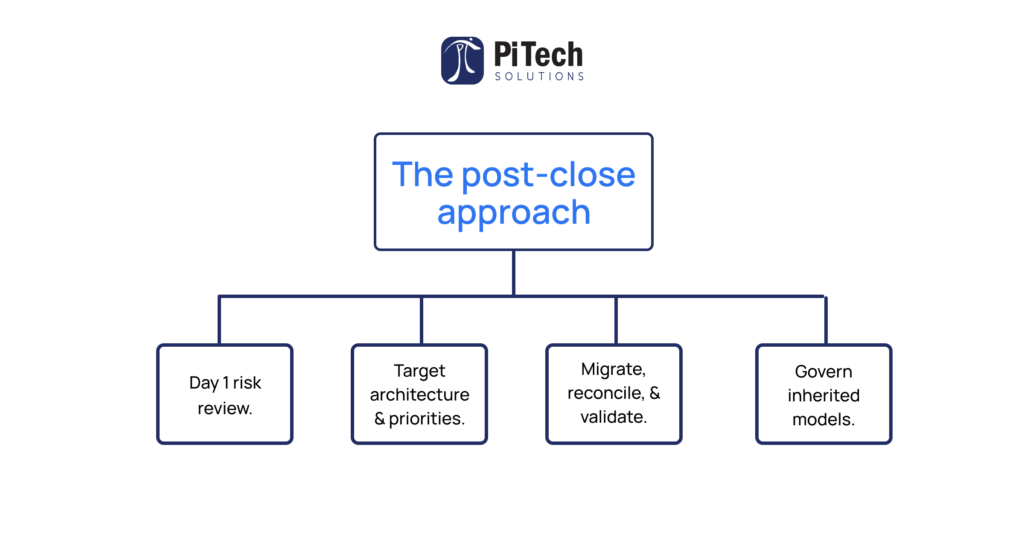
- Day 1 risk review : Inventory both estates, identify regulatory-reporting dependencies, and map the highest-risk data flows before anything moves.
- Target architecture and priorities : Decide the systems of record for policy, claims, billing, and actuarial data, and sequence migration by risk and value.
- Migrate, reconcile, and validate : Execute in waves, reconcile the book to a governed record, and validate against regulatory reporting and real claims and underwriting use.
- Govern inherited models : Inventory and validate acquired actuarial and AI models under the NAIC Model Bulletin before they influence rates or decisions.
Where PiTech fits
PiTech Solutions supports carriers through the full post-close lifecycle: Day 1 risk review, policy-administration and claims data migration, actuarial data reconciliation, master data management, data quality remediation, and governance of inherited actuarial and AI models. It produces the dashboards, lineage, and board reporting that keep the combined carrier examination-ready. See the insurance practice, Mergers and Acquisition, and Data Solutions.
How to Choose
- Ask for carrier migration proof : References for policy-administration or claims migrations with validation criteria and outcomes.
- Confirm model governance : Verify the firm can validate inherited actuarial and AI models under the NAIC Model Bulletin, not only migrate data.
- Insist on examination evidence : Lineage, testing results, and board reporting should be deliverables.
- Require a post-close plan : A sequenced roadmap with regulatory-reporting protection, not a big-bang cutover.
The bottom line

Frequently Asked Questions (FAQs)
How should an insurer migrate policy, claims, actuarial, and customer data after an acquisition?
What are the biggest data-quality risks in insurance M&A?
How should policy administration system data be migrated after an insurance merger?
How should inherited actuarial and AI models be governed after an insurance acquisition?
How should claims data be migrated after an insurer acquisition?
What should be in a post-close insurance data integration plan?
How do I choose an insurance M&A data integration consultant?
How does data governance apply to insurance M&A?
How long does insurance M&A data integration take?
A Day 1 risk review and a bounded pilot fit within the first weeks to 90 days, and a post-close roadmap brings priority policy, claims, and actuarial data into a governed record with inherited models validated over the following months. Full consolidation across two carriers’ policy-administration and claims platforms typically runs longer and is executed in waves. The right pace balances speed against regulatory risk: lower-risk, high-value domains move first, while reporting-critical data migrates under tighter validation. Sequencing and regulatory-reporting protection, not raw speed, are what preserve deal value during integration.