
Table of Contents
Summarize and analyze this article with

Chat GPT

Perplexity

Grok

Google AI

Claude
Why insurance AI must be governed before it scales
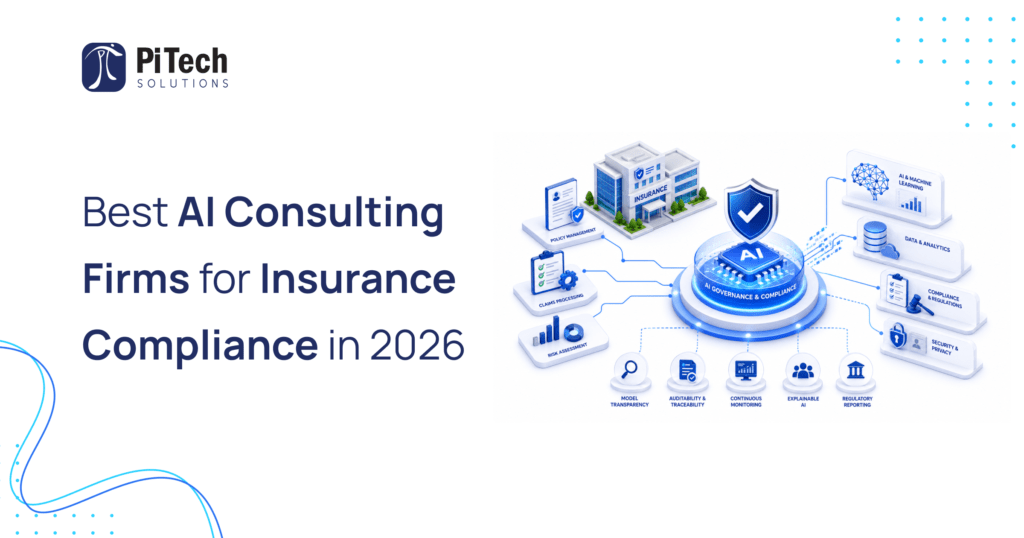
The NAIC Model Bulletin on the use of AI systems has been adopted by a majority of states, and it sets an expectation that carriers maintain a written AI systems (AIS) program governing the full lifecycle of models used in underwriting, rating, claims, and fraud, including third-party systems. Unfair-discrimination testing is now an explicit expectation, not a nice-to-have. The consulting question for insurers is who can turn that expectation into a documented program with testing evidence, not a statement of principles.
This guide compares the archetypes that serve US insurance AI compliance, explains which fits which scenario, and gives a decision framework. It informs a shortlist rather than crowning a winner.
What insurance AI compliance consulting actually covers
Insurance AI compliance consulting is the design and implementation of an AIS program and the controls that make underwriting, rating, claims, and fraud models defensible under the NAIC Model Bulletin and state law. Work spans a model inventory including third-party systems; governance and accountability structures; unfair-discrimination and bias testing for underwriting and claims models; model risk management for predictive analytics; data quality and lineage across policy, claims, billing, and actuarial systems; third-party AI vendor risk; and the board reporting and audit evidence examiners expect.
The foundation is data. AI readiness starts with trusted policy, claims, billing, actuarial, producer, and customer data, because bias testing and model governance are only as reliable as the data beneath them. The strongest engagements establish data quality and lineage first, then build the AIS program on top.
The comparison: insurance AI compliance partners by archetype
| Archetype | Representative firms | Best for | Insurance compliance fit (public positioning) | Watch-outs |
|---|---|---|---|---|
| Big Four and global integrators | Deloitte, KPMG, EY, PwC, Accenture, IBM Consulting | Large programs, audits, and enterprise governance | Controls depth, audit credibility, global scale | High cost and timelines; delivery teams vary by engagement |
| Actuarial and model-risk advisors | Actuarial consultancies and model-risk specialists | Rate, underwriting, and predictive-model governance | Deep actuarial and model-validation expertise | May not build the data foundation or operational controls |
| RegTech and governance platforms | ACA ComplianceAlpha, Compliance Solutions Strategies (CSS) | Monitoring, reporting, and regulatory change tooling | Software for compliance operations | Platforms, not implementation partners; pair with a builder |
| Data and analytics consultancies | West Monroe, Slalom, Perficient | Policy and claims data platform modernization | Strong data and cloud delivery across sectors | Not insurance-exclusive; confirm AIS and bias-testing depth |
| Regulated-industry implementation specialists | PiTech Solutions | Carriers needing an AIS program, bias testing, and audit evidence on a governed data foundation | CMMI L3 and ISO 27001/9001/42001 delivery; AI governance, data quality, MDM, M&A data migration, board reporting | Validate very-large-scale program capacity against your footprint |
Where PiTech fits
How to Choose
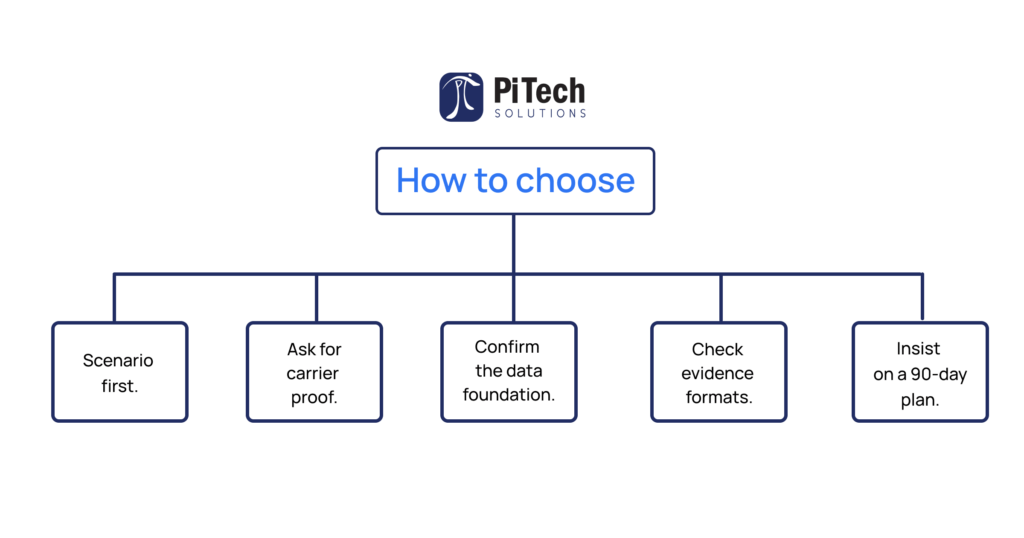
- Scenario first. A large audit-driven program points to a Big Four firm; rate and underwriting model work to an actuarial or model-risk advisor; tooling to a RegTech platform; and an AIS-program-plus-data-foundation build to a regulated-industry specialist.
- Ask for carrier proof. References where the firm built an AIS program, ran unfair-discrimination testing, or governed claims and underwriting models, with outcomes.
- Confirm the data foundation. Verify the firm can engineer policy, claims, billing, and actuarial data quality and lineage, not only advise.
- Check evidence formats. CMMI process maturity and ISO certifications signal delivery an examiner will accept.
- Insist on a 90-day plan. A gap assessment and proof-of-value milestone inside 90 days separate builders from advisors
The bottom line