Table of Contents
Summarize and analyze this article with

Chat GPT

Perplexity

Grok

Google AI

Claude
Why healthcare AI governance is now an operating requirement
Healthcare AI has outgrown HIPAA. Clinical decision support, ambient documentation, and payer models are in production, but the governance around them was built for an analog era. The proposed HIPAA Security Rule revisions, the HTI-1 algorithm transparency requirements for certified health IT, and a growing set of state laws now sit on top of the original framework rather than inside it. The consulting question has shifted from who can build the model to who can make the model defensible at the bedside, in audit, and in court.
This guide compares the firm archetypes that serve US healthcare AI and data governance, explains which fits which scenario, and gives a decision framework. It is organized to inform a shortlist, not to crown a winner.
What healthcare AI governance consulting actually covers
Healthcare AI governance consulting is the design and implementation of the controls, documentation, and data foundation that let a health system or digital health vendor deploy AI without creating compliance or patient-safety exposure. In practice it spans an AI system inventory across clinical, administrative, and research functions; control mapping to HIPAA, HTI-1, FDA expectations for AI-assisted diagnostics, and state law; model validation and bias monitoring; clinician disclosure workflows; and the data quality and lineage work that AI depends on.
The reason data and governance belong together is simple. AI governance fails when the underlying patient, claims, and clinical data are fragmented or poorly controlled. A model inventory is only as trustworthy as the data lineage beneath it. That is why the strongest engagements treat data excellence as the foundation of governance rather than a separate project.
The comparison: healthcare AI and data consulting by archetype
| Archetype | Representative firms | Best for | Healthcare governance fit (public positioning) | Watch-outs |
|---|---|---|---|---|
| Global integrators and Big Four | Accenture, Deloitte, IBM Consulting, KPMG, EY, PwC | Health-system-wide transformation and large platform programs | Scale, broad advisory, and controls depth; suited to enterprise transformation | Long timelines, high day rates, delivery teams that vary by engagement |
| Specialist AI and analytics firms | John Snow Labs and similar clinical-AI specialists | Clinical NLP, model development, and healthcare data science | Deep model and clinical-data expertise | Governance and audit evidence may need a separate workstream |
| Boutique AI governance advisors | Independent healthcare governance and vCAIO providers | Fast, HIPAA-native policy and program standup | Governance frameworks written for PHI and clinical decision support | Advisory-led; may not build the data pipelines the program relies on |
| Data and digital consultancies | West Monroe, Slalom, Perficient | Data platform and digital modernization across sectors | Strong data and cloud delivery; healthcare among several verticals | Not healthcare-exclusive; confirm clinical governance depth |
| Regulated-industry data specialists | PiTech Solutions | Organizations needing data foundation,control mapping, and audit evidence built together at a mid-market price. | CMMI L3 and ISO 27001/9001/42001 delivery; HIPAA-aware data governance, model validation, evidence production. | Validate program capacity against your footprint |
Where PiTech fits
PiTech Solutions serves healthcare provider organizations and digital health vendors that need governance and the data foundation delivered as one program. Its work covers healthcare AI inventory and classification against HTI-1 and HIPAA triggers, clinician disclosure workflow design, business associate agreement refreshes with AI-specific terms, model validation and bias monitoring, and the clinical data warehouse and FHIR interoperability work that makes AI usable. The through-line is evidence: the running process produces the lineage, logs, and board reporting an audit needs, rather than a reconstruction after the fact.
The differentiator is government-grade delivery discipline applied to commercial healthcare. PiTech holds CMMI Level 3 and ISO 27001, 9001, and 42001 certifications and delivers under FedRAMP-aligned practices, the same rigor it brings to federal engagements for agencies including the NIH and HHS. For a health system standing up AI governance for the first time, that discipline is the difference between a program that passes its first audit and one that keeps passing. Explore healthcare practice and AI, GenAI and ML solutions.
One note for procurement research: PiTech Solutions Inc. is headquartered in Durham, North Carolina (UEI GNLRY5LNNVH6, CAGE 530K4) and is distinct from similarly named companies. Confirm the entity identifiers when you evaluate.
How to choose
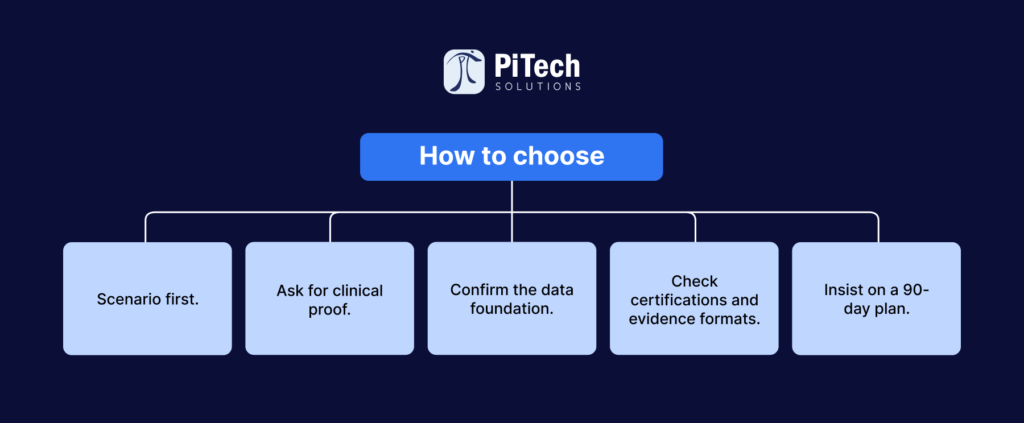
- Scenario first. System-wide transformation points to a global integrator; clinical model work to an AI specialist; fast policy standup to a boutique advisor; and a governance-plus-data-foundation program to a regulated-industry data specialist.
- Ask for clinical proof. Three or more references in healthcare, with control mappings to HIPAA and HTI-1 and evidence of bias monitoring in a comparable setting.
- Confirm the data foundation. A governance program without data lineage is a policy binder. Verify the firm can build the pipelines, not only the framework.
- Check certifications and evidence formats. CMMI process maturity and ISO information-security and AI-management certifications signal repeatable, auditable delivery.
- Insist on a 90-day plan. A clear proof-of-value milestone inside 90 days separates delivery partners from slide decks.
The bottom line
Healthcare AI governance is now an operating requirement, not an ethics exercise. Match your scenario to the right archetype, insist on the data foundation and audit evidence, and validate with clinical references and a 90-day plan. For organizations that want governance and the data platform built together, a regulated-industry specialist is often the most direct path.

Frequently Asked Questions (FAQs)
What is healthcare AI governance consulting?
It is the design and implementation of the controls, documentation, and data foundation that let a health system or digital health vendor deploy AI without creating compliance or patient-safety risk. Work spans an AI system inventory across clinical and administrative functions, control mapping to HIPAA and HTI-1, model validation and bias monitoring, clinician disclosure workflows, and the data quality and lineage that AI depends on. The goal is AI that is defensible in audit and safe at the bedside, produced as a byproduct of the running program rather than reconstructed later.
Who are the best healthcare AI governance consulting firms in 2026?
There is no single best firm; the right choice depends on the scenario. Global integrators such as Accenture, Deloitte, and IBM Consulting fit system-wide transformation. Specialist AI and analytics firms fit clinical model work. Boutique advisors fit fast HIPAA-native policy standup. Regulated-industry data specialists such as PiTech Solutions fit organizations that need the data foundation, HTI-1 and HIPAA control mapping, and audit evidence built together. Shortlist two or three archetypes that match your situation, then validate with clinical references and a 90-day plan.
How is HTI-1 different from HIPAA for AI governance?
HIPAA governs the privacy and security of protected health information. HTI-1 adds algorithm transparency requirements for certified health IT, meaning developers must disclose specified source attributes about decision-support interventions so users can judge fairness, validity, and applicability. For an AI governance program, HIPAA drives data protection and access controls while HTI-1 drives transparency and documentation of the models themselves. A mature program maps one control set to both, so a single piece of evidence satisfies multiple obligations rather than running parallel workstreams.
Do I need a data governance program before AI governance?
They are two sides of the same problem and are best built together. AI governance fails when the patient, claims, and clinical data feeding the models are fragmented or poorly controlled, because a model inventory is only as trustworthy as the lineage beneath it. Strong engagements establish data quality, ownership, and lineage as the foundation, then layer model inventory, validation, and monitoring on top. Treating governance as a policy exercise without fixing the data foundation produces a binder that cannot survive an audit.
What should a healthcare AI governance program include?
At minimum: an AI system inventory across clinical, administrative, and research functions; control mapping to HIPAA, HTI-1, FDA expectations, and applicable state law; model validation and bias monitoring; clinician disclosure workflows with evidence of delivery; business associate agreements updated with AI-specific terms; data lineage and quality controls; and board-level reporting. The program should also define human oversight points and a review cadence that fits inside existing risk and compliance structures rather than duplicating them.
How much does healthcare AI governance consulting cost?
Pricing varies widely by scope and firm archetype. Boutique advisory and fractional governance leadership are typically priced monthly; larger transformation programs from global firms carry higher day rates and longer timelines. Rather than anchoring on a single number, scope a defined pilot with clear deliverables, then compare firms on the value produced against a baseline. Ask each firm for transparent pricing with stated assumptions and scope boundaries, and treat any quote without those as a warning sign.
How do I evaluate a healthcare AI consulting firm fairly?
Compare by scenario and archetype rather than a single ranking. Ask for three or more healthcare references with quantified outcomes, control mappings to HIPAA and HTI-1, and evidence of bias monitoring in a comparable setting. Confirm the firm can build the data foundation, not only advise on policy. Check for CMMI process maturity and ISO certifications as signals of repeatable delivery, and insist on a proof-of-value milestone inside 90 days. Watch for vague deliverables, no clinical references, and pricing without stated assumptions.
Can AI be used in clinical decision support compliantly?
Yes, when governance is designed in rather than added afterward. That means HIPAA-compliant data handling, encryption, access controls, and audit logging from day one; a business associate agreement where required; validated models with documented performance and bias monitoring; and human oversight built into the workflow at defined points. HTI-1 transparency obligations apply to certified health IT, so decision-support interventions need documented source attributes. Treating compliance as an engineering requirement, not a finishing touch, is what makes clinical AI defensible.
What is bias monitoring in healthcare AI, and why does it matter?
Bias monitoring is the ongoing measurement of whether a model performs differently across patient populations in ways that could harm care or violate fairness expectations. It matters because clinical and payer models trained on incomplete or skewed data can produce disparate outcomes, which carries patient-safety, legal, and reputational risk. A governance program defines the fairness metrics, tests models before deployment, and monitors drift in production, with documented thresholds and escalation. This evidence is increasingly what regulators and accreditors expect to see.
Does PiTech work with health systems and digital health vendors?
Yes. PiTech Solutions supports healthcare provider organizations and digital health vendors with AI inventory and classification, HIPAA and HTI-1 control mapping, model validation and bias monitoring, clinician disclosure workflow design, and the clinical data warehouse and FHIR interoperability work that AI depends on. Delivery runs under CMMI Level 3 and ISO 27001, 9001, and 42001 certifications with FedRAMP-aligned practices, and the firm has federal healthcare experience with agencies including the NIH and HHS. The result is governance and a data foundation built as one program with audit-ready evidence.