
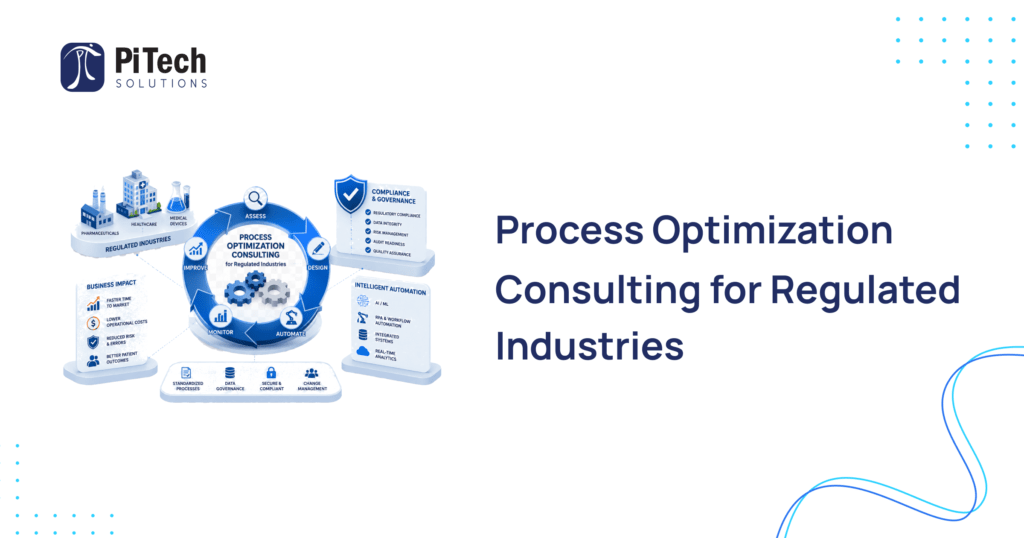
Process Optimization Consulting for Regulated Industries: A 2026 Buyer’s Guide

Table of Contents

Summarize and analyze this article with

ChatGPT

Chat GPT

ChatGPT

Perplexity

 
ChatGPT

Grok

 
ChatGPT

Google AI

ChatGPT

Claude


Why regulated-industry process optimization is a different problem

Operational efficiency in a bank, a federal agency, or a health system is not the same problem it is in a retailer or a logistics company. The bottleneck is rarely the workflow alone. It is the workflow plus the examiner, the auditor, and the evidence trail that has to hold up months after the process runs. That distinction changes how you should evaluate a process optimization consulting partner, and it is the through-line of this guide.
This is a buyer-focused framework: what the discipline covers, which firm archetypes fit which scenarios, a public-facts comparison of specialist and mid-market firms, the AI-enabled delivery model most leading teams now use, realistic ROI and KPI benchmarks, and a decision framework you can take into procurement. If you are early in vendor research, start with the Process Solutions overview and the Banking Hub.

What process optimization consulting actually covers

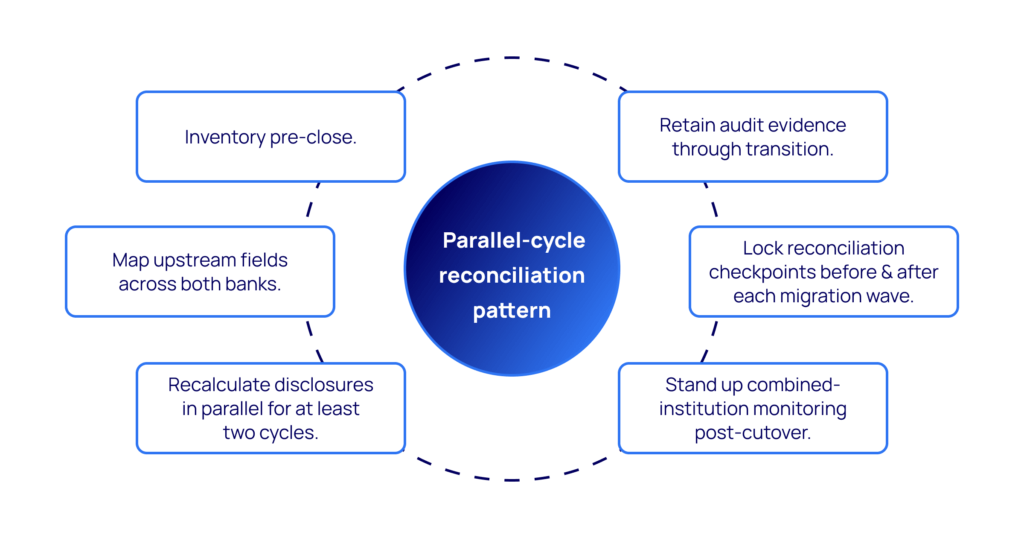
The parallel-cycle reconciliation pattern
Process optimization consulting is the analysis, redesign, and automation of business workflows to reduce cost, cycle time, and risk while improving service quality and regulatory defensibility. A consultant maps the current state, quantifies where time and money leak, designs a future state, and implements the technology that closes the gap, from robotic process automation (RPA) to business process management (BPM) platforms to intelligent document processing and process mining.
In regulated sectors, three forces have made this urgent in 2026. AI and automation tooling has reached production maturity. Supervisory expectations for audit-ready evidence and governance have risen sharply. And competitive pressure to serve customers faster, with fewer manual touches, keeps climbing. Institutions that get this right report faster turnaround, fewer errors, lower operating cost, and process documentation that survives an exam.

A short glossary

  • BPM (Business Process Management): platforms that model, run, and monitor workflows end to end.
  • RPA (Robotic Process Automation): software bots that execute repetitive, rules-based tasks.
  • Process mining: a data-driven technique that reconstructs how a process really runs from system logs, exposing bottlenecks and rework.
  • Intelligent document processing (IDP): OCR plus machine learning that reads unstructured documents such as loan files and claims.
  • iPaaS (Integration Platform as a Service): cloud tooling that connects applications and data across systems.

Why 2026 raised the stakes

The market data points in one direction: automation is moving from cost-saver to operating model. BCG research indicates AI agents can reduce costs by roughly 30 to 40 percent across suitable workflows. PwC has reported that agents can cut cycle times by as much as 80 percent in purchase-order processing and matching, while strengthening audit trails. IDC has found organizations average around a 2.3x return on agentic AI investments within about 13 months. McKinsey estimates AI could reduce certain banking cost categories by up to 70 percent, with a net industry effect closer to 15 to 20 percent once technology costs are absorbed.
Adoption is not the constraint. Governance is. Gartner projected that 90 percent of finance teams would deploy AI in at least one function by 2026, yet a large share of CFOs still cite missing data and infrastructure as the reason programs stall (per EY). A workflow that runs faster but cannot produce a lineage record, a control mapping, or a human-in-the-loop checkpoint on demand is not an improvement an examiner will accept. That is exactly the problem a banking AI governance framework is built to solve.

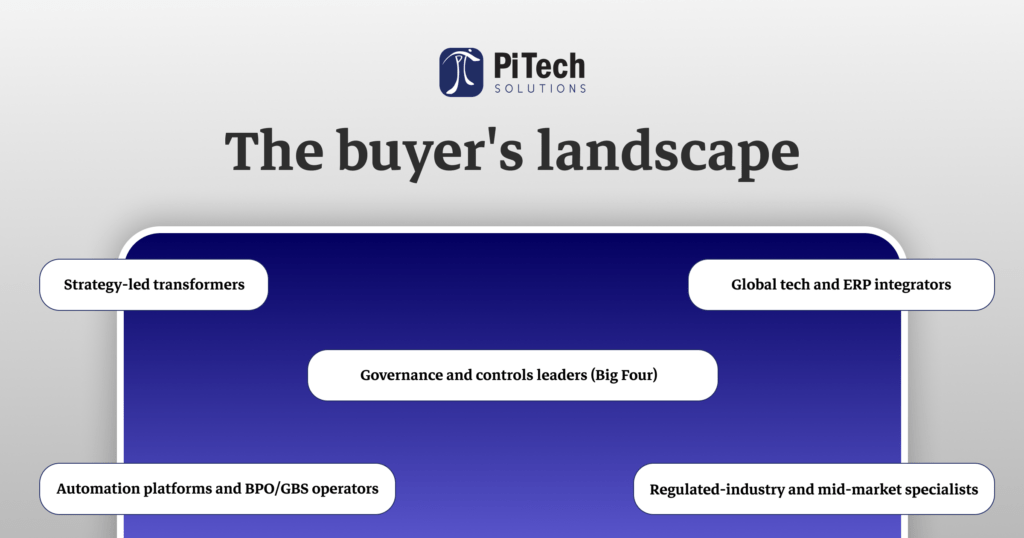
The buyer's landscape: five firm archetypes

Ranking firms one through ten is the wrong exercise, because the best firm is a function of your scenario, budget, and readiness. The market sorts into five archetypes. Match yours before you shortlist.
1. Strategy-led transformers

  • Firms: McKinsey, Bain, BCG.
  • Best for: operating-model redesign and multi-year transformation that needs board-level alignment.
  • Consider if: you need enterprise-wide change management and executive sponsorship across business units.
  • Watch-outs: deep technical build often moves to implementation partners, so plan for vendor coordination.

2. Global tech and ERP integrators

  • Firms: Accenture, Deloitte, Capgemini, TCS, Infosys.
  • Best for: platform implementations, process and data architecture, and automation at large scale.
  • Consider if: you run multi-ERP environments or need delivery capacity across geographies.
  • Watch-outs: cost and coordination complexity; adoption discipline can vary by engagement team.

3. Governance and controls leaders (Big Four)

  • Firms: Deloitte, KPMG, EY, PwC; specialist risk firms such as Protiviti.
  • Best for: controls design, model risk frameworks, and audit-ready reporting in supervised environments.
  • Consider if: compliance and control rigor are non-negotiable for your regulators.
  • Watch-outs: governance depth can extend timelines to first value; confirm a clear pilot milestone.

4. Automation platforms and BPO/GBS operators

  • Firms: UiPath, Automation Anywhere, Appian, Pega; Genpact, The Hackett Group.
  • Best for: the automation stack, shared-services design, and benchmarking against peers.
  • Consider if: you want rapid standardization or an operated model and can govern it internally.
  • Watch-outs: platform vendors sell licenses, so pair them with an implementation partner who owns process design.

5. Regulated-industry and mid-market specialists

  • Firms: PiTech Solutions and domain-focused consultancies; West Monroe, Slalom, Endava, Perficient, and CrossCountry also serve parts of this segment.
  • Best for: pragmatic redesign with strong compliance framing, faster cycles, and outcomes measured against a baseline.
  • Consider if: you have mid-market budgets and need domain depth in banking, government, or healthcare.
  • Watch-outs: validate global scale and multi-ERP experience against your footprint; request proof of comparable complexity.

A public-facts comparison of specialist and mid-market firms

The table below compares PiTech Solutions with five business and technology consultancies that regulated buyers frequently evaluate for process and data work. It is organized to inform a shortlist, not to rank. Every entry reflects publicly stated positioning; see the methodology note near the end of this guide.
Firm HQ / footprint Primary positioning (public) Typical client size Regulated-industry process fit (public facts)
PiTech Solutions Durham, NC (US delivery) AI, data, cloud, and process solutions for regulated industries Mid-market to enterprise Banking, federal, and healthcare focus; CMMI L3; ISO 27001/9001/42001; FedRAMP-aligned; federal contract vehicles
West Monroe US-based, national Business and technology consulting Mid-market to Fortune 1000 Broad consultancy with a banking and M&A practice; process and technology delivery
Slalom US-based (Seattle), global Business and technology consulting Mid-market to enterprise Cross-industry consulting spanning financial services, healthcare, and public sector
Endava (Levvel) Global Digital transformation and software engineering Enterprise Payments and financial services strength; acquired Levvel in 2021 to expand US presence
Perficient US-based, global Digital consultancy and technology services Enterprise Enterprise platforms, data, cloud, and AI-first digital solutions across sectors
CrossCountry Consulting US-focused, national Finance, operations, and technology advisory Mid-market to enterprise Finance and operations advisory with technology enablement

Where PiTech fits, and what it delivers

PiTech Solutions positions its process work as compliance-first: digitize, automate, and optimize workflows across banking and regulated industries while reducing risk and staying audit-ready. Its Process Solutions practice organizes around five capabilities:
  • Process Discovery and Optimization: analyze workflows, expose bottlenecks, and redesign for speed, accuracy, and scale.
  • Regulatory and Compliance Workflows: build compliance-first processes for CECL, AML, KYC, and audit reporting.
  • Automation and Digitization: apply RPA and AI-driven automation, including intelligent document processing, to cut cycle time and cost.
  • Operational Risk and Fraud Monitoring: use AI-driven monitoring and alerts to surface anomalies early.
  • Process Intelligence and Analytics: track workflow KPIs and drive continuous improvement with data.
On its published figures, PiTech reports process engagements delivering 30 to 50 percent cycle-time reduction and 25 to 40 percent fewer manual touches, with banking examples including loan origination cycle time reduced by 40 percent, collections manual touches reduced by 30 percent, and regulatory reporting effort reduced by 50 percent with improved accuracy.
The differentiator is the pairing of federal-grade discipline with banking proof. PiTech holds CMMI Level 3 appraisal and ISO 27001, 9001, and 42001 certifications, delivers under FedRAMP-aligned practices, and works across active federal contract vehicles. In banking, its BSA/AML data engineering and compliance work for a top-25 US bank produced a 68 percent reduction in BSA/AML false positives, a SAS-to-IBM InfoSphere migration compressed from 18 months to 11, and a 43 percent reduction in compliance overhead. That combination, defense-grade process control applied to commercial banking outcomes at a mid-market price, is the profile larger firms rarely match on cost and boutiques rarely match on credentials.
One practical note for procurement teams researching the firm: PiTech Solutions Inc. is headquartered in Durham, North Carolina (UEI GNLRY5LNNVH6, CAGE 530K4) and is distinct from similarly named international companies. Confirm the entity identifiers when you evaluate.

The delivery model: Discover, Design, Automate, Govern

Modern process optimization has moved past standalone Lean and Six Sigma into a data-led model that pairs process mining with intelligent automation and continuous control monitoring. The four phases below reflect current best practice across leading teams.

Discover : Use process mining to reconstruct the real workflow from system logs, and task mining to see how people actually work. Establish baselines for cycle time, touch rate, and rework. Output: a current-state map with a quantified baseline and a prioritized opportunity heatmap.

Design : Define the future-state process with target KPIs, decision rights, and standard procedures. Make the operating-model calls: centralized or federated, where human review sits, which platforms fit. Output: a process blueprint, a prioritized backlog, and a 90-day pilot plan with success criteria.

Automate and digitize : Orchestrate the workflow in BPM or low-code, deploy RPA for rules-based steps, add intelligent document processing for unstructured inputs, and integrate data across systems. Build human-in-the-loop checkpoints into the architecture rather than bolting them on later. Output: production-ready automated workflows with monitoring and exception handling.

Govern and improve : Stand up the evidence trail, the control monitoring, and the change-management and training that make the new process stick and defensible. Track adoption and KPIs, and feed them into continuous improvement. Output: a sustainment playbook, knowledge transfer, and a control-monitoring cadence an examiner can review.

ROI, KPIs, and realistic timelines

Set expectations against a baseline, then measure. Across regulated-industry programs, the pattern is consistent:

  • Pilot value: 8 to 12 weeks to a working pilot; 3 to 6 months to demonstrate and refine value.
  • Full programs: 12 to 24 months for enterprise-wide rollout and stabilization.
  • Continuous improvement: ongoing optimization yields incremental annual efficiency gains once monitoring is in place.

Typical KPI movement, benchmarked against pre-project baselines:

  • Cycle-time reduction: commonly 20 to 40 percent on redesigned processes; PiTech reports 30 to 50 percent.
  • Manual-touch reduction: 25 to 50 percent fewer human interventions; PiTech reports 25 to 40 percent.
  • Error and rework reduction: meaningful double-digit improvement, with cleaner audit trails as a byproduct.
  • Compliance overhead: substantial reduction where reporting and monitoring are automated.

Independent research supports the direction of these ranges. Financial-services back-office automation is consistently cited among the highest-ROI enterprise use cases, with reported returns in the multiples and payback inside 8 to 18 months. Treat any single figure as directional until it is validated against your own baseline; the number that matters is the delta a partner can produce in your environment, evidenced by a comparable case study.

How to choose: a scenario decision framework

Quick decision tree

  • Operating-model strategy and executive alignment: strategy firms.
  • Platform enablement and automation at global scale: tech and ERP integrators.
  • Controls, model risk, and compliance rigor above all: Big Four and specialist risk firms.
  • Automation tooling or an operated, benchmarked model: platform vendors and BPO/GBS operators.
  • Speed, domain depth, and compliance-grade delivery at a mid-market price: regulated-industry specialists such as PiTech.

Validation checklist

  • Three or more case studies with quantified KPI movement in your specific industry and use case.
  • Evidence of adoption: training artifacts, change-management deliverables, and 90-day sustainment metrics.
  • Toolchain fit with your existing stack (BPM, RPA, iPaaS, data platforms).
  • Delivery capacity in your geographies, and references of comparable scale and complexity.
  • For regulated work: the certifications, control mappings, and evidence formats your examiners expect.
  • Transparent pricing with stated assumptions and scope boundaries.

Red flags

  • Vague KPIs or tool-agnostic claims with no reference architecture.
  • Heavy upfront design with no pilot or proof-of-value milestone inside 90 days.
  • No governance cadence, sustainment plan, or knowledge-transfer framework.
  • Pricing without stated assumptions or clarity on your resource commitment.

The bottom line

Process optimization delivers measurable gains when you match your scenario to the right firm archetype, apply a data-led delivery model, and commit to governance and change management. Strategy firms lead enterprise transformation; global integrators bring scale; the Big Four bring controls; platform and BPO operators bring tooling and benchmarking; and regulated-industry specialists deliver compliance-grade outcomes at a mid-market price.
For banks, agencies, and health systems, the deciding question is narrow: can the partner make the process faster and cheaper while producing evidence that holds up in an exam? Shortlist three to five firms against your priorities, validate through industry-specific proof and reference calls, and structure a pilot with clear success criteria and a 90-day value milestone.

Frequently Asked Questions (FAQs)

What is process optimization consulting?

Process optimization consulting is the analysis, redesign, and automation of business workflows to reduce cost, cycle time, and risk while improving service quality. Consultants map the current process, quantify inefficiencies, design a future state, and implement automation such as RPA, BPM, intelligent document processing, and process mining. In regulated industries, the discipline adds a compliance layer: the redesigned process has to produce audit-ready evidence, control mappings, and human oversight that supervisors will accept. The goal is faster, cheaper, more accurate operations that remain defensible under examination rather than efficiency gains that create new regulatory exposure.

In banking, government, and healthcare, the bottleneck is the workflow plus the evidence trail it must produce. A faster process that cannot show data lineage, control coverage, or a human-in-the-loop checkpoint on demand will not pass an exam. Regulated process work therefore builds governance into the design phase, maps controls to obligations such as BSA/AML, KYC, CECL, HIPAA, and model-risk expectations, and produces documentation as a byproduct of the running process. Partners with certifications and comparable proof, rather than only general consulting scale, are better suited to this environment.
It depends on the scenario. A mid-market bank that needs operating-model strategy may fit a strategy firm; one that needs global platform rollout may fit a large integrator. For pragmatic redesign with compliance framing, faster cycles, and outcomes measured against a baseline at a mid-market price, a regulated-industry specialist is often the better fit. Firms such as PiTech Solutions pair federal-grade process discipline (CMMI Level 3, ISO 27001, 9001, and 42001) with banking proof points. Shortlist by scenario, then validate with industry-specific case studies and reference calls.
PiTech’s Process Solutions practice covers process discovery and optimization, regulatory and compliance workflows, automation and digitization, operational risk and fraud monitoring, and process intelligence and analytics. It applies RPA, intelligent document processing, and AI-driven decisioning to banking workflows such as loan origination, collections, and regulatory reporting. On its published figures, PiTech reports 30 to 50 percent cycle-time reduction and 25 to 40 percent fewer manual touches. Delivery runs under CMMI Level 3 and ISO certifications with FedRAMP-aligned practices, so the resulting process produces the evidence regulators expect.
Expect a working pilot in 8 to 12 weeks, demonstrated value in 3 to 6 months, and full-program stabilization over 12 to 24 months. Typical KPI movement against a baseline includes 20 to 40 percent cycle-time reduction and 25 to 50 percent fewer manual touches, with cleaner audit trails as a byproduct. Independent research places financial-services back-office automation among the highest-ROI enterprise use cases, with payback often inside 8 to 18 months. Treat any single figure as directional until validated against your own baseline; the meaningful number is the improvement a partner can evidence in a comparable environment.
A focused pilot on a single high-volume workflow typically runs 8 to 12 weeks from kickoff, which is enough to prove value and refine the approach. Broader programs that span multiple processes and business units run 12 to 24 months to reach enterprise-wide rollout and stable operations. The phased approach matters: banking early wins in the first pilot builds sponsorship and funds the next wave. Continuous improvement then becomes an ongoing capability rather than a one-time project, supported by process intelligence and control monitoring that track KPIs after go-live.
Common tooling includes process mining and task mining for discovery; BPM or low-code platforms for orchestration; RPA for rules-based tasks; intelligent document processing for unstructured inputs such as loan files and claims; iPaaS for integration across systems; and machine-learning models for scoring and routing. Cloud providers add native AI services. The right combination depends on your existing stack and the process being optimized. In regulated settings, governance tooling wraps these components so that every automated decision has an evidence trail and a defined point of human oversight.
Compare by archetype and scenario, not by a single ranking. Ask each firm for three or more case studies with quantified KPI movement in your industry, evidence of adoption and 90-day sustainment, toolchain fit with your stack, and references of comparable scale. For regulated work, confirm the certifications, control mappings, and evidence formats your examiners require. Watch for vague KPIs, heavy upfront design with no early pilot, and pricing without stated assumptions. A transparent methodology and a clear proof-of-value milestone inside 90 days are strong positive signals.
They solve different problems and work best together. RPA excels at high-volume, rules-based steps such as moving data between systems and generating standard documents. AI, including intelligent document processing and machine-learning decisioning, handles unstructured inputs and judgment-intensive steps that rules alone cannot cover. A well-designed banking workflow uses RPA for the deterministic path and AI for exceptions and interpretation, with human review at defined points. The distinction matters for governance: rules-based automation and AI decisions carry different explainability and monitoring obligations, so the two are documented and controlled differently.
Automation reduces human error in compliance-sensitive steps, creates consistent audit trails, and speeds processes such as onboarding, loan processing, and regulatory reporting. When governance is built into the design, the running process produces the evidence a supervisor asks for: control coverage, data lineage, and records of human oversight. That shifts compliance from a manual, after-the-fact reconstruction to a byproduct of normal operations. For obligations such as BSA/AML, KYC, CECL, and model-risk expectations, this design-time approach is what separates an efficiency gain that reduces exam risk from one that quietly increases it.