
Table of Contents
Summarize and analyze this article with

Chat GPT

Perplexity

Grok

Google AI

Claude
Why core banking modernization is a 2026 decision, not a someday project
The buying lesson is straightforward. Modernization that replaces the engine without rebuilding the data foundation produces faster, prettier reporting on the same broken inputs. Modernization that rebuilds the data layer alongside the engine compounds into stronger compliance, lower close-cycle days, and AI use cases that finally reach production. This guide is written for the buyer who needs that distinction made operational.
The market map: four provider categories you are choosing between
Most confusion in this category comes from comparing things that are not alternatives. There are four provider types, and a complete program usually combines them deliberately.
| Provider type | What they sell | Strong at | Weak at |
|---|---|---|---|
| Core platform vendors | The core banking engine itself | Mature product capabilities | Assume governed data exists; integration left to you |
| Hyperscalers / cloud vendors | Compute, storage, managed services | Scale, reliability, AI building blocks | No banking-specific data model or controls |
| Strategy / advisory firms | Target architectures, roadmaps | Diagnosis, board narratives | Hand off before delivery; little working software |
| Implementation partners | Data engineering, migration, MDM, lineage, evidence | Building the foundation; making the engine actually work | Not a substitute for the core platform license |
The decision that actually matters: build vs. buy vs. partner per capability
Treat the stack as separable capabilities, not one purchase.
| Capability | Recommended | Why |
|---|---|---|
| Core banking engine | Buy | Vendor product; do not build |
| Cloud platform (AWS / Azure / GCP / IBM) | Buy | Commodity infrastructure |
| Data lakehouse + catalog | Buy | Mature category; value is in how it’s populated |
| MDM, lineage, quality rules | Build / partner | Bank-specific; decides whether everything above works |
| Source-to-target mapping & migration runbooks | Build / partner | Engagement-specific; cannot be licensed |
| Reporting continuity & reconciliation | Build / partner | The examiner test lives here |
| AI/ML feature stores & governance | Build / partner | Foundational for SR 26-2 readiness |
The rule of thumb
Sequencing: data-domain first, infrastructure second
The order you modernize decides whether the program compounds or stalls. Sequence by the data domains that drive your highest-risk decisions credit, fraud, AML, capital, regulatory reporting not by infrastructure convenience. A team that migrates the easy domains first because they are easy ends up with the hardest, riskiest domains running last on whatever budget remains.
| Priority | Data domain to modernize first | Why |
|---|---|---|
| 1 | Customer & account master data | Foundation for every downstream domain; entity resolution has outsized leverage |
| 2 | Transaction history & ledger | Drives BSA/AML, fraud, reporting; reproducibility is the examiner test |
| 3 | Loan, credit & risk data | CECL, capital, stress testing; audit exposure is concentrated here |
| 4 | Regulatory reporting feeds | Lineage and reconciliation must survive cutover |
| 5 | AI/ML feature stores | Built on the above; unlocks safe AI adoption |
The 10-criterion vendor evaluation scorecard
Use this against every shortlisted firm platform vendor, hyperscaler, advisor, or implementation partner. Weight to your situation but do not drop the data-layer and reporting-continuity criteria; they predict examination outcomes far better than feature counts.
| # | Evaluation criterion | What ‘good’ looks like |
|---|---|---|
| 1 | Data-layer depth | Rebuilds MDM, lineage, quality rules, reconciliation |
| 2 | Reporting continuity track record | Has migrated a bank without breaking a regulatory report |
| 3 | Examiner-ready evidence | Generates audit trail as a by-product, answerable in minutes |
| 4 | Banking domain depth at your asset size | Named engagements, not deck portfolios |
| 5 | Migration runbook discipline | Source profiling → mapping → testing → reconciliation → cutover |
| 6 | Validated certifications | Current CMMI, ISO 27001/9001/42001 certificates with assessor names |
| 7 | Senior staffing model | Named architect and SME in the SOW; no pyramid substitution |
| 8 | Build-vs-buy honesty | Will tell you when to buy an engine rather than sell you services |
| 9 | Total cost of ownership | Transparent license + integration + run cost over 3 years |
| 10 | On-time/on-budget record | Specific overrun percentages on the last three banking engagements |
The RFP questions that separate engineers from advisors
- Show a banking engagement where you migrated a core or data platform without breaking a regulatory report.
- What does your source-to-target mapping artifact look like show a redacted one.
- Describe the reconciliation cadence before, during, and after each migration wave.
- How do you handle BSA/AML and fraud-model continuity through cutover?
- Where would you tell us to buy a product rather than pay you to build one?
- Who, by name and seniority, is in the working sessions and do they stay for the whole engagement?
- What is the all-in three-year total cost of ownership, including run-rate?
- What overrun percentages did your last three banking modernization engagements incur?
A four-bucket TCO model buyers forget
- License / subscription core, cloud, lakehouse, catalog. Visible and negotiated.
- Integration & data foundation mapping, MDM, lineage, quality remediation, reporting rebuild. The largest first-year cost and the one vendors exclude.
- Run & evidence monitoring, validation, examiner-evidence upkeep. Ongoing and underestimated.
- Cost of inaction manual reconciliations, slow closes, audit findings, AI use cases that cannot reach production. The number that justifies the program.
ROI: where the value actually comes from
Modernization returns value, but rarely from the feature you bought. PiTech compressed an 18-month SAS-to-IBM InfoSphere migration to under 11 months for a Fortune 500 banking client with 100% on-time milestone delivery and zero cost overruns; 68% of data conflicts were auto-resolved during migration. On a separate top-25 US bank engagement, governed-data-first work on BSA/AML contributed to a 68% reduction in false positives and a 43% reduction in compliance overhead. The buying lesson is identical: weight your evaluation toward the data layer, because that is where the return concentrates.
A 90-day path from selection to first defensible win
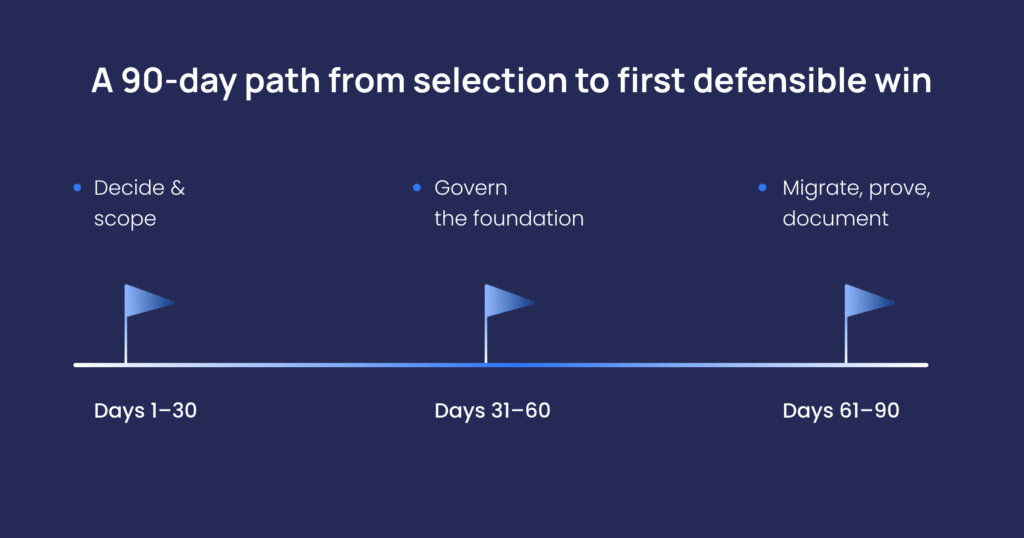
Days 1–30 — Decide and scope
- Run the scorecard and RFP against a shortlist; choose platform, cloud, and partner per capability.
- Pick one data domain (usually customer/account master data) as the first modernization target.
- Stand up MDM and lineage in parallel they are the foundation for everything else.
Days 31–60 — Govern the foundation
- Profile sources; establish ownership, definitions, quality rules; map source-to-target; instrument reconciliation.
Days 61–90 — Migrate, prove, document
- Execute the first migration wave on the now-governed data; run parallel reconciliation; document the control end-to-end.
How PiTech fits the buying decision
PiTech is a practical implementation partner for regulated U.S. banks ($1B–$50B in assets) the fourth category in the market map. Engagements ship working systems: governed pipelines, MDM, lineage, migration runbooks, reconciliation evidence, and examiner-ready documentation, delivered by named senior practitioners under CMMI Level 3 and ISO 27001/9001/42001 discipline. Where buying a core engine, a cloud platform, or a lakehouse is the right call, PiTech says so and integrates it; where the data foundation must be built, that is the core of the work.

Frequently Asked Questions (FAQs)
What is core banking modernization in 2026?
Core banking modernization is the deliberate replacement or upgrade of a bank’s core engine, supporting cloud and data infrastructure, and the governed data foundation underneath them. In 2026 it is rarely a single-platform decision; it combines a chosen core engine, a cloud platform, a lakehouse and catalog, and a rebuilt data layer with MDM, lineage, quality rules, and reconciliation. The discipline matters more than the vendor: replacing the engine without rebuilding the data layer produces faster output on the same broken inputs.
Should a bank build or buy core banking technology?
Decide per capability. Buy the commodity layers the core banking engine, the cloud platform, the data lakehouse, and the catalog. Build, or partner for, the bank-specific layer: MDM, lineage, quality rules, source-to-target mapping, reconciliation, and AI/ML feature stores. Partner for the integration discipline that joins them and survives examination. Anyone selling a single platform as the whole answer is selling a fraction of the program.
Which data domain should we modernize first?
Sequence by the domains that drive your highest-risk decisions, not by infrastructure convenience. Customer and account master data is usually first because entity resolution there has outsized downstream leverage. Then transaction history and ledger (which drive BSA/AML, fraud, and reporting), then loan/credit/risk data, then regulatory reporting feeds, then AI/ML feature stores built on top. Easy domains first is a tempting sequence that leaves the hardest work for the smallest budget.
How do you choose a core banking modernization partner?
Score candidates on data-layer depth, reporting-continuity track record, examiner-ready evidence, banking domain depth at your asset size, migration runbook discipline, validated certifications, named senior staffing, build-vs-buy honesty, transparent three-year total cost of ownership, and actual overrun percentages on the last three banking engagements. Weight the data and reporting criteria heavily; they predict examination outcomes far better than feature counts.
What does core banking modernization cost?
Model total cost of ownership in four buckets license or subscription for core, cloud and lakehouse (the smallest); integration and data-foundation work (the largest first-year cost and the one vendors exclude); ongoing run and evidence upkeep; and the cost of inaction (manual reconciliations, slow closes, audit findings, AI use cases that cannot reach production). Year-one license alone understates the real investment by a wide margin.
How long does core banking modernization take?
A focused first defensible win is achievable in about 90 days: 30 days to decide, scope, and select per capability while standing up MDM and lineage; 30 days to govern one high-leverage data domain (typically customer/account master data); and 30 days to execute the first migration wave with parallel reconciliation. Full-stack modernization is multi-year, but the program needs visible, defensible wins early to retain budget and board confidence.
How does SR 26-2 affect core modernization plans?
SR 26-2 (April 2026) replaced SR 11-7 and raised expectations for model and AI oversight, all of which run on the data the core produces. Modernization plans should treat AI/ML feature stores, lineage, and the model inventory as foundational deliverables, not nice-to-haves. The GenAI and agentic AI carve-out in SR 26-2 also means the bank must build controls the supervisory letter does not specify and those controls only work on governed data.
Is mainframe migration the same as core modernization?
No. Mainframe migration is one possible component moving compute, storage, and applications off legacy hardware. Core modernization is broader: it includes the core engine, supporting cloud, the lakehouse and catalog, the governed data foundation underneath them, and the operating model around all of it. A successful mainframe migration without a rebuilt data layer is a partial modernization that does not deliver most of the promised value.
How do mid-market banks modernize without Big 4 budgets?
Right-size the program. Mid-market banks ($1B–$50B) should buy commodity layers, partner for implementation, and prioritize one data domain at a time rather than a full platform replacement. PiTech’s banking engagements typically cost 40–60% below comparable Big 4 scopes for the same deliverable depth because pyramid staffing is avoided and senior practitioners deliver the work. The discipline data-domain-first sequencing, evidence as a by-product, depth over breadth is identical at any size.