
Table of Contents
Summarize and analyze this article with

Chat GPT

Perplexity

Grok

Google AI

Claude
Why partner selection decides the outcome
Compliance automation rarely fails on technology. The engines for transaction monitoring, screening, and regulatory computation are mature. Programs fail on execution and execution is mostly about whom you choose to do the work. A bank that selects the wrong partner does not discover the mistake at signing; it discovers it around week six, when the team is hand-cleaning the data feeding the new tool and exception queues are growing. By then the budget is committed.
The same pattern shows up in AI adoption, where most pilots never reach production for identical reasons covered in 88% of Bank AI Pilots Never Reach Production. So before comparing features, learn to compare partners. This guide gives you the screen, the failure modes, and the scorecard.
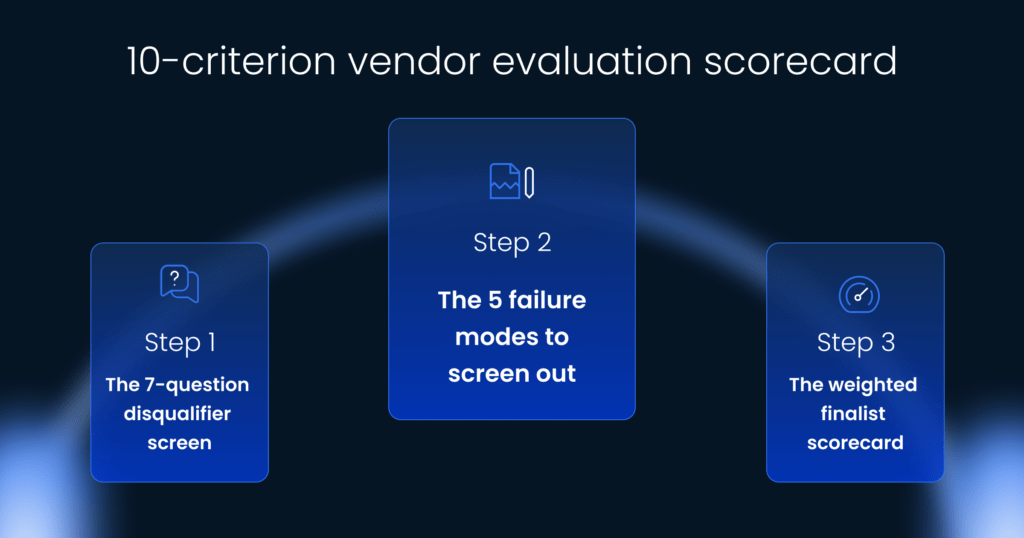
Step 1 — The 7-question disqualifier screen
Run these early. Any candidate who fumbles three or more is not a fit, regardless of brand.
- Data first? Can you show a banking engagement where you rebuilt lineage, ownership, and quality rules not just authored a framework?
- Evidence path? When an examiner asks how a number was produced, what is the answer path in the system you build?
- Model inventory? How do you deliver a model and AI inventory, and how do you handle the GenAI/agentic carve-out under SR 26-2?
- Named seniors? Who, by name and seniority, is in the working sessions and do they stay the whole engagement?
- Build-vs-buy honesty? Where would you tell us to buy an engine rather than pay you to build one?
- TCO clarity? What is the all-in three-year cost, including run-rate, not just year-one?
- Real references? Which peer banks can speak to overruns and closed examiner findings under NDA?
Step 2 — The 5 failure modes to screen out
These are the patterns behind most stalled programs. Learn to spot them in a demo or a reference call.
Failure mode 1 Automating ungoverned data
The candidate proposes to point an engine at your existing extracts without first fixing ownership, lineage, and quality. The result is the same defects produced faster, with lineage still unshowable. Ask: ‘What do you do in the first 30 days about the data feeding the engine?’ If the answer is not ‘profile, own, and govern it,’ move on.
Failure mode 2 Selling software as a program
Procurement is steered toward a license while the data foundation is assumed. The license is roughly 20% of the work; the governed data is the unbought 80%. A partner who does not scope the data foundation is scoping a fraction of the project.
Failure mode 3 Boiling the ocean
The proposal automates everything at once, spreading scarce SME time across too many domains so nothing reaches examiner-ready depth. The right answer is one high-exposure domain first.
Failure mode 4 No model and AI inventory underneath
Failure mode 5 Evidence assembled after the fact
If audit evidence is reconstructed at examination time rather than generated as a by-product, you will spend your savings on documentation scrambles. Durable programs produce the trail automatically.
The single tell
Every failure mode traces to the same root: treating compliance automation as a tooling purchase instead of a governed-data program. The partner who leads with the data layer Data Solutions is the one whose work compounds.
Step 3 — The weighted finalist scorecard
Score finalists 1–5 on each criterion, apply the weights, and compare. Do not drop the data-layer and evidence weights; they predict examination outcomes better than features.
| Criterion | Weight | What a 5 looks like |
|---|---|---|
| Data-layer depth | 25% | Rebuilds lineage, ownership, quality, reconciliation |
| Examiner-ready evidence | 20% | Audit trail as a by-product; answerable in minutes |
| Model & AI oversight (SR 26-2) | 15% | Defensible inventory, risk-tiering, carve-out plan |
| Banking track record at your size | 15% | Named engagements, not deck portfolios |
| Senior staffing model | 10% | Named architect + SME for the full engagement |
| Total cost of ownership | 10% | Transparent 3-year, all-in |
| References & closed findings | 5% | Peer-bank references; examiner findings closed |
Three partner archetypes and when each is right
Neutrally: the market offers three archetypes. A complete program often blends them, but knowing which you are buying prevents disappointment.
- Software vendor right when you need a proven engine and already have a strong data foundation and integration capacity in-house.
- Strategy / advisory firm right when the board needs a diagnosis, benchmark, or operating-model design and you have implementers to execute it.
- Implementation partner right when the gap is execution: building the governed foundation, integrating the engine, and producing examiner-ready evidence. This is where most mid-market programs actually stall.
A note on cost: cheap is expensive here
The lowest bid usually excludes the integration and data-foundation work — the 80% that determines whether the program reaches production. Compare total cost of ownership over three years, including the run-rate to keep evidence examiner-ready, and weigh it against the cost of inaction: analyst hours lost to false positives, slow closes, and examination findings. A partner who is transparent about all four cost buckets is signaling competence, not expense.
How PiTech screens against its own scorecard
PiTech is a practical implementation partner for regulated U.S. banks the third archetype above. Engagements are scoped data-first, staffed with named senior practitioners, and delivered under CMMI Level 3 and ISO 27001/9001/42001 discipline. PiTech will tell a bank when to buy an engine rather than build one. Representative outcome: at an anonymized top-25 US bank, governed-data-first work contributed to a 68% reduction in BSA/AML false positives and a 43% reduction in compliance overhead. The full evaluation framework PiTech expects banks to apply to PiTech included is on the Banking Hub.
To run this scorecard against your shortlist with a senior practitioner, book a 30-minute banking discovery call. For the broader market map and TCO model, see Banking Compliance Automation: The Complete Buyer’s Guide.
Frequently Asked Questions (FAQs)
How do you choose a banking compliance automation partner?
Run a disqualifier screen first: ask whether they lead with the data foundation, can show an examiner-evidence path, deliver a model and AI inventory, staff named seniors for the full engagement, are honest about build-vs-buy, and are transparent on three-year total cost. Then score finalists on data-layer depth, examiner-ready evidence, model and AI oversight, banking track record at your asset size, staffing, TCO, and references with closed examiner findings.
What are the warning signs of a weak compliance automation vendor?
Five failure modes signal trouble: proposing to automate ungoverned data, selling a software license as if it were the whole program, attempting to automate every domain at once, lacking a model and AI inventory underneath detection and decisioning, and assembling audit evidence after the fact rather than generating it as a by-product. Each traces to treating compliance automation as a tooling purchase instead of a governed-data program.
Is the lowest bid usually the best value in compliance automation?
Rarely. The lowest bid typically excludes the integration and data-foundation work the roughly 80% of effort that determines whether the program reaches production and survives examination. Compare total cost of ownership over three years, including the run-rate to keep evidence examiner-ready, against the cost of inaction. Transparency about all cost buckets is a competence signal, not an expense red flag.
Should we hire a strategy firm or an implementation partner?
It depends on the gap. A strategy or advisory firm fits when the board needs a diagnosis, benchmark, or operating-model design and you already have implementers. An implementation partner fits when the gap is execution building the governed foundation, integrating the engine, and producing examiner-ready evidence. Most mid-market programs stall on execution, which is why the implementation gap is where partner selection matters most.