




20-35%
Fraud loss reduction
40-60%
Fewer false positives
<100ms
Real-time scoring
SR 11-7
Compliant documentation
Client Snapshot
Industry
Banking & Financial Services
Solution
AI, GenAI & ML
Complexity
High
Delivery
Advisory + Implementation
The Problem
US financial institutions recorded more than $12.5 billion in consumer fraud losses in 2024 (FTC). Legacy rules-based fraud systems were built for yesterday’s threat patterns — they can’t adapt in real time to synthetic identity fraud, AI-generated social engineering, or account takeover via mobile banking without manual intervention.
The result is a costly squeeze: static rule sets generate excessive false positives that decline legitimate customers, while novel fraud patterns route around them undetected. Manual review queues grow faster than fraud teams can clear them — and every hour of delay is direct loss exposure.
Ready to Start?
Schedule a Fraud Detection Assessment
200–400
Active rules the average community bank fraud team manages — many conflicting, overlapping, or written for threats that no longer exist. Rule proliferation is itself a risk.
How PiTech Delivers
01
Discovery & Baseline Assessment
24–36 months of transaction and fraud outcome data analyzed. Current false-positive rate audited. Fair lending impact of existing detection assessed.
Deliverable: fraud detection maturity report with gap sizing.
02
Multi-Layer Architecture Design
03
Shadow Mode Validation (60–90 Days)
04
Production Deployment & Governance
Proven Outcomes
68%
of data conflicts auto-resolved in banking migration
43%
compliance overhead reduction for banking client
11mo
18-month migration delivered in under 11 months
Proven Outcomes
18+
Years in Regulated Industries
What You Gain
20-35%
Reduction in fraud losses within 12 months of full production deployment
40-60%
Reduction in false-positive alert rate — freeing fraud operations capacity
<100ms
Real-time transaction scoring replacing 24–72 hour batch review cycles
SR 11-7
Compliant model documentation package ready for OCC and Fed examination
Technology Stack
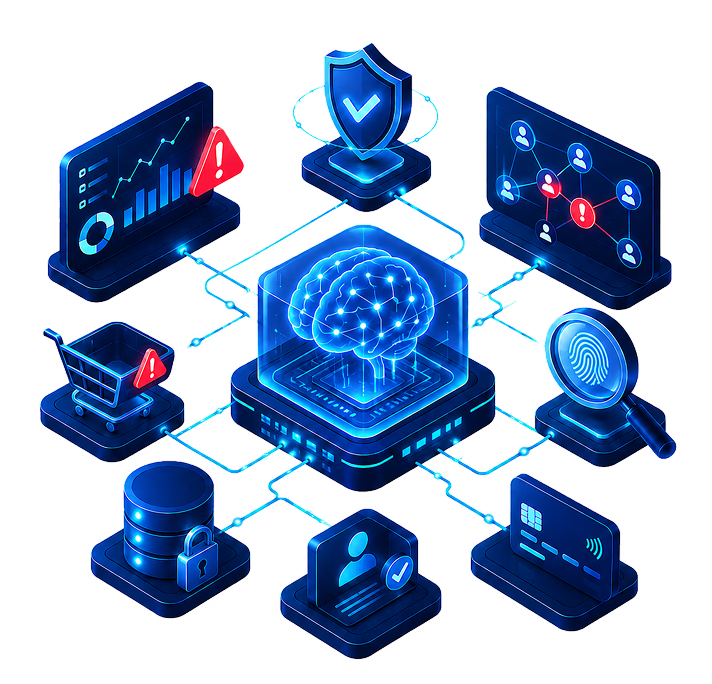
Real-time scoring engine
Supervised fraud models
Anomaly detection layer
Feature engineering pipeline
SR 11-7 model documentation
Fair lending monitoring module
Automated retraining pipeline
Frequently Asked Questions
How long does AI fraud detection deployment take for a regional bank?
Does PiTech's fraud model satisfy OCC and Federal Reserve SR 11-7 requirements?
How does PiTech handle fair lending risk in fraud detection?
What fraud types can the AI detect?
What data is required to build the initial fraud detection model?
Fraud detection modernization is the highest-ROI AI investment available to banks today
Related Use Cases

AI Risk Management in Banking: Models, Compliance, and Governance That Actually Work
Introduction Banks are accelerating artificial intelligence adoption across credit scoring, fraud detection, and customer service. Yet growth brings scrutiny. Strong

How Banks Can Safely Deploy Generative AI Without Hallucinations, Bias, or Compliance Risks
Introduction Generative AI is rapidly reshaping the banking industry. From customer service chatbots to fraud detection and credit assessment, banks

Agentic AI for Capital Markets: Building a Foundation for Success
Introduction Capital markets have access to vast amounts of data. They are constrained by how fast teams can interpret it,
Reach Our Customer Service Team
-
Address
4000 Sancar Way, Suite 205, Durham, NC 27709
-
Contact Details
(919) 439-3163