
Table of Contents
Summarize and analyze this article with

Chat GPT

Perplexity

Grok

Google AI

Claude
Why Industrial Transformation Failure Has Higher Stakes
What Makes Industrial Transformation Fundamentally Different
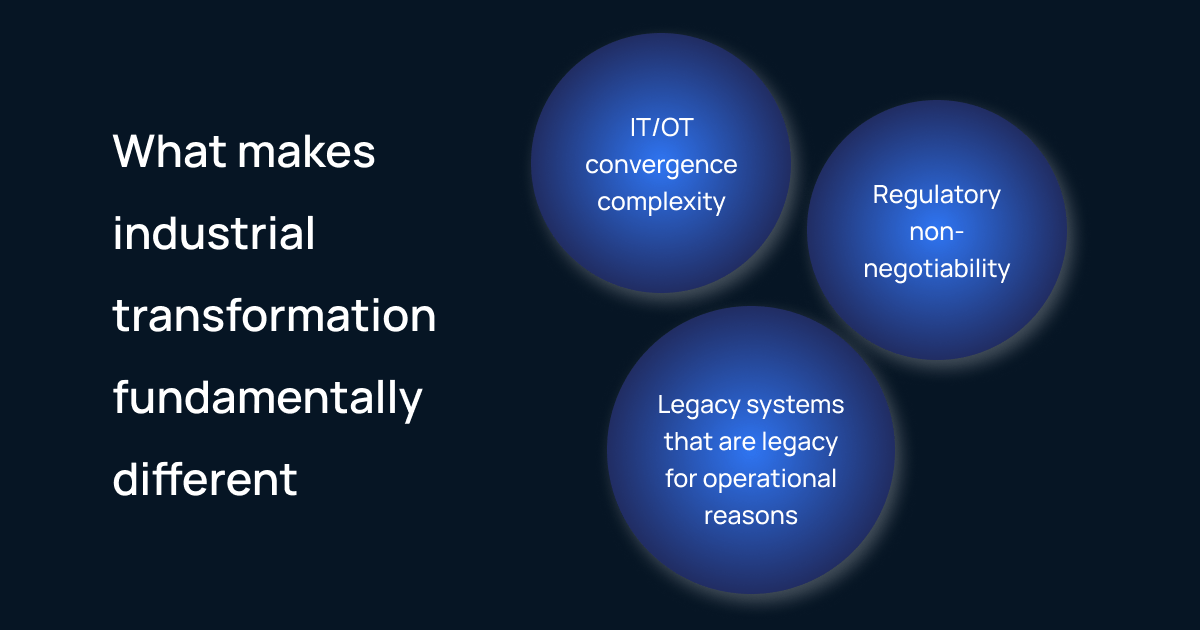
IT/OT Convergence Complexity
Manufacturing and energy transformations involve connecting IT systems to equipment that operates in the physical world. When you digitize these operations, you create connections between the digital domain and the physical domain and those connections carry risks that purely digital transformations do not. This is the threat model that defines responsible OT security practice. A misconfigured IT system produces a service outage. A misconfigured OT system produces a safety incident.
Regulatory Non-Negotiability
NERC CIP requirements for bulk electric system cybersecurity, CMMC requirements for defense manufacturing, environmental compliance mandates these are not governance overhead. They are design constraints that shape every architecture decision from the beginning. Transformation programs that treat compliance as a post-deployment review consistently require expensive remediation. PiTech’s IT consulting practice integrates compliance requirements into transformation architecture from day one.
Legacy Systems That Are Legacy for Operational Reasons
The SCADA system running a manufacturer’s production environment is not running legacy software because modernization was never considered. It is running because it processes critical operations with availability requirements that most modern cloud-native platforms cannot yet guarantee. The IT/OT convergence challenge means organizations must find ways to modernize through phased cloud migration strategies that account for the specific availability, safety, and latency requirements of operational systems.
How PiTech Approaches Industrial Digital Transformation
PiTech’s Digital Transformation Advisory practice is built on a foundational principle: process discipline before technology deployment. Our engagement approach starts with structured workload and capability assessment: understanding what the transformation is intended to achieve, what the current process maturity baseline is, what the OT security and compliance implications are, and what data foundations the intended AI and analytics capabilities actually require.
For AI and Analytics deployment in industrial contexts, PiTech provides governance architecture before model deployment: data lineage documentation, model validation frameworks, decision rights specification, and the OT security integration that AI connectivity in manufacturing requires. We build the governance infrastructure that makes AI programs scalable so when the first deployment succeeds and leadership wants to expand to additional production lines or facilities, the architecture was designed for that expansion.
The Sustainability Data Opportunity
ESG reporting requirements from investor standards, regulatory mandates, and customer expectations demand auditable data that demonstrates actual emissions and energy performance. IoT-enabled energy monitoring, predictive maintenance data, and supply chain optimization metrics all generate sustainability evidence, but only if the underlying data governance infrastructure is built to collect, validate, and report that evidence in a way that withstands scrutiny. PiTech builds this infrastructure as part of the digital transformation program not as a subsequent compliance exercise.
Organizations that build auditable sustainability measurement systems as part of digital transformation will be positioned to meet requirements that are tightening globally. Those that treat sustainability reporting as a separate subsequent initiative will face double the implementation burden.
Frequently Asked Questions (FAQs)
How does PiTech's approach differ from standard digital transformation consulting?
What does process maturity assessment involve before a transformation program launches?
PiTech’s pre-transformation assessment covers process documentation and standardization, configuration management capability, change management discipline,data quality and governance OT security posture, regulatory compliance status, and organizational change capacity.
How does PiTech handle NERC CIP compliance requirements in transformation programs?
PiTech incorporates NERC CIP compliance implications into transformation architecture design from the beginning. For bulk electric system operators and transmission owners, we map transformation architecture decisions against applicable CIP standards and identify compliance gaps before they become compliance findings. Learn more about our IT consulting and compliance services.
Does PiTech work with defense manufacturers subject to CMMC requirements?
Yes. PiTech’s cybersecurity compliance practice covers CMMC alongside our industrial transformation work, and for defense manufacturers, these programs are integrated. Explore our Governmfent solutions and contract vehicles to understand how PiTech serves defense and federal clients.