
Table of Contents
Summarize and analyze this article with

Chat GPT

Perplexity

Grok

Google AI

Claude
For years, explainability was an abstract principle in AI ethics frameworks. That era is definitively over. Regulators in the US, EU, and UK have shifted their focus from basic transparency — documenting what models do — to functional explainability: demonstrating why an AI system produces specific outputs for specific customers in terms that regulators, plaintiff’s attorneys, and consumers can evaluate. Twenty-eight point four percent of financial institutions cite explainability and transparency as their most acute AI regulatory concern, according to Wolters Kluwer’s Q1 2026 Banking Compliance AI Trend Report.
The challenge is intensifying as agentic AI systems proliferate. Traditional machine learning models are relatively straightforward to explain — you can demonstrate feature importance and walk through decision logic. Agentic AI systems chain together multiple models, make sequential decisions, and interact with external data sources. When an agentic system denies a loan application or flags a transaction, the explanation may involve a dozen intermediate reasoning steps. Deloitte’s 2026 Banking and Capital Markets Outlook describes many AI implementations as stuck in isolated proofs of concept, marked by weak governance. The weakness is not in the models — it is in the organizational discipline required to govern them.
For institutions already navigating the AI pilot-to-production gap, explainability failures are the single most common reason a system that works technically cannot be deployed at scale.
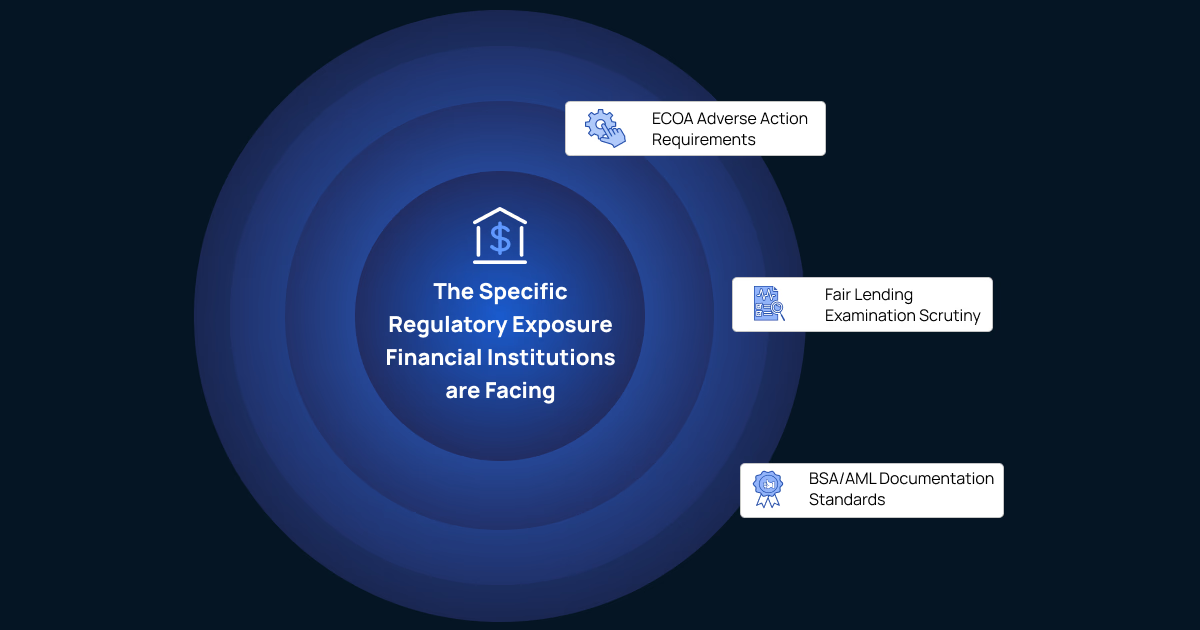
ECOA Adverse Action Requirements
Fair Lending Examination Scrutiny
BSA/AML Documentation Standards
How PiTech Builds Explainability Into Financial Services AI
PiTech’s approach to explainability in financial services AI treats it as an architectural requirement from the first day of system design, not as a feature request at the end of development. Our financial services AI engagements begin by mapping the specific explainability requirements of the use case — adverse action notice standards for credit decisioning, fair lending examination requirements, BSA/AML documentation standards — and then selecting model architectures and explainability methods appropriate to those specific requirements.
For credit decisioning, PiTech designs hybrid architectures: interpretable models for the decision layer that regulators directly scrutinize, paired with more powerful models for upstream pattern recognition and data enrichment that stays internal. SHAP values, LIME, and attention visualization techniques are selected based on the regulatory context — credit decisioning models face different requirements than fraud detection models, which face different requirements than internal risk management models. We do not apply a single explainability method uniformly; we design the right approach for the specific regulatory context.
PiTech implements audit trail architecture that captures every input a model receives, every decision point and the reasoning, every output delivered to users or downstream systems, and every instance where the model’s confidence or behavior approaches defined escalation thresholds. This documentation is not produced as a compliance exercise after the fact — it is generated automatically as a natural output of system operation, because documentation produced reactively under examination pressure is fundamentally less reliable than documentation produced continuously by design.
Our model monitoring capability continuously tracks accuracy, fairness metrics across protected class dimensions, output consistency, and data drift — producing the ongoing evidence that regulators are moving toward expecting rather than accepting point-in-time validation snapshots. We design monitoring thresholds aligned with regulatory examination expectations, and we build escalation workflows that ensure performance degradation or fairness concerns are routed to the right decision-makers before they become regulatory findings.
PiTech’s CMMI certified delivery processes are what make the governance documentation we produce reliable and consistent. The institutional habits of process documentation, compliance monitoring, and management review that CMMI requires are the same habits that make AI governance documentation credible — because it reflects how the system actually operates, not how it was documented for a certification audit.
What Banks Are Getting Wrong and How to Fix It
The most common error in bank AI governance is optimizing for certification artifacts rather than actual governance capability. Organizations create documentation to satisfy examination requirements, achieve satisfactory examination ratings, and then do not actually operate the governance system the documentation describes. Regulators and sophisticated examination teams are increasingly equipped to detect this gap — through interview questions that test whether practitioners actually understand the governance processes, review of operational metrics that would exist if monitoring were actually functioning, and examination of whether governance documentation updates reflect actual system changes.
Organizations with CMMI-certified operations are more resistant to this failure mode because the institutional habits of process documentation, compliance monitoring, and management review are embedded in how they work, not performed for audit events. When an OCC examiner asks to see evidence that model monitoring thresholds were reviewed and updated when the model was retrained, a CMMI-disciplined organization produces operational records because those exist in the normal course of operations — not as examination preparation artifacts.
Where Healthcare Organizations Should Focus Right Now
The five-step remediation priority: start with a Shadow AI inventory this week — identify every tool in use, not just what IT approved. Build a mandatory MFA roadmap immediately — map every system touching ePHI and identify which support modern authentication. Conduct an encryption gap analysis — document where ePHI is encrypted at rest and in transit and where it is not. Shift from annual to continuous risk analysis. And treat AI vendor management as a compliance function, not a procurement activity.
Security is not a project with a finish line in healthcare. It is a permanent operational discipline. The organizations that will handle the convergence of rising breach rates, updated HIPAA requirements, and expanding AI adoption will be the ones that have built that discipline into their operations — not the ones that respond to each new development as a separate crisis.