
Table of Contents
Summarize and analyze this article with

Chat GPT

Perplexity

Grok

Google AI

Claude
The business case for compliance automation in financial services is no longer speculative. Financial institutions using AI-driven compliance automation report 40 to 60 percent reductions in document processing times and 30 to 50 percent improvements in response times for compliance-related inquiries. Gartner projects that 90 percent of finance functions will deploy at least one AI-enabled technology by 2026. Regulatory monitoring, transaction surveillance, suspicious activity reporting, and customer due diligence workflows are all areas where AI has demonstrated measurable performance improvements at institutions that have deployed it correctly.
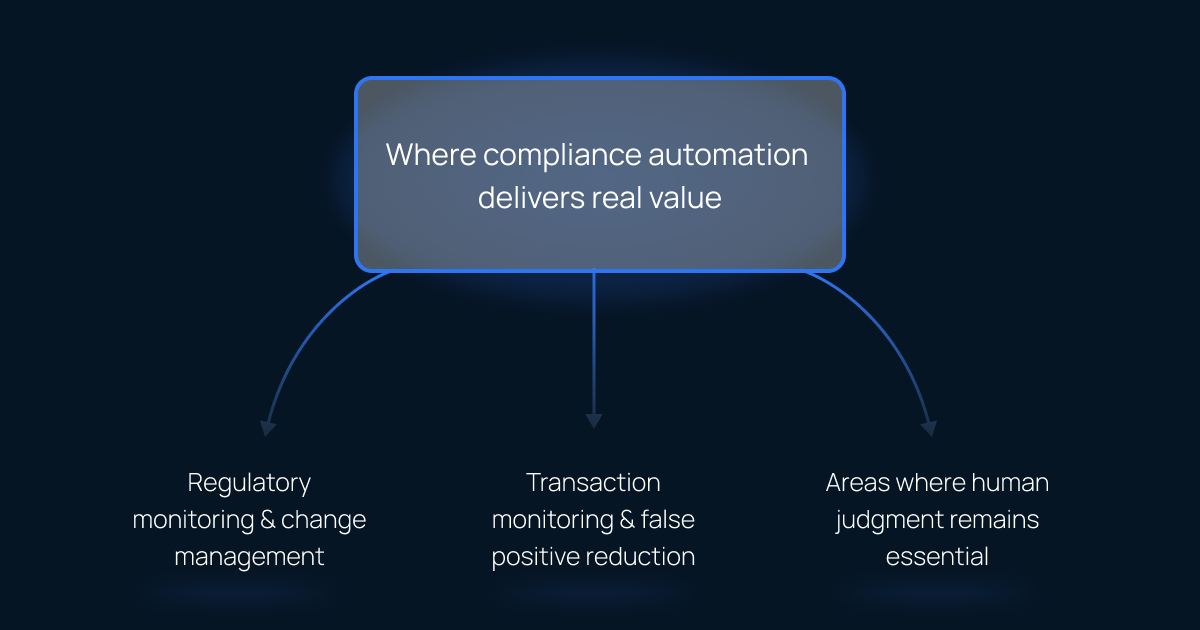
Where Compliance Automation Delivers Real Value
Regulatory Monitoring and Change Management
Monitoring for new regulations, rule changes, enforcement actions, and guidance documents across federal and state jurisdictions is a natural fit for AI automation. The task is information-intensive, time-sensitive, and pattern-driven exactly the profile where AI systems outperform manual processes. Institutions with automated regulatory monitoring reduce the time between a regulatory change being published and the compliance team being notified from days or weeks to hours, and they virtually eliminate the risk of missing a change entirely a risk that grows as regulatory volume increases and compliance teams face resource constraints.
Transaction Monitoring and False Positive Reduction
Areas Where Human Judgment Remains Essential
The Governance Foundation That Makes Compliance Automation Work
How PiTech Delivers Compliance Automation That Survives Regulatory Scrutiny
For BSA/AML specifically, PiTech designs hybrid monitoring architectures that combine interpretable models for the suspicious activity determination layer the layer that regulators directly scrutinize in SAR filings with more sophisticated models for upstream pattern detection. This architecture satisfies BSA/AML documentation requirements while capturing the performance advantage of advanced pattern detection. The SAR narrative documentation produced by the system reflects the actual model reasoning, not a generic description that creates examination risk.
Frequently Asked Questions (FAQs)
What does PiTech's HIPAA-Aligned AI Architecture service include?
How does PiTech approach OCC SR 11-7 compliance for AI-driven compliance systems?
What does PiTech’s compliance automation governance foundation phase include?
How does PiTech handle cross-framework regulatory compliance for institutions with both US and EU obligations?
PiTech maps compliance automation systems against both US regulatory frameworks OCC, FDIC, Federal Reserve, CFPB, FinCEN and EU AI Act requirements for high-risk financial services AI systems. We build dual-compliance governance architectures that satisfy both regulatory regimes simultaneously rather than maintaining parallel compliance programs, leveraging the substantial overlap between US model risk management requirements and EU AI Act conformity assessment requirements to minimize duplicative compliance effort.