
Table of Contents
Summarize and analyze this article with

Chat GPT

Perplexity

Grok

Google AI

Claude
Introduction
Most US bank mergers encounter problems after the deal closes, not during the negotiation process. Integration of systems, data, teams, and customers is where the real risk begins.
Once the deal is signed, banks must unify systems, migrate data, align cultures, and reassure customers, all while meeting strict regulatory expectations. For many institutions, this phase is far more complex than the acquisition itself. A poorly executed integration can lead to system outages, customer churn, regulatory scrutiny, and a loss of merger value.
This is why post-merger integration for US banks must be treated as a structured, multi-year transformation but certainly not a short-term IT project. This blog explains how US bank merger plans should address technology, data, people, and customers to ensure a smooth and secure transition.
What Is Post-Merger Integration in Banking?
- Regulated customer data
- Legacy core banking platforms
- Multiple digital channels
- Branch and workforce consolidation
- Heightened customer sensitivity to change
Key Phases of a Post-Merger Integration Plan for US Banks
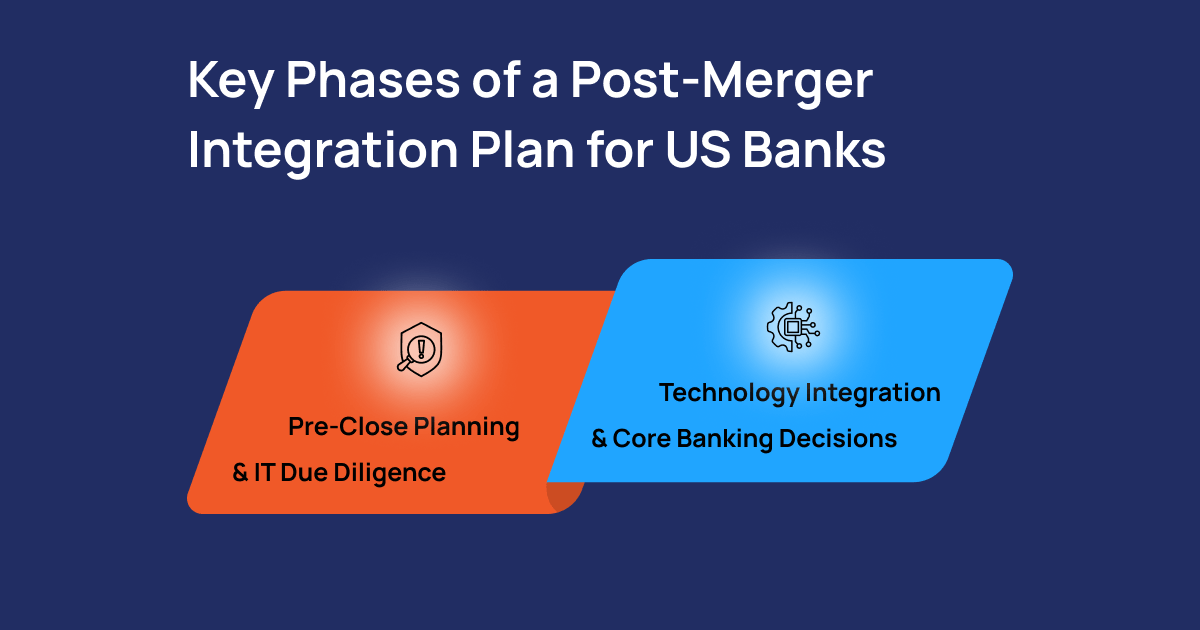
1. Pre-Close Planning and IT Due Diligence
- Mapping core banking systems and digital platforms
- Identifying overlapping applications and vendors
- Assessing data quality, security, and regulatory risks
- Defining Day-1 operational readiness
2. Technology Integration and Core Banking Decisions
Technology is the backbone of any bank merger. One of the most difficult decisions is whether to retain, replace, or consolidate core systems.
A structured bank merger technology strategy typically includes:
- Application rationalisation (stop, continue, transform)
- Infrastructure consolidation
- Vendor and licensing optimisation
- Cybersecurity and access control alignment
According to EY, banks that align technology decisions with long-term business strategy are far more likely to succeed than those that treat it as a short-term cost savings decision.
This phase defines the foundation for post acquisition banking integration.
Data Migration During US Bank Mergers: Risks and Best Practices
Common risks include:
- Data loss or duplication
- Inconsistent customer profiles
- Broken integrations with downstream systems
- Regulatory non-compliance
Best practices for US banks:
- Perform multiple test migrations before final cutover
- Use reconciliation tools to validate data accuracy
- Migrate in phases rather than “big-bang” approaches
- Maintain parallel systems during transition periods
Timeline: How Long Does Full Integration Take After a US Bank Merger?
First 90 Days (Stabilisation Phase)
- Day-1 readiness
- Customer communication
- Initial system access alignment
- Leadership and governance setup
3 to 9 Months (Execution Phase)
- Core system migrations
- Data consolidation
- Branch and staff transitions
- Process standardisation
12 to 24 Months (Optimization Phase)
- Legacy system retirement
- Digital transformation initiatives
- Advanced analytics and AI adoption
- Culture and performance alignment
What Happens to Customer Accounts After a Bank Merger?
One of the most searched questions during mergers is “What happens to my account in a bank merger?”
From a customer perspective, changes may include:
- New account numbers or routing details
- Updated mobile and online banking interfaces
- Reissued debit or credit cards
- Modified fee structures or product names
Clear, proactive communication is critical. Poor messaging is a leading cause of customer churn during the US bank post-merger phases.
Banks that prioritize US bank merger customer impact management typically retain higher customer loyalty, even during large-scale transitions.
Cultural Alignment and Workforce Integration
Technology issues can be fixed. Cultural misalignment is far harder to repair.
Post-merger success depends on:
- Leadership alignment across both institutions
- Transparent communication with employees
- Harmonised performance metrics and incentives
- Respect for institutional identity and legacy
Treasury and Financial Operations Integration
- Consolidation of cash management systems
- Alignment of liquidity risk frameworks
- Integration of payment rails and reporting tools
- Governance over treasury decision-making
Role of AI in Accelerating Bank Merger Integrations
AI is increasingly being used to reduce complexity and risk in banking M&A integration.
Practical AI use cases include:
- Automated data mapping and reconciliation
- Predictive identification of customer churn risk
- Anomaly detection during data migration
- Intelligent document review for compliance reporting
How US Banks Can Minimize Risk and Customer Churn Post-Merger
- Early and realistic planning
- Phased technology and data migration
- Customer-first communication strategies
- Strong governance and accountability
- Selective use of AI and automation
Banks that treat integration as a business transformation, not just an IT exercise, consistently outperform peers in merger outcomes.
Conclusion
Post-merger integration is where US bank mergers are truly won or lost. From bank merger technology decisions to data migration, cultural alignment, and customer trust, every element must work in coordination.
Institutions that invest in structured post merger integration plans for banks, supported by modern tooling and disciplined execution, are far better positioned to realise merger value while minimising disruption. In an era of increasing consolidation, integration excellence is no longer optional—it is a competitive advantage.
Planning a bank merger or acquisition?
Partner with PiTech to de-risk post-merger integration—from core banking technology and data migration to AI-driven optimisation. Talk to our banking integration experts and ensure a secure, regulator-ready transition.

Key Takeaways
- Post-merger integration determines success — not the deal itself, but how effectively systems, data, people, and customers are integrated.
- Early IT due diligence is critical to reduce operational risk, regulatory exposure, and unexpected post-merger costs.
- Data migration is the highest-risk area, requiring phased execution, multiple validations, and strong governance to avoid compliance issues.
- Full US bank integration typically takes 12–24 months, with stabilisation, execution, and optimisation phases that should not be rushed.
- Customer communication directly impacts retention,</b. as unclear messaging is a leading cause of churn during bank mergers.
- AI accelerates integration while reducing risk, supporting data accuracy, compliance, and customer experience when used selectively.
Frequently Asked Questions (FAQs)
What are the key steps in a post-merger IT integration plan for US banks?
The key steps in a post-merger IT integration plan for US banks include early IT due diligence, core system assessment, application rationalisation, phased data migration, cybersecurity alignment, and post-merger optimisation. Successful plans prioritise Day-1 readiness, regulatory compliance, and long-term scalability over short-term cost savings.