
Manufacturing AI Is Now Running the Plant Floor. Here’s What It Takes to Deploy It Without Creating New Risks

Table of Contents

Summarize and analyze this article with

ChatGPT

Chat GPT

ChatGPT

Perplexity

 
ChatGPT

Grok

 
ChatGPT

Google AI

ChatGPT

Claude


The Scale of Manufacturing AI Deployment in 2026

More than 40 percent of manufacturers with production scheduling systems are upgrading to AI this year — not piloting, not evaluating, actively upgrading production operations. Twenty-nine percent are already running AI and machine learning at the facility or network level. Generative AI deployment in manufacturing has reached 24 percent at operational scale. Companies in the energy sector are spending $897 million annually on agentic AI systems that coordinate forecasting, scheduling, and optimization across entire operational environments. The pilot phase is over for early movers. The operational math is compelling: AI-driven manufacturers are achieving 15 to 30 percent production cost reductions. But the gap between manufacturers deploying AI successfully and those creating expensive new problems — integration failures, data quality breakdowns, security exposures, models that degrade faster than expected — almost always comes down to process readiness, not technology selection.

Why Manufacturing AI Deployment Is Different From Enterprise AI Deployment

Manufacturing AI does not just process information — it affects equipment, production schedules, supply chains, and physical safety systems. Legacy OT systems, strict safety requirements, distributed assets, regulatory environments including NERC CIP and environmental compliance, and the IT/OT security challenges that manufacturing connectivity creates — these factors make standard enterprise AI deployment playbooks inadequate.

The organizations succeeding at production-scale manufacturing AI have treated deployment with the same process rigor they apply to physical infrastructure projects: documented procedures, validation testing, rollback plans, and continuous monitoring.

Where Manufacturing AI Programs Are Stalling
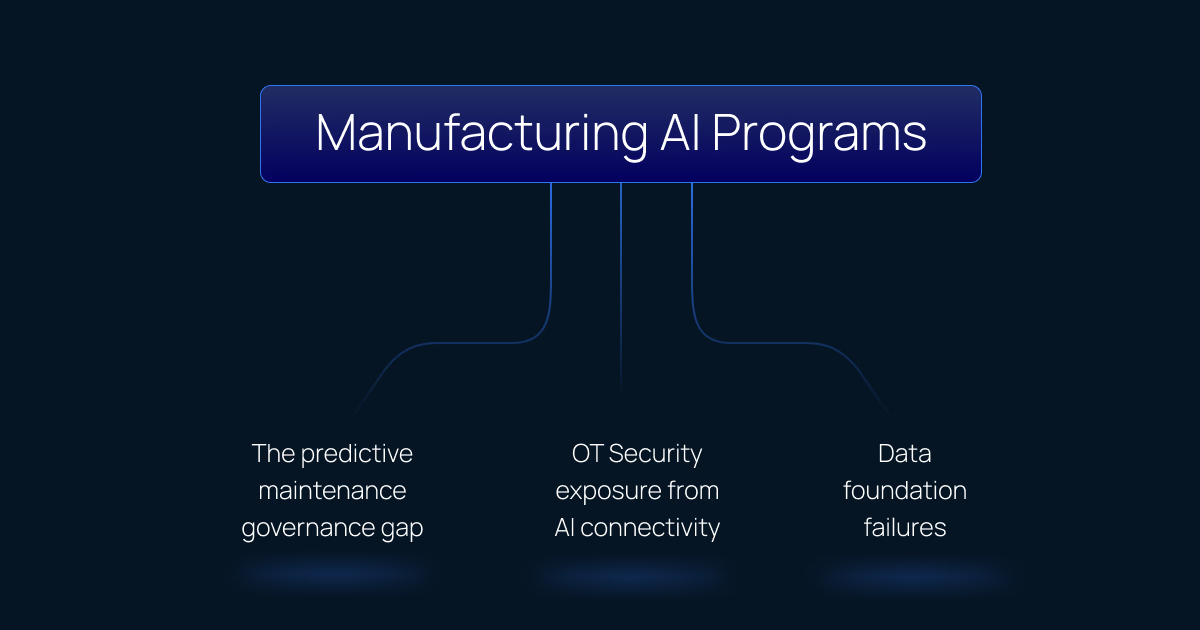
3a. The Predictive Maintenance Governance Gap

Predictive maintenance is the most commonly deployed manufacturing AI use case. But most deployments handle the technology well and the governance poorly. Sensors collect real-time data from production equipment. Models generate failure probability predictions. But who validates the sensor data quality? How is model drift detected when underlying equipment conditions change? In environments where maintenance decisions affect production safety and continuity, these governance gaps have operational and sometimes safety consequences.

3b. OT Security Exposure From AI Connectivity

Every AI deployment in a manufacturing or energy environment creates new data flows between operational systems and broader networks. The entry path for attackers is commonly through IT systems with lateral movement to OT environments enabled by insufficient network segmentation. AI deployments that create new IT/OT connectivity without corresponding OT security architecture reviews are expanding the attack surface faster than security programs can track.

3c. Data Foundation Failures

Manufacturing AI programs are consistently throttled by brittle and fragmented data foundations. Production data lives in equipment-specific historians. Maintenance records exist in separate CMMS platforms. Supply chain data lives in ERP systems implemented in different technological eras with different data definitions. The organizations that skip the data engineering and governance foundational work before deploying AI create expensive pilots that cannot scale.

How PiTech Helps Manufacturers Deploy AI at Production Scale

PiTech’s practice serving energy and manufacturing organizations combines OT security expertise, AI governance capability, and CMMI-certified delivery processes — three capabilities that most technology firms offer separately and that production-scale manufacturing AI requires together.

For AI readiness, we conduct comprehensive assessments of data foundations, operational processes, OT security posture, and organizational capability. When data foundations are not ready, we build data engineering and governance infrastructure first. Our AI governance frameworks address the full model lifecycle: model validation, decision rights, configuration management, continuous monitoring, and change management for model updates.

Where AI deployments create new IT/OT connectivity, PiTech integrates cloud architecture design and OT security architecture into the deployment program from day one — not as a subsequent workstream. Network segmentation review, OT asset inventory updates, monitoring extension, and third-party access controls are built in.

The Process Discipline Foundation That Makes the Difference

Deloitte’s 2026 analysis describes manufacturing AI implementations as throttled by weak governance, duplication, and uneven impact. The pattern is consistent: companies that invested in data governance, change management, and structured deployment processes before scaling AI are getting results. Companies that moved from proof-of-concept to production without that foundation are dealing with integration failures and models that degrade faster than expected.

PiTech’s CMMI certification and ISO standards are the institutional infrastructure that makes our manufacturing AI deployments reliably deliver what they are designed to deliver. When your production environment is the thing that needs to be protected and improved, your technology partner’s process discipline matters as much as their technical capability.

Frequently Asked Questions (FAQs)

How does PiTech integrate OT security into manufacturing AI deployments?

PiTech integrates OT security architecture review into AI deployment programs from the start — not as a subsequent separate workstream. Network segmentation review, OT asset inventory updates, monitoring extension for new data flows, and third-party access controls for AI platform vendors are built into the deployment architecture design.
PiTech’s manufacturing AI readiness assessment covers data foundation quality and governance, operational process documentation, OT security posture and IT/OT boundary definition, organizational change management capability, and regulatory environment mapping.
PiTech implements governance frameworks covering model validation, decision rights documentation, configuration management for the full data pipeline, continuous validation, and change management for model updates — applying the same CMMI-certified process discipline to AI model lifecycle management as we do to complex manufacturing programs.
Yes. PiTech’s practice serves both energy operators and manufacturers. Many of our most complex engagements span both — defense manufacturers with energy production on-site, industrial facilities with significant energy management requirements, and energy companies with manufacturing-adjacent operations.