
Table of Contents
Summarize and analyze this article with

Chat GPT

Perplexity

Grok

Google AI

Claude
Introduction
Bank mergers promise scale, efficiency, and digital strength. Yet real value appears only when banking technology synergy post merger execution succeeds. Many institutions still struggle to convert integration plans into measurable outcomes. Recent industry data from 2025 shows that fewer than half of projected IT savings materialize within two years, even though technology drives a large share of merger economics.
This blog explains how banks achieve technology synergy realization, where failures occur, and what leaders must do to unlock durable value after consolidation.
Why Banking Technology Synergy Defines Post Merger Success
Technology now sits at the center of every merger thesis. Core platforms, customer data, cybersecurity layers, and digital channels determine both cost efficiency and growth. Therefore, post merger IT synergies play a major role in shaping the overall return on investment.
Industry research indicates that technology contributes roughly 15 to 30 percent of total merger savings. However, execution gaps reduce realized value to nearly half of projections. This mismatch highlights the urgency of disciplined bank merger technology rationalization rather than symbolic integration.
Banks that succeed focus on three outcomes:
- Lower structural IT cost
- Unified digital customer experience
- Scalable data and AI foundation
How Banks Actually Capture Technology Synergies Post Merger
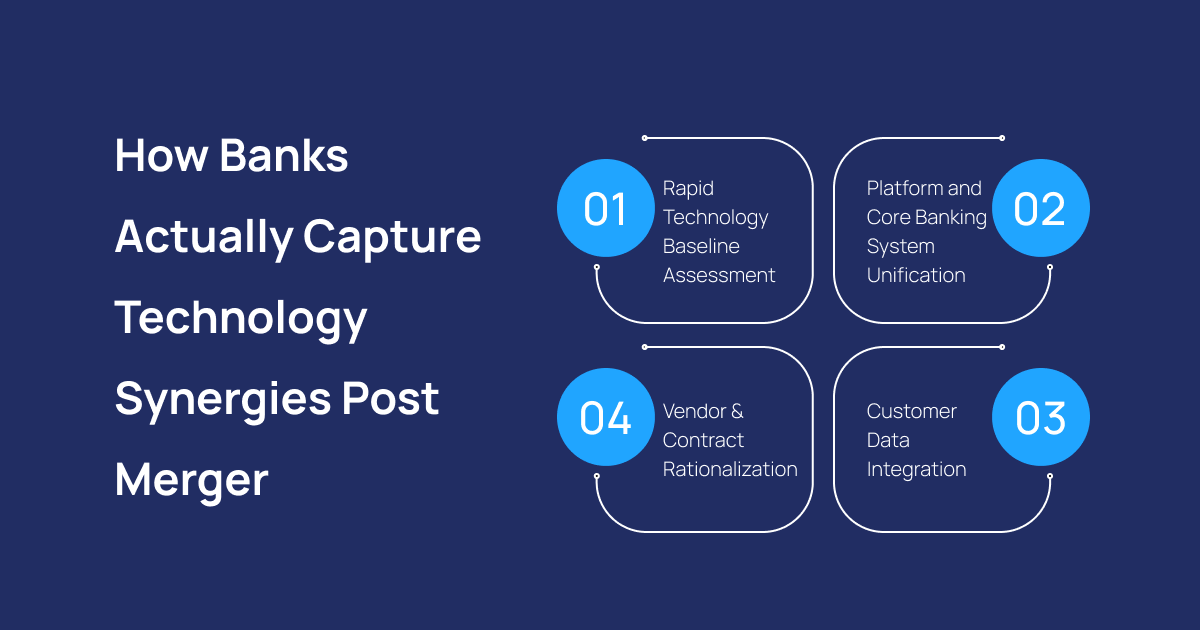
1. Rapid Technology Baseline Assessment
2. Platform and Core Banking System Unification
3. Vendor and Contract Rationalization
4. Customer Data Integration
Why Most Bank Mergers Fail to Deliver Promised IT Synergies
Siloed Planning and Governance
Platform Rationalization Delays
“Best of breed” debates stall platform rationalization banking M&A decisions. Each month of delay reduces projected savings.
Cultural Resistance
Measurement Confusion
Banks struggle to distinguish one time savings from run rate efficiency. Weak KPI design causes nearly 30 percent value leakage in large mergers.
These barriers explain why only 40 to 60 percent of projected technology synergies become real financial outcomes.
Real Examples of Successful Technology Synergy Realization
Recent global banking consolidations provide useful lessons.
- Large US regional bank mergers completed bank M&A tech stack unification within 18 months by selecting a single cloud native core.
- European digital bank acquisitions achieved rapid customer data integration mergers using centralized data lakes and API governance.
- Asian banking groups accelerated AI accelerated bank synergies through shared fraud detection and credit analytics platforms.
The Role of AI in Accelerating Post Merger Synergy
Artificial intelligence now plays a central role in AI technology synergy banking.
By 2026, analysts expect over 70 percent of large banks to use AI driven automation during integration programs. Key use cases include:
- Automated application dependency mapping
- Intelligent data reconciliation across legacy cores
- AI driven customer segmentation after digital synergy post merger
- Predictive cost tracking for measuring technology synergies
Measuring ROI on Technology Rationalization After Mergers
Cost Metrics
- Infrastructure reduction percentage
- License and vendor savings
- Application retirement count
Revenue Metrics
- Cross sell uplift from unified data
- Digital channel adoption growth
- Time to launch new products
Operational Metrics
- System availability improvement
- Incident reduction after bank tech stack integration
- Processing speed across unified platforms
Best Practices for Sustainable Banking Technology Synergy
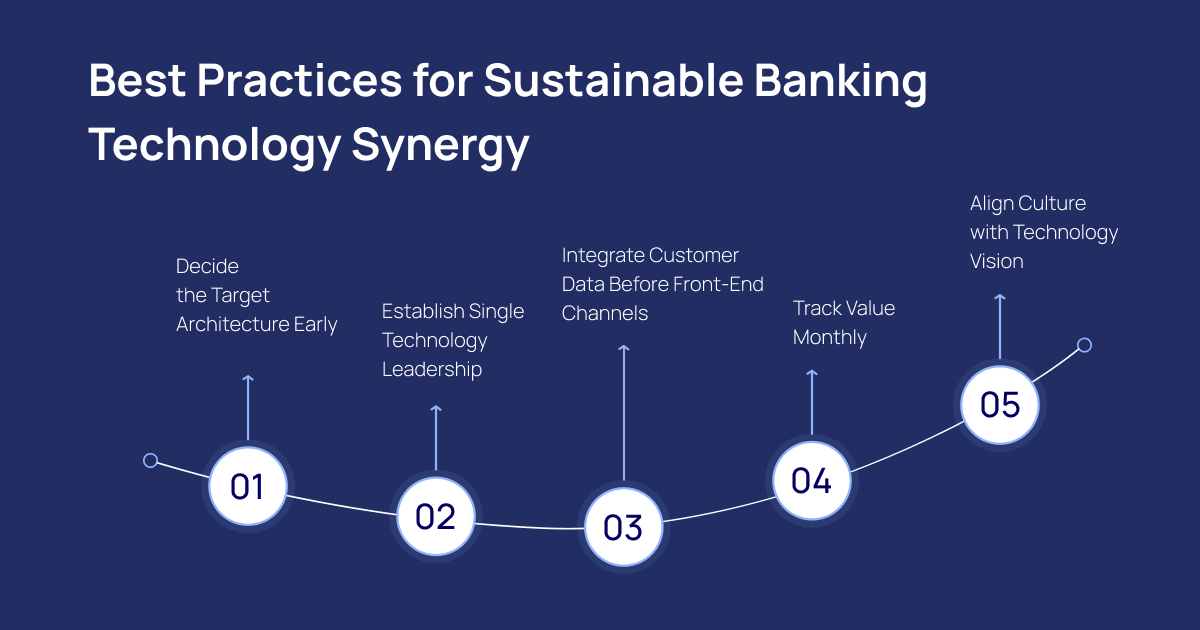
Decide the Target Architecture Early
Establish Single Technology Leadership
Integrate Customer Data Before Front-End Channels
Track Value Monthly
Align Culture with Technology Vision
The Future of Technology Synergy in Bank Mergers
- Cloud first core modernization will replace legacy coexistence models.
- AI driven integration tooling will cut timelines by nearly 30 percent.
- Real time data platforms will unlock continuous digital synergy post merger revenue rather than one time savings.
Ready to Accelerate Your Post-Merger Technology Synergy?

Key Takeaways
- Technology execution determines whether mergers deliver the expected 15 to 30 percent IT value, yet less than half of projected savings are usually realised.
- Early target architecture and core platform decisions are essential to prevent delays in bank merger technology rationalisation and accelerate synergy capture.
- Customer data integration drives real revenue through cross sell, AI driven segmentation, and stronger digital synergy post merger outcomes.
- Structured post merger vendor consolidation unlocks fast, measurable gains, often delivering 20 to 25 percent incremental IT savings by removing duplication.
- Unified governance, cultural alignment, and strong KPI tracking are critical since siloed leadership limits realised post merger IT synergies banks to about 40 to 60 percent.
- AI enabled automation, dependency mapping, and predictive cost tracking can reduce integration timelines by nearly 30 percent while improving measurable technology synergy realisation banking results.