
Table of Contents
Summarize and analyze this article with

Chat GPT

Perplexity

Grok

Google AI

Claude
Introduction
Operational excellence in banking has always depended on consistency, control, and reliability. What has changed is the scale and complexity at which banks must now operate. Rising transaction volumes, tighter regulations, fragmented legacy systems, and higher customer expectations have made traditional operating models difficult to sustain.
This is where operational banking AI is increasingly becoming a practical enabler rather than an experimental add-on. Banks are using AI to improve efficiency, strengthen controls, and reduce operational friction across core processes. When implemented correctly, AI banking excellence is less about transformation rhetoric and more about measurable improvements in day-to-day operations.
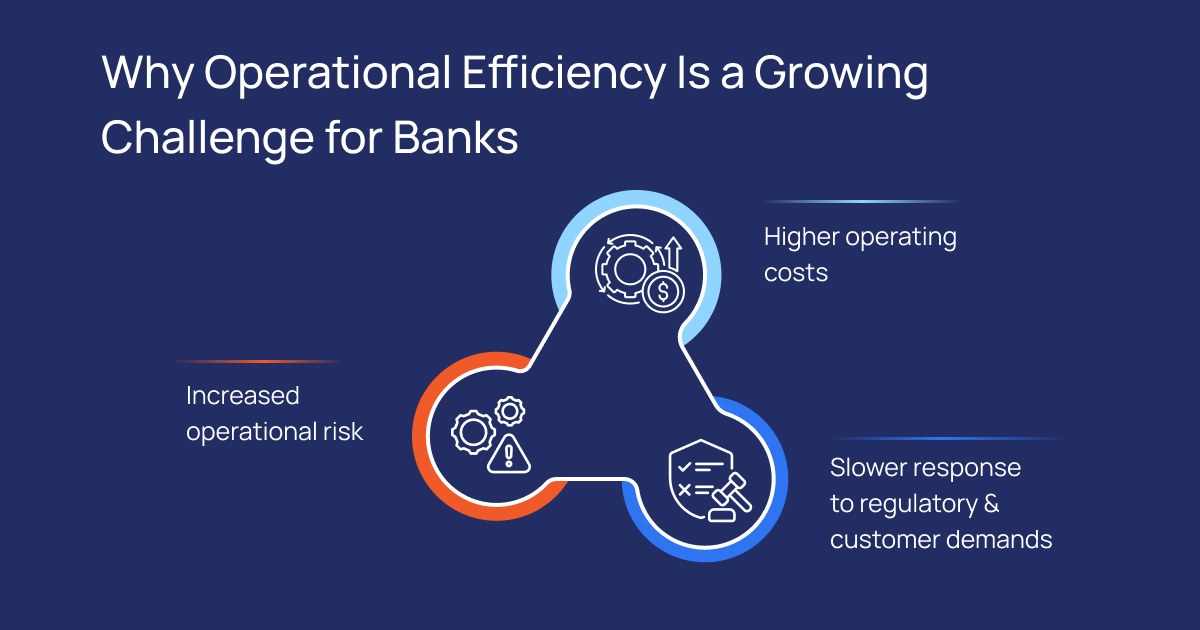
Why Operational Efficiency Is a Growing Challenge for Banks
- Higher operating costs
- Slower response to regulatory and customer demands
- Increased operational risk
Using AI to Improve Banking Operational Efficiency
- Document classification and validation
- Exception handling in transactions
- Pattern detection in large data sets
- Workflow prioritization and routing
Automating KYC and Onboarding With AI
- Extracting and validating identity data from documents automatically
- Flagging inconsistencies for targeted review
- Reducing onboarding time without lowering compliance standards
Generative AI in Fraud Detection and Risk Management
- Identify abnormal behavior across accounts and transactions
- Correlate signals that would be missed in siloed systems
- Adapt detection models as patterns change
AI-Driven Transaction Processing at Scale
- Straight-through processing rates
- Error detection before settlement
- Exception resolution through intelligent routing
- Modified fee structures or product names
Concerns around reliability are valid. Leading banks mitigate risk by applying AI within defined control frameworks, supported by audit trails and fallback rules.
Scaling AI for Compliance in Regulated Banking
- Aggregate regulatory data across systems
- Validate completeness and accuracy
- Maintain clear documentation and traceability
- Respect for institutional identity and legacy
Recent operational excellence research highlights that AI delivers the most value when embedded into compliance workflows, not layered on top as a reporting tool.
Integrating AI With Legacy Banking Systems
- Apply AI as a connective layer across platforms
- Standardize data access without disrupting core systems
- Improve visibility across end-to-end processes
Cost Optimization Through AI Banking Operations
- Lower manual processing effort
- Fewer rework cycles
- Reduced compliance remediation costs
These gains are cumulative, improving margins over time rather than delivering one-time savings.
AI Chatbots and Customer Service Operations
- Faster response times
- Consistent information delivery
- Better workload distribution for service teams
Measuring ROI From Generative AI in Banking Operations
ROI remains a key concern for banking leaders. The return from AI is not always immediate, but it is measurable.
With ROI generative AI banking, banks typically see value through:
- Reduced processing time per case
- Improved compliance accuracy
- Lower operational risk exposure
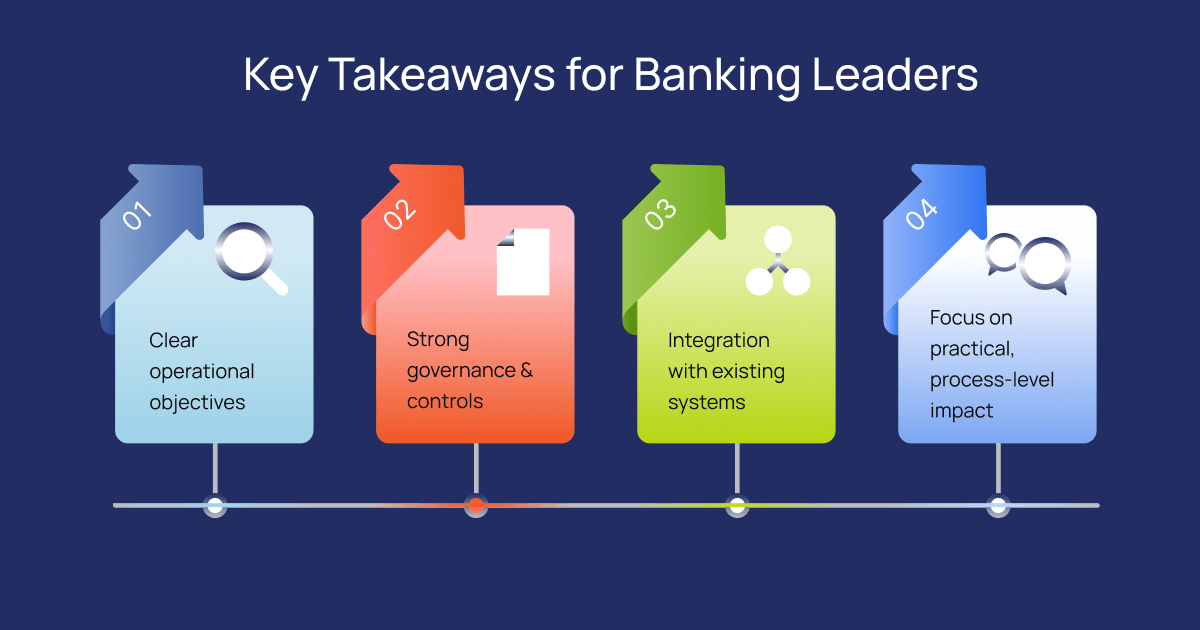
Key Takeaways for Banking Leaders
- Clear operational objectives
- Strong governance and controls
- Integration with existing systems
- Focus on practical, process-level impact
As regulatory pressure and cost constraints continue to rise, GenAI banking operations are shifting from experimentation to necessity. The banks that treat AI as part of their operating model, rather than as a standalone initiative, will be best positioned to sustain operational excellence.
Conclusion
Operational excellence in banking is no longer driven by incremental process improvements alone. AI is now central to how banks manage efficiency, compliance, and risk at scale. From KYC automation and fraud detection to transaction processing and regulatory reporting, PiTech’s Banking Hub solutions enable operational excellence.“AI enables banks to operate with greater accuracy, speed, and control.
The most effective banks treat AI as part of their operating model rather than a standalone initiative. By embedding AI into core workflows, integrating it with legacy systems, and applying strong governance, banks can achieve sustainable efficiency gains while meeting regulatory expectations. As cost pressures and operational complexity continue to rise, operational banking AI is becoming a necessity, not a differentiator.

Key Takeaways
- Operational banking AI improves efficiency by reducing manual effort across KYC, fraud detection, compliance, and transaction processing.
- AI banking excellence depends on governance, integration with existing systems, and clear operational objectives.
- KYC automation AI and fraud detection AI reduce processing time while strengthening risk controls.
- Compliance AI banking improves reporting accuracy and audit readiness in regulated environments.
- Cost optimization AI banking operations delivers sustained savings through process efficiency, not one-time cuts.
- ROI from GenAI banking operations is strongest when AI targets specific operational bottlenecks.
Frequently Asked Questions (FAQs)
How can AI automate KYC verification in banking?
AI automates KYC by extracting and validating identity data from documents, detecting inconsistencies, and routing only high-risk cases for manual review. This reduces onboarding time while maintaining compliance standards.
What are real-world GenAI use cases for fraud detection?
Banks use GenAI to analyze transaction patterns, detect anomalies across channels, and adapt fraud models as behavior changes. This improves detection accuracy and reduces false positives.
How do banks scale AI for compliance reporting?
Can LLMs handle transaction processing without errors?
LLMs support transaction processing by identifying exceptions, improving routing, and detecting anomalies. Banks control risk through defined rules, human oversight, and fallback mechanisms.
What risks come with GenAI in regulated banking?
Key risks include data privacy exposure, model bias, lack of explainability, and governance gaps. These risks are mitigated through controls, validation, and regulatory-aligned oversight.