
Table of Contents
Summarize and analyze this article with

Chat GPT

Perplexity

Grok

Google AI

Claude
Introduction
The New Era of Banking M&A
Traditional M&A Challenges in Banking
- Exhaustive due diligence processes requiring review of thousands of documents, contracts, and financial statements
- Risk assessment complexity involving credit portfolios, regulatory exposure, and operational risks
- Compliance verification across multiple jurisdictions and evolving regulatory frameworks
- Post-merger integration challenges that often determine deal success or failure
- Slow deal execution timelines that can span 12-18 months from announcement to completion

These bottlenecks not only increase transaction costs but also create vulnerability windows where market conditions, regulatory landscapes, or target company performance can shift dramatically.
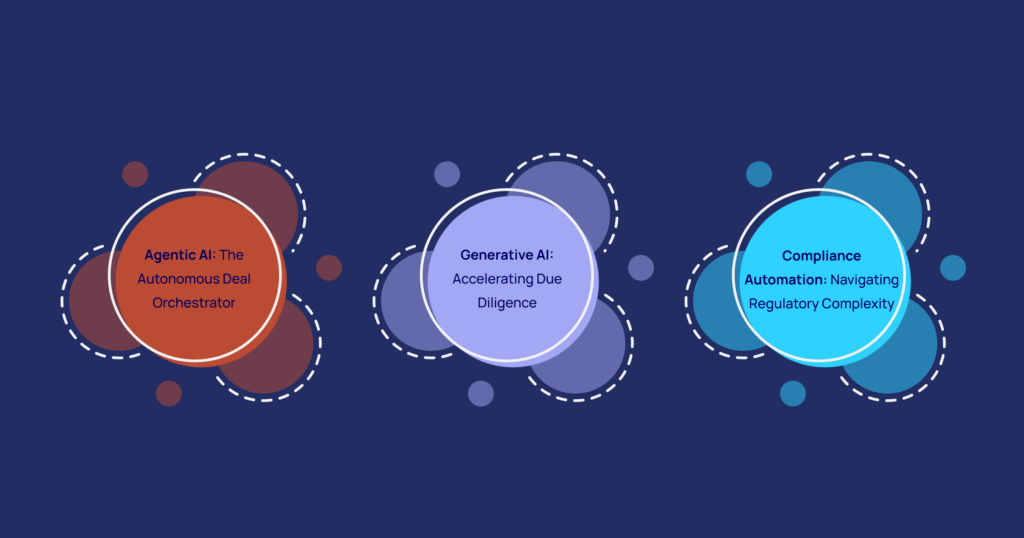
Agentic AI: The Autonomous Deal Orchestrator
Agentic AI banking use cases are revolutionizing how institutions approach mergers and acquisitions in banking. Unlike traditional AI systems that require constant human intervention, Agentic AI operates autonomously, making decisions and executing tasks across the M&A lifecycle.
Intelligent Deal Sourcing and Target Screening
Agentic AI systems continuously monitor the banking landscape, analyzing financial performance metrics, market positioning, regulatory filings, and strategic fit indicators. These systems can autonomously:
- Screen thousands of potential acquisition targets based on predefined strategic criteria
- Generate detailed target profiles with financial health scores and synergy potential
- Prioritize opportunities based on real-time market intelligence and competitive dynamics
- Alert deal teams to emerging opportunities before they become publicly known
This proactive approach reduces target identification time from months to days, enabling institutions to move swiftly in competitive bidding situations.
Autonomous Risk Assessment and Valuation
AI-driven risk assessment M&A capabilities have transformed how banks evaluate potential acquisitions. Agentic AI systems deploy sophisticated algorithms that:
- Analyze entire loan portfolios for credit risk exposure in minutes rather than weeks
- Identify hidden liabilities buried in legal documents and historical transactions
- Model thousands of integration scenarios to predict post-merger performance
- Assess cultural compatibility through sentiment analysis of employee communications and reviews
AI-powered M&A insights generated through these autonomous systems provide decision-makers with unprecedented clarity on deal risks and opportunities.
Generative AI: Accelerating Due Diligence
While Agentic AI orchestrates processes, GenAI excels at content generation, analysis, and synthesis—critical capabilities for AI-driven due diligence banking.
Document Intelligence and Synthesis
Generative AI transforms the document-intensive due diligence process by:
- Automatically extracting and summarizing key terms from thousands of contracts, loan agreements, and regulatory filings
- Generating comprehensive due diligence reports that synthesize findings across legal, financial, and operational domains
- Creating comparison matrices that highlight discrepancies between target representations and discovered facts
- Drafting preliminary integration plans based on identified operational overlaps and synergies
Financial institutions leveraging GenAI in banking M&A report up to 80% reduction in manual effort for document review and analysis.
Predictive Analytics for Deal Success
AI predictive analytics in banking acquisitions leverage historical M&A data to forecast outcomes. GenAI models trained on decades of banking transactions can:
- Predict regulatory approval likelihood based on market concentration metrics and historical precedents
- Estimate integration timelines and identify potential execution risks
- Forecast revenue synergies and cost savings with greater accuracy than traditional financial models
- Generate scenario analyses showing deal value under various economic conditions
Compliance Automation: Navigating Regulatory Complexity
AI compliance automation in financial mergers addresses one of the most challenging aspects of banking M&A. The regulatory landscape for financial institutions is extraordinarily complex, involving multiple federal and state agencies with overlapping jurisdictions.
Real-Time Regulatory Monitoring
AI systems continuously monitor regulatory requirements across all relevant jurisdictions, automatically:.
- Tracking changes to merger review criteria and antitrust thresholds
- Flagging compliance gaps in proposed deal structures
- Generating required regulatory filings with appropriate documentation
- Maintaining audit trails that demonstrate regulatory adherence throughout the transaction
This proactive compliance approach significantly reduces the risk of regulatory delays or rejections that have historically plagued larger acquisitions.
Fraud Detection and Financial Crime Prevention
AI-driven risk assessment in M&A extends to financial crime screening. Before completing acquisitions, banks must ensure targets aren’t exposed to money laundering, fraud, or sanctions violations. AI systems:
- Analyze transaction patterns across target institutions to identify suspicious activity
- Screen customers and counterparties against sanctions lists and adverse media
- Assess anti-money laundering program effectiveness through transaction monitoring analysis
- Generate comprehensive financial crime risk assessments for acquirer boards and regulators
Post-Merger Integration: Where AI Delivers Maximum Value
The success of any mergers and acquisitions in banking ultimately depends on integration execution. Post-merger integration AI automation is transforming this critical phase.
Agentic AI systems orchestrate the complex technical integration process by:
- Mapping data structures across legacy systems to identify compatibility issues
- Automating data migration and validation processes
- Optimizing branch and ATM network configurations based on customer usage patterns
- Recommending product rationalization strategies that maximize customer retention
Customer Experience Optimization
AI-powered M&A insights enable banks to maintain customer satisfaction during transitions. AI systems:
- Predict which customer segments face highest attrition risk during integration
- Personalize communication strategies for different customer cohorts
- Identify opportunities to cross-sell products from the combined institution
- Monitor sentiment across digital channels to detect and address integration friction points
Financial institutions deploying these capabilities report significantly higher customer retention rates and faster realization of revenue synergies.
Real-World Impact: Measurable Outcomes
- 80% reduction in manual due diligence effort, freeing senior bankers to focus on strategic decision-making.
- Accelerated deal timelines, with some transactions completing 30-40% faster than traditional approaches
- Enhanced accuracy in risk and valuation assessments, reducing post-close surprises
- Improved regulatory outcomes, with higher approval rates and fewer conditional approvals
- Superior integration success, with faster achievement of projected synergies
The Future of AI-Driven M&A
As we progress through 2025 and beyond, the convergence of Agentic AI and Generative AI will continue reshaping mergers and acquisitions in the banking sector. Institutions that embrace these technologies position themselves to execute smarter, faster, and more compliant deals while competitors struggle with manual processes.
The fragmented U.S. banking landscape, with over 4,400 institutions remaining, ensures continued consolidation opportunities. However, success will increasingly belong to those who leverage AI-driven due diligence banking and AI compliance automation financial mergers to gain competitive advantages in deal execution.
Conclusion
The transformation of mergers and acquisitions in banking through Agentic AI and GenAI represents more than technological evolution; it’s a fundamental reimagining of how financial institutions approach strategic growth. By automating labor-intensive processes, enhancing decision-making through predictive analytics, and ensuring regulatory compliance, AI technologies are enabling banks to execute transactions that were previously too complex, risky, or time-consuming to pursue.
Financial institutions and investment banks seeking to modernize their M&A capabilities can deploy these AI technologies to capture value in an increasingly competitive consolidation landscape. The future of banking M&A is intelligent, autonomous, and already here.
Transform your M&A lifecycle with AI-driven due diligence, risk modelling, and integration intelligence with PiTech. Start your journey today.

Key Takeaways
- AI is transforming the entire M&A lifecycle—from deal sourcing to integration.
- Agentic AI operates autonomously, reducing screening and risk analysis timelines.
- GenAI accelerates due diligence with automated document intelligence and synthesis.
- AI strengthens valuation accuracy with predictive analytics and scenario modelling.
- Compliance becomes faster and safer through automated monitoring and audit trails.
- AI-driven integration improves customer retention and accelerates synergy capture
- Banks using AI see up to 80% reduction in manual effort and faster deal execution.
- The future of banking M&A belongs to institutions that adopt AI-first strategies early.
- Future-ready fraud detection will be predictive, self-learning, and resilient — making AI the foundation of secure digital banking.
Frequently Asked Questions (FAQs)
How is Generative AI transforming M&A in banking?
GenAI automates document review, synthesises reports, extracts insights, and generates predictive models—cutting due diligence time by up to 80%.
What role does Agentic AI play in banking mergers?
Agentic AI autonomously scans markets, identifies targets, evaluates risks, and triggers alerts—reducing target screening from months to days.
Can AI accurately predict risks and opportunities in bank acquisitions?
Yes. AI models analyse credit portfolios, operational risks, regulatory patterns, and market shifts to produce more accurate valuation and risk forecasts.
How does AI improve compliance during financial mergers?
AI automates regulation mapping, tracks real-time policy changes, flags compliance gaps, and generates complete audit trails for regulators.
What are the best AI use cases in post-merger integration?
Key use cases include automated data migration, customer churn prediction, portfolio fraud monitoring, branch optimisation, and product rationalisation.