
CECL
Compliance Achieved
Audit- Ready
Documentation Standard
Cost Overruns
0
%
Reduced
Manual Reconciliation
Client Snapshot
Industry
Banking & Financial Services
Client Type
Larger Regional Bank
Scope
Enterprise risk data mart · CECL expected-loss calculations · Regulatory reporting

Platform
IBM DB2 · IBM InfoSphere · IBM Cognos Analytics
Engagement
Solution Architecture · Data Mart Development · Compliance Integration
The Challenge
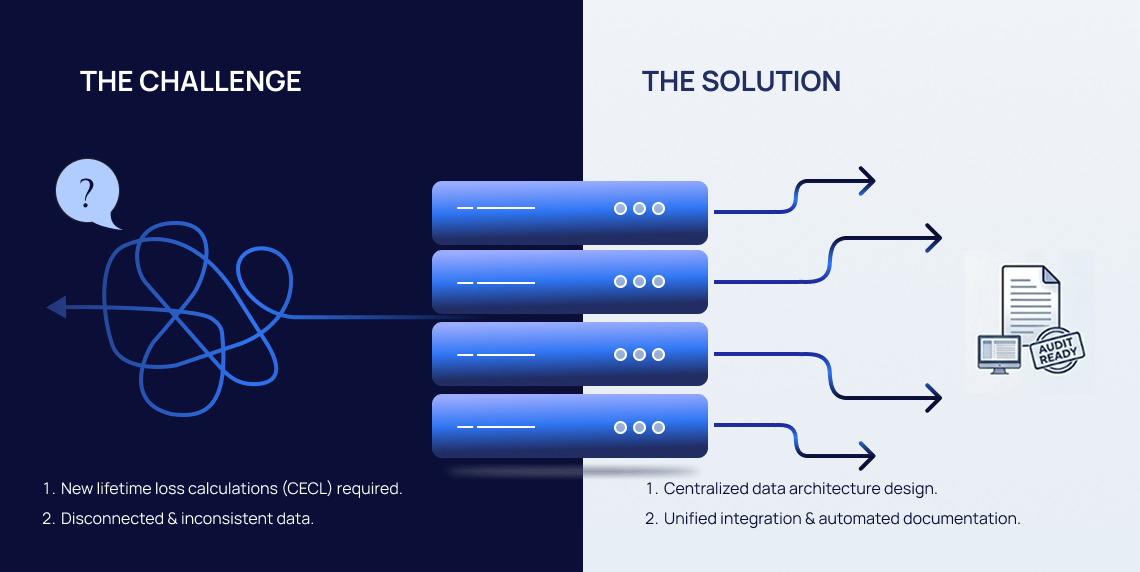
- CECL the Current Expected Credit Loss standard fundamentally changed how banks calculate and report credit losses, requiring institutions to estimate lifetime expected losses from origination rather than recognizing losses only after they occurred. For a bank with a complex credit portfolio spread across multiple systems, this meant building a data architecture capable of producing defensible expected-loss calculations with full lineage back to source data.
- The bank's existing source systems were fragmented. Credit data lived across multiple platforms with different data models, update frequencies, and governance standards. Producing a single, consistent expected-loss calculation required either a real-time integration layer the bank did not have or a consolidated risk data mart that could bring the data together in a governed, traceable environment.
- Manual reconciliation had been the interim solution analysts pulling data from multiple sources and reconciling discrepancies in spreadsheets before producing CECL estimates. This process was not sustainable, was prone to human error, and would not survive examiner scrutiny as CECL reporting became a standard audit focal point.
- Examiner expectations for CECL documentation were high. Regulators wanted to see not just the final numbers but the complete data lineage which source systems contributed which data, under which transformation rules, validated against which controls. Producing that documentation retrospectively for a spreadsheet-based process was nearly impossible.
- The risk data mart had to integrate cleanly with the bank's modernized ingestion and shared-services layer, which was itself being built concurrently. Design decisions made on one program directly constrained the other — requiring cross-program coordination that added complexity to both efforts.
The PiTech Solution
- Designed the end-to-end solution architecture for the enterprise risk data mart, establishing the data model, source-to-target mappings, transformation logic, and validation framework required to support CECL expected-loss calculations across the full credit portfolio.
- Built and deployed the code packages and ETL processes that populate the risk data mart from the bank's source systems — applying the data model and transformation logic defined in the architecture phase, with validation controls that caught data quality issues before they propagated into CECL calculations.
- Integrated the risk data mart into the bank's modernized ingestion and shared-services layer, ensuring that CECL reporting consumed data through the same governed pipeline as other regulatory and analytical consumers — eliminating the data quality discrepancies that had previously required manual reconciliation.
- Designed the data mart to produce audit-ready documentation as a standard output throughout the calculation and reporting lifecycle. Source-to-target lineage, transformation rule documentation, and validation exception reports were generated automatically — giving examiners the traceability they required without requiring analysts to produce it manually.
- Coordinated with the bank's compliance and risk teams throughout development to align the data mart's output to the specific CECL methodology the bank had selected, ensuring that the technical implementation supported the bank's regulatory position rather than creating ambiguity about which data underpinned each estimate.
Results That Matter
A CECL-ready enterprise risk data mart now supports the bank's full expected-loss
calculation and reporting lifecycle replacing a fragmented, manual process with a
governed, automated, audit-ready data environment.
Manual reconciliation across fragmented source systems was substantially reduced.
Analysts shifted from data assembly work to analytical work a change in how the risk
function spends its time that compounds over every reporting cycle.
Audit-ready documentation is produced as a standard platform output, not assembled
after the fact. The bank entered its post-implementation examination cycle with
complete, automatically generated source-to-target lineage for every CECL estimate.
The risk data mart integrated cleanly with the broader ingestion modernization program,
creating a unified data architecture that serves CECL reporting, credit risk analytics, and portfolio management from shared, governed infrastructure.
Delivered on time and on budget, zero cost overruns the consistent outcome across
every engagement in this institution's decade-long PiTech partnership.
Technology Stack
Databases & Data Management
Databases & Data Management
IBM DB2 (primary store), IBM InfoSphere (ETL and
data governance)
Reporting & Analytics
Reporting & Analytics
IBM Cognos Analytics (CECL reporting and risk dashboards)
Architecture Deliverables
Architecture Deliverables
Source-to-target data maps, transformation rule
documentation, CECL data model
Compliance
Compliance
Automated audit lineage generation, validation exception reporting
framework
Delivery Methodology
Delivery Methodology
Multi-track Agile (Business Analysis · Development · Technology)
Architecture Artifacts
Architecture Artifacts
Gap analysis documentation, migration runbooks, operational
governance framework
Why PiTech
PiTech designs CECL data architectures that satisfy regulators and examiners not just datateams. The audit-trail standard expected by federal banking oversight bodies is built into theplatform from the architecture phase, not retrofitted after the first examination finds gaps. That
standard is consistent with how PiTech approaches every federal and regulated-industry
engagement.

Ready to achieve results like these?
Talk to PiTech. Federal-grade delivery discipline. Deep domain expertise. Zero cost overruns.

Reach Our Customer Service Team
-
Address
4000 Sancar Way, Suite 205, Durham, NC 27709
-
Contact Details
(919) 439-3163
