
Business Units Aligned
0
Cost Overruns
100
On-Time Delivery
0
%
Continuous Partnership
0
Y
Client Snapshot
Industry
Banking & Financial Services
Client Type
Larger Regional Bank
SCope
Credit Administration · Credit Operations · Underwriting · Compliance

Disciplines
Program Management · Enterprise Architecture · Data Architecture · Visualization · Training
Engagement
Architecture Design · Stakeholder Workshops · Validation Solutions · User Training
The Challenge
- The bank's four credit business units — credit administration, credit operations, underwriting, and compliance — operated on disconnected systems with no shared architectural foundation. Each unit maintained its own data definitions, processing logic, and reporting conventions, making cross-functional decisions slow, rework-intensive, and difficult to defend to regulators who expected a coherent, documented credit process.
- There was no unified target architecture to guide technology investment decisions or align the organization on a common direction. Individual teams were making incremental system changes in isolation, creating integration debt that compounded with each project cycle. Strategic planning conversations stalled because leadership had no shared blueprint to anchor prioritization discussions.
- Regulatory examination cycles were exposing documentation gaps in the bank's credit process architecture. Examiners expected institutions of this size to operate from a documented, version-controlled understanding of how credit data flowed across systems and functions. The bank's response — produced ad hoc before each examination — was not sustainable and was beginning to attract examiner commentary.
- User adoption of existing credit systems was inconsistent across the four business units. Workarounds had proliferated as users adapted to system limitations, creating undocumented process variation that was invisible to management and audit functions until something failed. Retraining users on a new architecture would require a fundamentally different approach — embedded enablement rather than classroom instruction.
- Leadership recognized that a successful transformation required more than a technology decision. The organizational alignment problem — getting four business units with different priorities, incentives, and system dependencies to commit to a shared architectural direction — was as complex as the technical problem, and no one owned it.
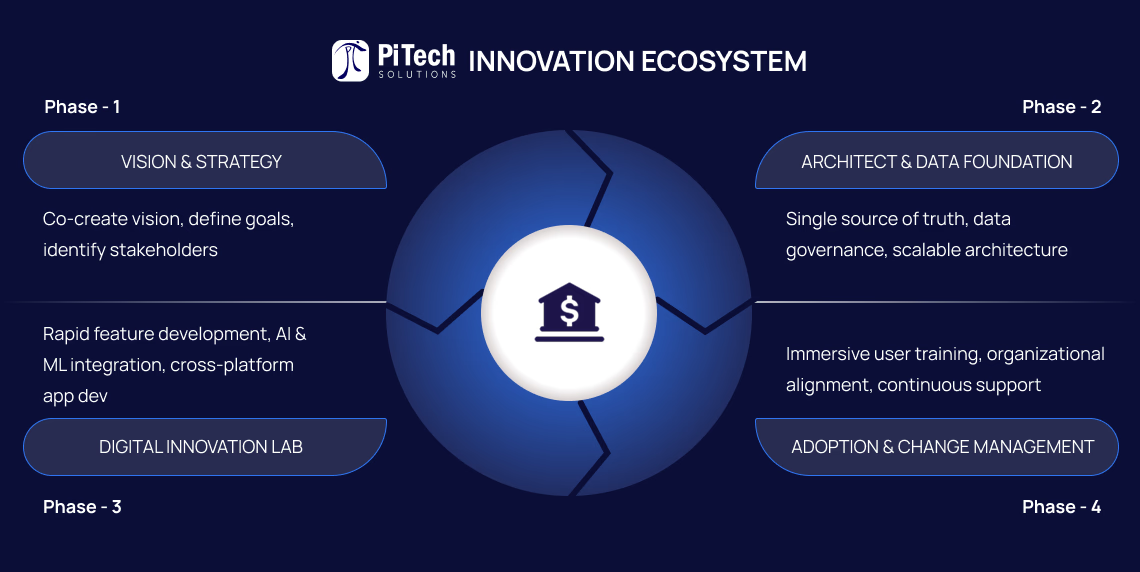
The PiTech Solution
- Designed and facilitated a structured workshop series with stakeholders from all four business units to surface conflicting process assumptions, document the current-state credit architecture, and build the cross-functional alignment required before any target-state design could be credibly executed. Workshops were structured to produce decision records, not just discussion — each session ended with documented agreements on scope, definitions, and priorities
- Conducted a detailed current-state analysis of data flows, system dependencies, and process hand-offs across credit administration, credit operations, underwriting, and compliance. The resulting As-Is architecture documentation served as the authoritative baseline for target-state design and the audit-ready artifact the bank needed for regulatory examinations.
- Designed a unified target data and systems architecture spanning all four business units, with clear data ownership assignments, interface specifications between systems, and a phased implementation roadmap that sequenced changes by risk and dependency. The target architecture was designed to accommodate the bank's existing platform investments rather than requiring wholesale replacement.
- Built visualization and decision-support solutions directly on top of the new architecture — operational dashboards that surfaced credit process KPIs in real time, data validation tools that flagged inconsistencies before they became audit findings, and workflow integration points that embedded the new architecture into daily credit decision-making rather than leaving it as a documentation artifact.
- Delivered role-based user enablement programs designed around actual job workflows, not platform feature lists. Training was embedded into go-live sequences so that users experienced the new architecture through their daily work from day one. Adoption metrics were defined in advance and tracked through workflow data — not completion certificates.
Results That Matter
Unified credit architecture blueprint adopted across all four business units, replacing the fragmented, unit-specific system documentation that had created cross-functional friction and regulatory examination risk.
Current-state architecture documentation produced as an audit-ready deliverable, directly addressing the examination gaps that had been attracting regulatory commentary. The bank entered its next examination cycle with a structured, defensible response to process architecture questions.
Decision-support tools and operational dashboards embedded into daily credit workflows reduced the time credit administrators and operations staff spent on manual data reconciliation — a recurring source of errors and rework under the previous state.
User adoption achieved and measured through workflow metrics, not training completion rates. Workarounds were eliminated systematically by embedding process changes into system interfaces rather than relying on behavioral change alone.
The target architecture became the strategic foundation for a decade of subsequent technology investment and a partnership that has extended across nine distinct banking use cases — all delivered on time and on budget.
Technology Stack
Architecture Modeling
Architecture Modeling
Enterprise data architecture frameworks, current-state and target-state modeling tools
Visualization & Dashboards
Visualization & Dashboards
Decision-support dashboard design, credit operations KPI visualization
Data Validation
Data Validation
Validation rule frameworks, data quality monitoring solutions
Process Documentation
Process Documentation
Workflow mapping, interface specification templates, architecture decision records
Training & Enablement
Training & Enablement
Role-based curriculum design, workflow-integrated onboarding programs
Program Management
Program Management
Stakeholder alignment frameworks, workshop facilitation, delivery governance
Why PiTech
PiTech applies the program management and documentation discipline of federal government engagements to banking modernization. Regulators expect the same audit-trail rigor at a regional bank that DoD and Homeland Security require of their contractors — and PiTech builds to that standard from day one. The bank’s regulators see the difference. So do the business units that have operated from a shared architectural blueprint for more than a decade.

Ready to achieve results like these?
Talk to PiTech. Federal-grade delivery discipline. Deep domain expertise. Zero cost overruns.

Reach Our Customer Service Team
-
Address
4000 Sancar Way, Suite 205, Durham, NC 27709
-
Contact Details
(919) 439-3163
