
Table of Contents
Summarize and analyze this article with

Chat GPT

Perplexity

Grok

Google AI

Claude
Healthcare organizations are under simultaneous pressure from opposite directions. AI tools that demonstrably reduce physician burnout, improve diagnostic accuracy, streamline prior authorization, and cut administrative costs are available and ready to deploy. At the same time, the regulatory environment for healthcare AI is more complex — and more actively enforced — than it has ever been. OCR AI enforcement actions rose 340 percent in a single year. Texas TRAIGA and California AB 489 are in effect. The updated HIPAA Security Rule finalizes requirements for AI tools in 2026. The EU AI Act applies to high-risk AI systems including clinical decision support as of August 2026.
Navigating this environment requires healthcare IT partners who understand both the clinical operation and the compliance architecture. Speed matters — but not more than getting the governance right the first time. Health systems that deploy first and govern later are discovering that retrofitting compliance onto deployed AI systems costs two to three times as much as building it in from the start — and takes significantly longer.
The Compliance Gaps That Modern Healthcare IT Modernization Creates
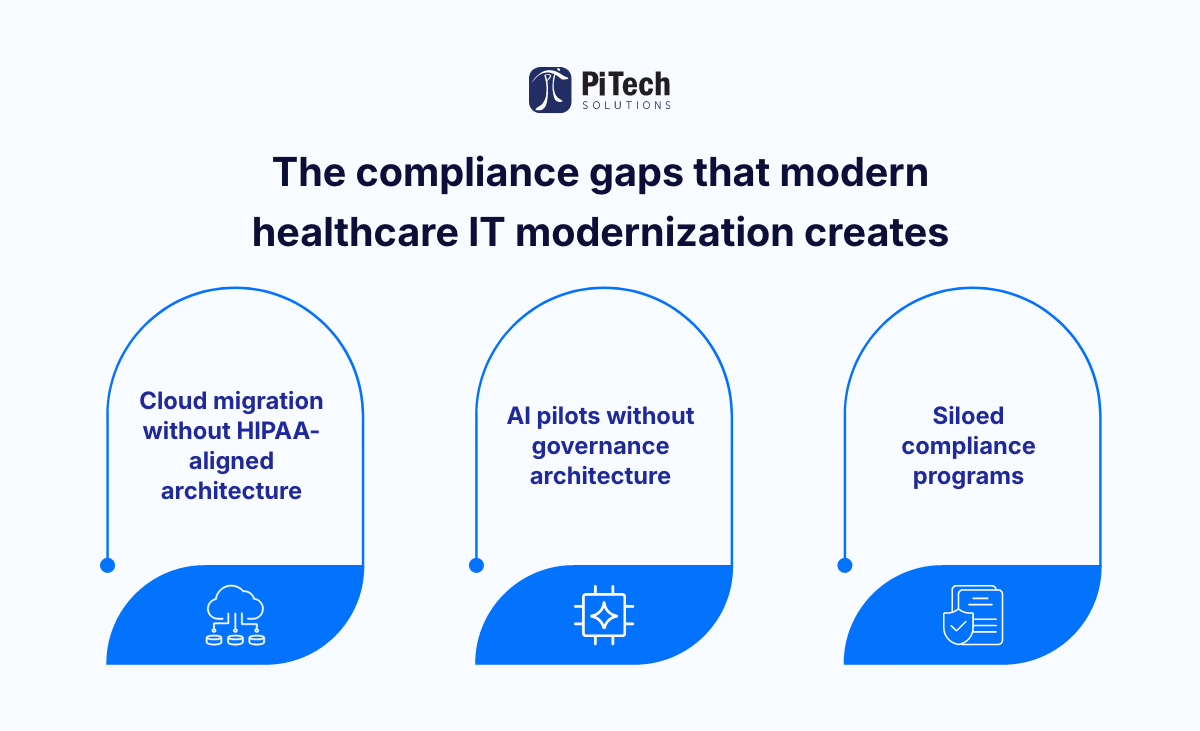
Cloud Migration Without HIPAA-Aligned Architecture
AI Pilots Without Governance Architecture
Siloed Compliance Programs
How PiTech Approaches Healthcare IT Modernization
For AI Implementation and Governance, we design and implement the full AI governance stack: AI Impact Assessment frameworks aligned with OCR’s expected guidance, explainability documentation meeting state disclosure requirements, bias testing and monitoring protocols, BAA structuring with AI-specific provisions, and human oversight models that satisfy both internal risk management requirements and external regulatory scrutiny. We work across clinical decision support, ambient documentation, AI-assisted revenue cycle management, and patient engagement applications.
For Cloud Migration with HIPAA-Aligned Architecture, we design healthcare cloud environments with Security Rule requirements built into the architecture — not added as a compliance layer afterward. Our migrations include encryption at rest and in transit across all workloads, access controls meeting HIPAA’s minimum necessary standard, audit logging for all PHI access events, breach detection integrated with incident response workflows, and geographic data residency controls for sensitive clinical data categories. We design for the updated Security Rule’s 2026 requirements from day one, so migrations do not require re-architecture when the rule takes full effect.
Our Compliance Program Development service builds the frameworks, tools, and expertise to establish systematic AI and digital technology governance rather than reactive compliance management. For health systems building or rebuilding their compliance infrastructure, we provide the roadmap from current-state gap assessment to sustainable operational compliance, including staff training, process documentation, and the management review cycles that make compliance programs self-sustaining rather than dependent on point-in-time consulting. Everything PiTech delivers is grounded in our ISO 27001 certified security management, ISO 9001 certified quality management, and CMMI certified delivery processes. These certifications are not marketing credentials — they are evidence of the operational discipline that makes healthcare IT modernization predictable and auditable. Healthcare system procurement committees look for exactly these credentials when evaluating partners for programs where compliance failure has patient safety implications.
Why Process Discipline Is the Differentiating Factor in Healthcare Modernization
Healthcare organizations with mature, documented processes consistently absorb regulatory changes more efficiently than those operating informally. When your organization has institutionalized processes for requirements documentation, validation testing, change control, and compliance monitoring, each new regulatory requirement becomes an extension of existing capability rather than a net-new operational burden. The organizations that appear in breach headlines are not always the ones with the weakest technology. They are often the ones with the weakest processes — organizations where compliance depends on individual knowledge rather than institutional systems.
PiTech’s approach builds the process infrastructure that makes healthcare IT modernization sustainable — not a series of fire drills responding to successive regulatory developments, but an operational capability that adapts as the environment evolves. Healthcare technology decisions made today carry compliance consequences for years. Getting the governance architecture right from the start is not a constraint on modernization. It is what makes modernization durable.