
Faster Resource Provisioning
0
%
Storage Cost Reduction
0
%
Compute Capacity Increase
0
%
CapEx Deferred
$
0
M
Security Incidents
100
Client Snapshot
Industry
Federal Healthcare Research
Client Type
NIH Research Institute
Scale
850+ scientists and support staff · $500M+ annual research budget

Environment
Hybrid on-premise legacy systems at or near capacity
Engagement
Cloud Strategy · Architecture · Migration · Compliance · Training
The Challenge
- Scientists waited 3 to 4 weeks for new computational resources after submitting a request — directly delaying research timelines, threatening federal grant deliverables, and damaging the agency's ability to attract competitive research talent accustomed to cloud-speed infrastructure at peer institutions.
- On-premise storage was reaching physical capacity under 40% year-over-year data growth driven by genomic sequencing runs, longitudinal clinical trials datasets, and epidemiological surveillance studies. The agency was buying storage faster than it could absorb the administrative and operational overhead
- A $3.5M hardware refresh was scheduled for the following fiscal year — capital expenditure that would defer innovation funding without meaningfully addressing the underlying scalability ceiling. The IT leadership needed a credible alternative to present to senior administration before the budget cycle closed.
- Any new infrastructure had to achieve FISMA Moderate certification, meet HIPAA compliance for certain research datasets, and pass NIH's own internal security review. Cloud adoption at federal research agencies had a troubled track record, and the compliance pathway — not the technology — was the project's most complex dimension
- The agency lacked in-house AWS expertise and had no established reference architecture for federal scientific computing workloads. The migration had to be safe enough for 850+ users on day one, not a multi-year phased experiment.
The PiTech Solution
- Conducted a structured 4-week cloud readiness assessment — including 25+ stakeholder interviews with scientists, administrators, and IT leads — to characterize workloads, identify data classification requirements, and build a total cost analysis comparing cloud migration against the planned on-premise hardware refresh. The assessment produced the business case leadership needed to secure executive approval.
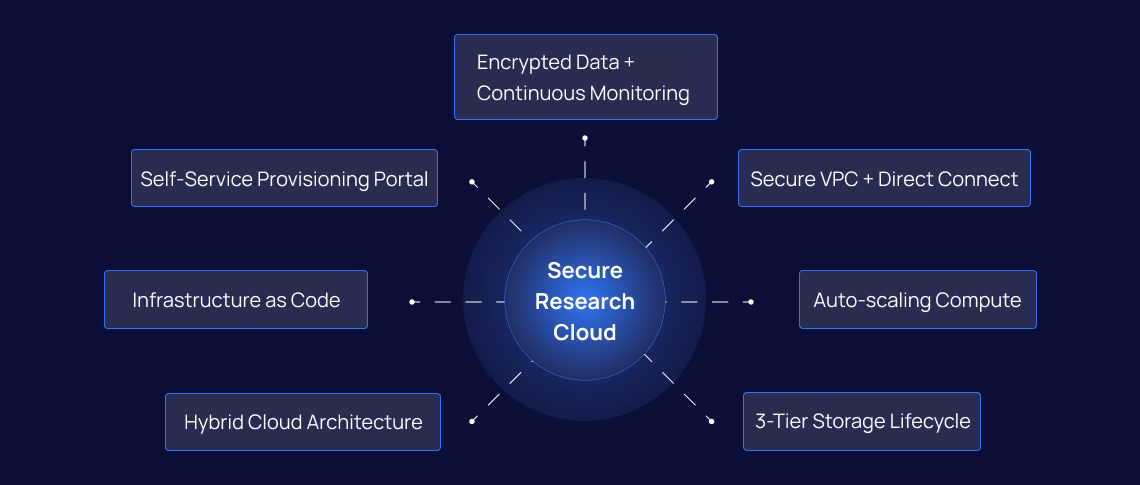
- Designed a multi-tier AWS VPC architecture with AWS Direct Connect for secure hybrid connectivity, AWS GuardDuty for continuous threat detection, AWS KMS for end-to-end data encryption at rest and in transit, and a layered CloudTrail and CloudWatch logging framework that met federal audit requirements from day one.
- Deployed EMR clusters purpose-configured for genomic data processing, auto-scaling EC2 groups for burst scientific compute workloads, and RDS plus DynamoDB for research data management — each environment provisioned through Infrastructure as Code via AWS CloudFormation, making environments repeatable, version-controlled, and auditable.
- Implemented a 3-tier S3 storage lifecycle policy — Standard for active datasets, Intelligent-Tiering for datasets with variable access patterns, and Glacier for archival — aligned to actual research access patterns measured during the readiness assessment. Storage costs dropped 40% compared to the on-premise expansion scenario.
- Obtained Authority to Operate and full FISMA Moderate certification through a structured documentation and assessment process. Delivered role-based training to 15 CTB staff and established a self-service resource provisioning portal that reduced new environment requests from a 21-day manual process to a 4-hour automated workflow.
Results That Matter
Resource provisioning time dropped from 21 days to 4 hours — a 95% reduction that transformed the scientist-facing IT experience and removed infrastructure delays as a constraint on research velocity.
Year 1 cost savings of $1.2 million versus the planned on-premise expansion; $3.5 million in hardware CapEx deferred, with capital redeployed toward research programs rather than datacenter equipment.
Computational capacity increased 300%, enabling the agency to support burst genomic sequencing workloads that previously required queuing delays; average analysis job time dropped from 8 hours to 3 hours
Zero post-migration security incidents; clean FISMA Moderate audit findings in the first formal assessment cycle; 80% reduction in manual compliance reporting effort through automated CloudTrail log export and audit-ready dashboard reporting.
Fifteen additional research projects were supported in the first year without incremental infrastructure spend — a direct outcome of elastic compute capacity replacing the fixed-capacity on-premise model.
Technology Stack
Cloud Platform
Cloud Platform
Amazon Web Services (AWS), AWS GovCloud
Compute
Compute
EC2, Auto Scaling Groups, Elastic MapReduce (EMR)
Storage
Storage
S3 (Standard · Intelligent-Tiering · Glacier), EBS, EFS
Networking
Networking
VPC, Route 53, Transit Gateway, AWS Direct Connect
Security & Compliance
Security & Compliance
AWS GuardDuty, KMS, WAF, CloudTrail, VPC Flow Logs, CloudWatch, Config
Automation & IaC
Automation & IaC
AWS CloudFormation, Systems Manager, Service Catalog, AWS Directory Service, ADFS
Databases
Databases
RDS (PostgreSQL, MySQL), DynamoDB
Why PiTech
PiTech brings more than 15 years of federal agency delivery experience — including programs at NIH, FDA, and CDC — with demonstrated expertise in FISMA, FedRAMP, and HIPAA compliance. As an AWS Advanced Consulting Partner with Government Competency, PiTech designs cloud environments that satisfy regulators and security reviewers, not just architects and engineers. The compliance pathway is built in from the start, not retrofitted after the fact.

Ready to achieve results like these?
Talk to PiTech. Federal-grade delivery discipline. Deep domain expertise. Zero cost overruns.

Reach Our Customer Service Team
-
Address
4000 Sancar Way, Suite 205, Durham, NC 27709
-
Contact Details
(919) 439-3163
