
Table of Contents
Summarize and analyze this article with

Chat GPT

Perplexity

Grok

Google AI

Claude
The Scale of Manufacturing AI Deployment in 2026
Why Manufacturing AI Deployment Is Different From Enterprise AI Deployment
Manufacturing AI does not just process information — it affects equipment, production schedules, supply chains, and physical safety systems. Legacy OT systems, strict safety requirements, distributed assets, regulatory environments including NERC CIP and environmental compliance, and the IT/OT security challenges that manufacturing connectivity creates — these factors make standard enterprise AI deployment playbooks inadequate.
The organizations succeeding at production-scale manufacturing AI have treated deployment with the same process rigor they apply to physical infrastructure projects: documented procedures, validation testing, rollback plans, and continuous monitoring.
Where Manufacturing AI Programs Are Stalling
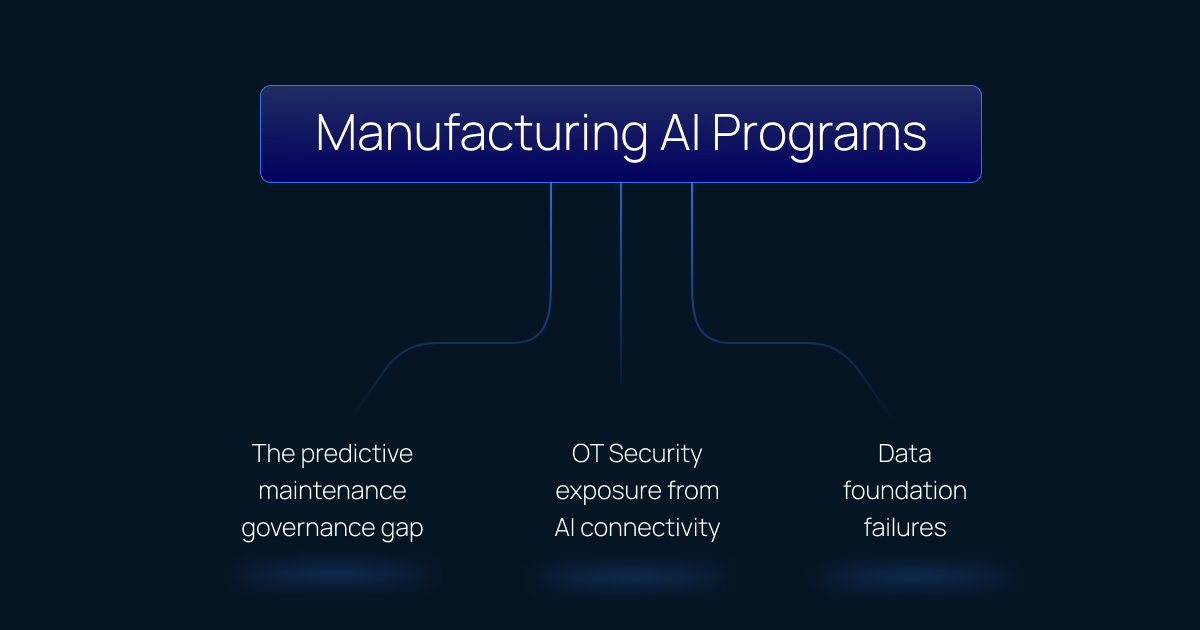
3a. The Predictive Maintenance Governance Gap
3b. OT Security Exposure From AI Connectivity
3c. Data Foundation Failures
How PiTech Helps Manufacturers Deploy AI at Production Scale
PiTech’s practice serving energy and manufacturing organizations combines OT security expertise, AI governance capability, and CMMI-certified delivery processes — three capabilities that most technology firms offer separately and that production-scale manufacturing AI requires together.
For AI readiness, we conduct comprehensive assessments of data foundations, operational processes, OT security posture, and organizational capability. When data foundations are not ready, we build data engineering and governance infrastructure first. Our AI governance frameworks address the full model lifecycle: model validation, decision rights, configuration management, continuous monitoring, and change management for model updates.
Where AI deployments create new IT/OT connectivity, PiTech integrates cloud architecture design and OT security architecture into the deployment program from day one — not as a subsequent workstream. Network segmentation review, OT asset inventory updates, monitoring extension, and third-party access controls are built in.
The Process Discipline Foundation That Makes the Difference
Deloitte’s 2026 analysis describes manufacturing AI implementations as throttled by weak governance, duplication, and uneven impact. The pattern is consistent: companies that invested in data governance, change management, and structured deployment processes before scaling AI are getting results. Companies that moved from proof-of-concept to production without that foundation are dealing with integration failures and models that degrade faster than expected.
PiTech’s CMMI certification and ISO standards are the institutional infrastructure that makes our manufacturing AI deployments reliably deliver what they are designed to deliver. When your production environment is the thing that needs to be protected and improved, your technology partner’s process discipline matters as much as their technical capability.