
Table of Contents
Summarize and analyze this article with

Chat GPT

Perplexity

Grok

Google AI

Claude
The AI governance challenge facing regulated organizations in 2026 is not whether to build a governance framework — that question is settled. The EU AI Act became fully enforceable for high-risk systems in February 2026 and reaches full applicability August 2. Colorado’s AI Act takes effect June 30. California’s AI transparency requirements are already active. Sector-specific regulators — OCC and CFPB in banking, HHS in healthcare, CISA for critical infrastructure — continue applying existing authority to AI oversight. The question is whether the governance framework an organization builds can actually withstand simultaneous regulatory pressure from multiple directions without requiring a separate compliance program for each one.
ISO/IEC 42001 adoption jumped from approximately 1 percent to 28 percent of businesses in a single year. Gartner forecasts over 70 percent of enterprises will adopt a formal AI governance standard by the end of 2026. The market is moving fast because the regulatory environment is demanding evidence of systematic governance — not just policy documentation. Organizations that build governance around common requirements across all applicable frameworks, then layer jurisdiction-specific additions, are the ones that will scale compliance efficiently as the regulatory surface area continues to expand.
The Regulatory Convergence Problem — and Its Solution
Despite the apparent complexity of the multi-jurisdictional AI governance environment, regulatory expectations are converging around a set of common requirements. Every major framework — EU AI Act, NIST AI RMF, ISO 42001, Colorado AI Act, sector-specific guidance — demands that organizations maintain current AI system inventories with risk classifications. Every framework requires formal risk assessment documenting what the system does, who it affects, what could go wrong, and what controls mitigate identified risks. Every framework expects functional explainability, meaningful human oversight, and continuous monitoring rather than point-in-time validation.
The organizations managing this complexity most efficiently are building governance frameworks around these common requirements and treating jurisdiction-specific additions as incremental extensions rather than separate programs. When a new regulation arrives — and they will keep arriving — it adds a data point to the compliance matrix rather than requiring a new governance program. The organizations that build separate compliance programs for each regulation are building toward an unsustainable compliance burden.
The Process Maturity Advantage in AI Governance
How PiTech Builds AI Governance Frameworks That Work
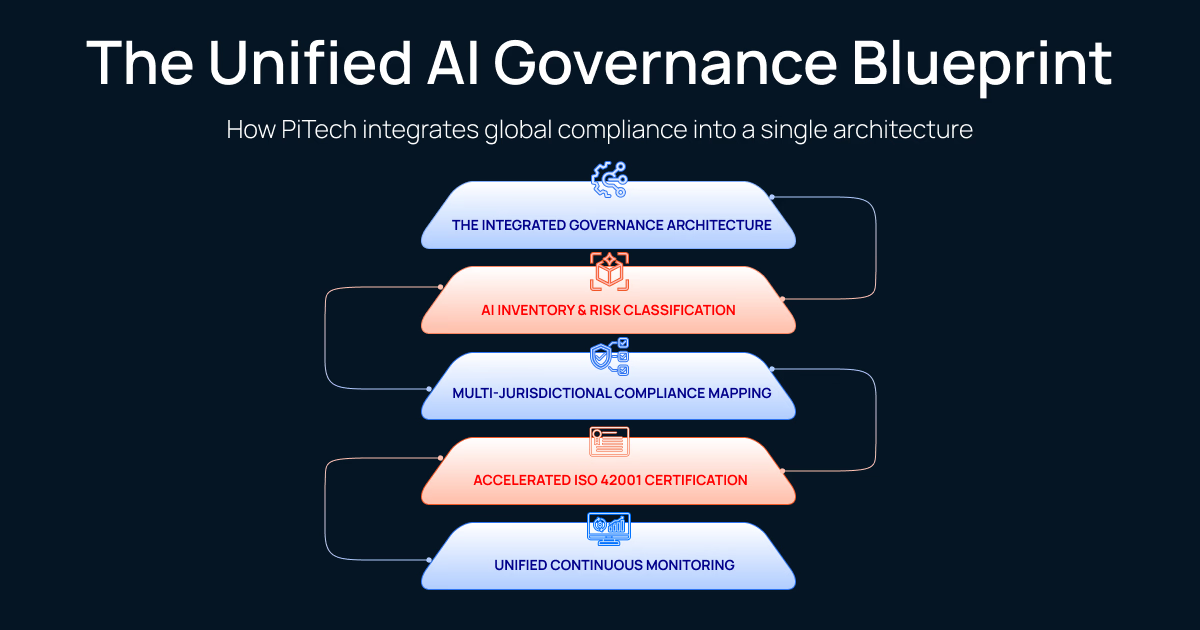
PiTech’s AI Governance Advisory practice helps regulated organizations build governance frameworks that work across multiple regulatory regimes — not separate compliance programs that multiply effort and create gaps at the boundaries. Our approach is built on the integrated governance architecture: CMMI process discipline as the execution foundation, ISO 27001 and ISO 9001 as the security and quality management backbone, and NIST AI RMF/ISO 42001 as the AI-specific governance layer. Each component builds on the one below it rather than standing independently.
We start with AI Inventory and Risk Classification: mapping every AI system in organizational use — including shadow AI and vendor-embedded AI not separately evaluated — and classifying each by risk level, regulatory exposure, and business criticality. This exercise consistently surfaces systems that leadership did not know were deployed, systems whose risk classification has not been revisited as their use has evolved, and systems whose governance documentation does not reflect their current operational scope. Visibility is the prerequisite for everything else.
Our Multi-Jurisdictional Compliance Mapping service identifies common requirements across all applicable regulatory obligations — EU AI Act, Colorado AI Act, NIST AI RMF, sector-specific rules — and builds governance processes that satisfy all of them from a single framework through our IT consulting practice. We eliminate the duplication that drives up compliance costs when organizations maintain parallel programs. Organizations that implement our integrated mapping approach consistently find that 60 to 70 percent of controls across major AI governance frameworks substantially overlap — meaning the incremental cost of adding regulatory coverage to an established framework is a fraction of the cost of building a new compliance program.
For organizations pursuing ISO 42001 certification, PiTech provides the implementation roadmap that leverages existing ISO management system infrastructure to achieve certification on accelerated timelines. For ISO 27001-certified organizations, this typically means four to six months for well-scoped, single-domain implementations. We design certification programs that produce genuine governance capability, not documentation that satisfies audit requirements while the governance system operates independently.
Our Continuous Monitoring Design service builds compliance evidence generation that satisfies both FedRAMP 20x’s KSI requirements and EU AI Act post-market monitoring requirements for high-risk systems — from the same monitoring infrastructure rather than separate systems. The convergence of continuous compliance expectations across major frameworks creates an efficiency opportunity: build continuous monitoring once, satisfy multiple frameworks with the same evidence stream. PiTech designs that architecture.