
FedRAMP 20x Is Compressing Authorization From 18 Months to Weeks. Here’s How to Be Ready for It

Table of Contents

Summarize and analyze this article with

ChatGPT

Chat GPT

ChatGPT

Perplexity

 
ChatGPT

Grok

 
ChatGPT

Google AI

ChatGPT

Claude


FedRAMP’s traditional authorization process had a well-earned reputation as a market access barrier. Timelines regularly exceeding twelve to eighteen months. Documentation requirements consuming millions in preparation costs. A process designed for thoroughness that became synonymous with delay. FedRAMP 20x is the government’s attempt to fix that without gutting the security requirements that make the framework meaningful — and based on the Phase 2 pilot results, the redesign is working.

The core shift is from static compliance documentation to machine-readable security evidence. Instead of a cloud service provider writing hundreds of pages of system security plans reviewed by a human assessor, FedRAMP 20x introduces Key Security Indicators — continuously-generated, automated evidence demonstrating compliance in real time. IBM received FedRAMP authorization for 11 AI and automation products including watsonx. Oracle launched a FedRAMP-authorized AI Data Platform for federal use. The demand for authorized AI cloud tools is real and growing. FedRAMP 20x Phase 3 rolls out broadly in Q3-Q4 FY2026, and Consolidated Rules are publishing by June 2026, valid through 2028. The window to position for the new framework is now.
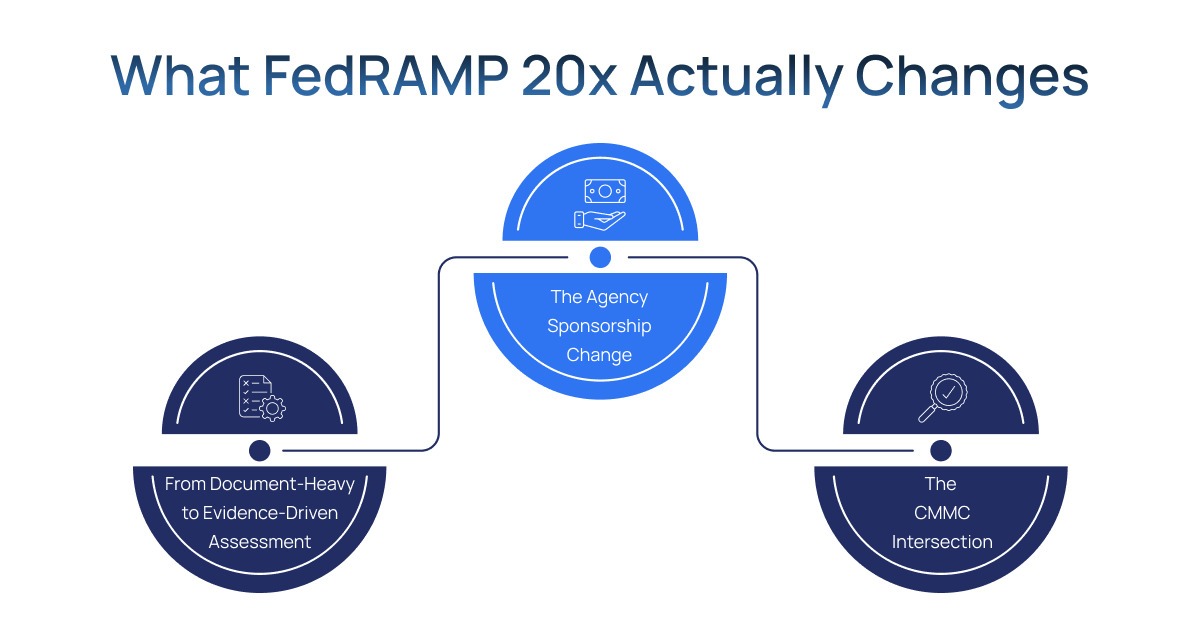
From Document-Heavy to Evidence-Driven Assessment

Traditional FedRAMP was essentially a compliance snapshot: prepare documentation over many months, undergo point-in-time assessment, receive authorization, then maintain compliance through periodic reviews. FedRAMP 20x replaces this with persistent validation — ongoing, automated security evidence that reflects actual current security posture rather than a snapshot that may be outdated within days of preparation. For cloud providers already operating with mature, automated security monitoring, the new model is faster and more accurate. For those relying on manual evidence collection and periodic reviews, it exposes the gap between documented controls and operational security reality.

The Agency Sponsorship Change

FedRAMP 20x opens new certification pathways that may not require agency sponsorship — eliminating the market access barrier that historically prevented mid-size and specialized providers from pursuing authorization. For innovative cloud service providers with genuine security maturity who could not justify the traditional authorization process, this changes the federal market calculus entirely. The authorization barrier is shifting from institutional relationships to demonstrable security capability.

The CMMC Intersection

For defense contractors managing both FedRAMP and CMMC compliance, the two frameworks are increasingly convergent around continuous monitoring, evidence automation, and security process maturity. An organization that builds its compliance infrastructure on ISO 27001 and operates with CMMI-level process discipline can satisfy both frameworks through an integrated program rather than maintaining separate compliance workstreams. PiTech provides integrated FedRAMP/CMMC compliance programs that reduce duplicative effort and eliminate consistency gaps between separate compliance efforts.

How PiTech Helps Government Contractors Navigate FedRAMP 20x

PiTech’s FedRAMP Advisory and Government Cloud practice is built on the same security discipline and delivery rigor that FedRAMP 20x is specifically designed to reward — not adapted from commercial IT security practice for government requirements, but developed through years of federal and defense engagement where government-grade security standards are the starting point, not the ceiling.

Our 20x Readiness Assessment evaluates current security posture against FedRAMP 20x KSI requirements: where you are already generating the automated evidence 20x demands, where you need to build or automate, and what specific gaps stand between your current posture and successful 20x authorization. The assessment produces a concrete roadmap to authorization under the new framework with realistic timelines and resource requirements — not an aspirational three-month target that assumes capabilities you have not yet built.

Our Continuous Compliance Architecture service designs and implements the monitoring infrastructure, automated evidence generation, and reporting systems that make FedRAMP 20x compliance operational rather than aspirational. This means infrastructure-as-code with embedded security controls that verify configurations against FedRAMP baselines on every deployment, API-driven security monitoring that captures technical control status in machine-readable formats, and audit log aggregation that provides continuous visibility for both internal compliance teams and eventual KSI reporting. We do not describe continuous monitoring — we build the infrastructure that makes it real.

For organizations pursuing authorization under either traditional or 20x pathways, our Authorization Acceleration service provides documentation, evidence preparation, 3PAO coordination, and process management that moves efficiently through authorization. Our CMMI-certified delivery processes mean the work is executed systematically — no dropped requirements, no last-minute documentation scrambles. The organizations that attempt authorization with inadequately prepared posture consume time and cost without advancing toward authorization. Our preparation work front-loads the effort that produces successful outcomes.

Our Cross-Framework Control Mapping service is particularly valuable for organizations maintaining ISO 27001, SOC 2, and CMMC compliance alongside FedRAMP. We map existing controls to FedRAMP requirements, identifying what is already covered and what must be built — reducing both effort and cost compared to treating FedRAMP as a standalone compliance program. The ISO 27001:2022 restructuring specifically facilitates this mapping, and organizations already certified to the current standard have completed a significant portion of FedRAMP’s technical control requirements.

Why PiTech's Background Makes the Difference

PiTech’s security practices were developed in federal and defense contexts where security failures have national security implications — not in commercial IT environments where the rigor was developed for commercial risk profiles and adapted for government clients. That background shapes how we approach FedRAMP engagements in ways that matter: we understand from operational experience what continuous monitoring actually requires to satisfy government reviewers, what documentation is substantive versus performative, and where the gaps between what organizations document and what they actually operate tend to appear. Government clients and prime contractors evaluate partners on process maturity that is externally verified, not self-asserted. Our CMMI certification, ISO 27001 certification, and ISO 9001 certification are the evidence that our delivery processes are institutionalized.

Frequently Asked Questions (FAQs)

What does PiTech's FedRAMP 20x Readiness Assessment cover?

PiTech’s 20x Readiness Assessment evaluates automated evidence generation capability for each KSI domain, continuous monitoring infrastructure maturity, vulnerability detection and response time performance against new 20x requirements, security configuration documentation against FedRAMP recommended baselines, and cross-framework control mapping if the organization maintains ISO 27001, SOC 2, or CMMC compliance. The assessment produces a gap analysis, prioritized remediation roadmap, and realistic authorization timeline.
PiTech designs integrated compliance programs that satisfy both FedRAMP and CMMC requirements through shared controls, unified evidence repositories, and coordinated assessment preparation. The two frameworks share substantial common ground around continuous monitoring, access control, incident response, and configuration management. Organizations managing them as separate compliance programs duplicate significant effort and create consistency risk. PiTech’s integrated approach reduces authorization timeline and total compliance cost.
For organizations with mature security posture, automated compliance evidence generation, and genuine continuous monitoring, FedRAMP 20x authorization timelines are projected at approximately three months for Low and Moderate impact levels. Organizations that arrive at the authorization process with significant security posture gaps will spend more time in preparation than in authorization. PiTech’s readiness assessment establishes where a specific organization falls on this spectrum and what investment is required to reach the three-month-viable posture.
Yes. PiTech serves both federal agencies evaluating and adopting FedRAMP-authorized cloud services and cloud service providers pursuing authorization. For agencies, we provide cloud migration planning, security architecture design for hybrid environments, FedRAMP-authorized solution evaluation against mission requirements, and governance framework development for AI-enabled cloud deployments. For cloud service providers, we provide the full authorization preparation and acceleration service.