
Table of Contents
Summarize and analyze this article with

Chat GPT

Perplexity

Grok

Google AI

Claude
Introduction
Banks are accelerating artificial intelligence adoption across credit scoring, fraud detection, and customer service. Yet growth brings scrutiny. Strong AI risk management banking practices are now essential to satisfy regulators, protect customers, and sustain trust. Institutions that embed banking AI compliance and transparent governance into every model lifecycle are better positioned to scale innovation without penalties. This guide explains how AI model risk management, explainable AI banking, and structured AI governance banking frameworks help financial institutions stay compliant while unlocking measurable value.
Why AI Risk Management Is Now a Regulatory Priority
Global AI Regulations Reshaping Banking Compliance
AI governance in financial services is rapidly shifting from internal policy to enforceable regulation. New global rules classify several banking use cases as high risk, requiring transparency, human oversight, and continuous monitoring. Resilience regulations are also increasing scrutiny on third-party AI model risk and technology dependencies.
In the United States, supervisory guidance is evolving beyond traditional AI model risk management toward full lifecycle accountability. This shift makes explainable AI banking, automated AI regulatory reporting in banks, and enterprise-wide AI governance banking critical to achieving sustained AI risk management banking and dependable banking AI compliance.
Banks that align early with these regulatory expectations can reduce remediation exposure, accelerate approval timelines, and build stronger long-term supervisory trust.
Rising Model Complexity and Compliance Pressure
Compliance as the Biggest Adoption Barrier
Core Pillars of AI Model Risk Management in Banking
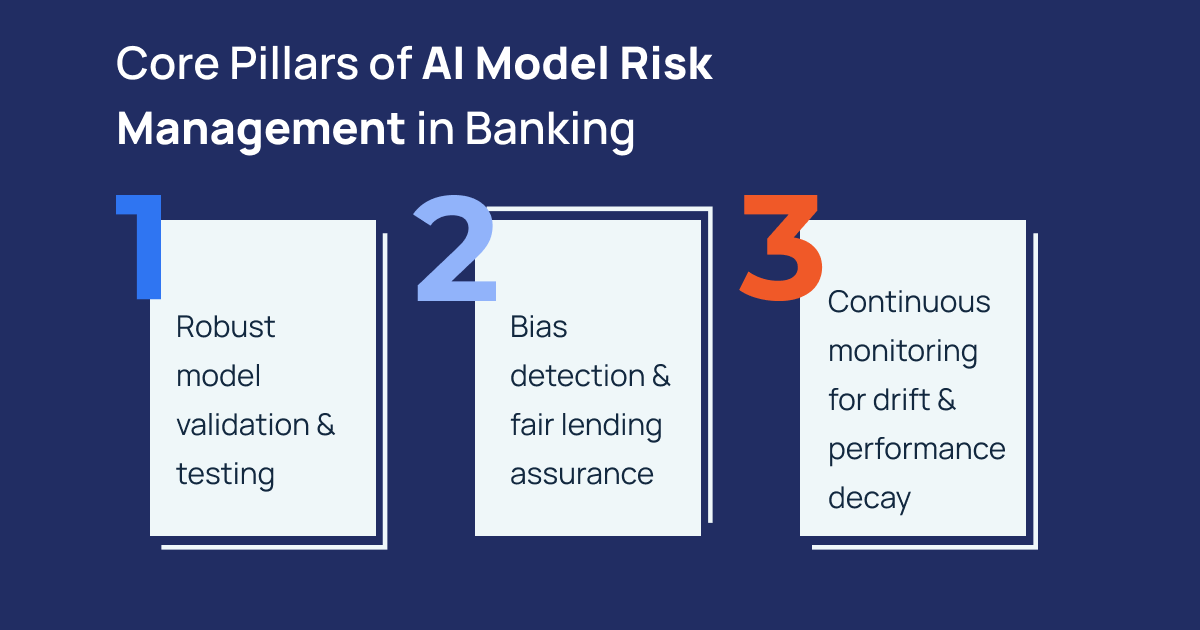
1. Robust model validation and testing
2. Bias detection and fair lending assurance
3. Continuous monitoring for drift and performance decay
Explainable AI and Transparency Requirements
Moving from black box to accountable AI
Documentation and audit readiness
Managing Third Party and GenAI Risks
Third party accountability expectations
Emerging GenAI compliance frameworks
Building a Scalable AI Governance Framework
Enterprise model inventory and lifecycle control
Integration with RegTech and automation
Real World Compliance Failures and Lessons
Conclusion:
Turn AI Compliance into a Competitive Advantage
Leading banks and several other financial institutions are moving beyond fragmented controls toward integrated AI governance and lifecycle risk management. PiTech enables this shift through regulatory-aligned frameworks, continuous monitoring, and enterprise-grade compliance automation.
Key Takeaways
- Strong AI risk management banking is now a regulatory necessity, not optional innovation control.
- Independent AI model validation banking and AI stress testing banking prevent costly compliance failures.
- Explainable AI banking is essential for fair lending transparency and audit defence.
- Effective AI governance banking must include drift monitoring, documentation, and lifecycle oversight.
- Vendor solutions increase third-party AI model risk, demanding rigorous supervision.
- Automation through RegTech AI compliance reduces reporting burden while improving regulatory confidence.
Frequently Asked Questions (FAQs)
How do banks validate AI models for regulatory compliance?
Banks conduct independent model validation, stress testing, fairness analysis, and full lifecycle documentation. These controls align with supervisory expectations and internal model risk management standards to ensure safe and explainable AI use.