
Table of Contents
Summarize and analyze this article with

Chat GPT

Perplexity

Grok

Google AI

Claude
Introduction
Why Traditional Risk Models Are Breaking Down
-
Risk data is fragmented across trading, compliance, and operations systems
- Model validation lags behind new products and changing market behaviour
-
Manual trade reconciliation causes delays and increases errors
Adaptive Risk Management Is Now a Requirement
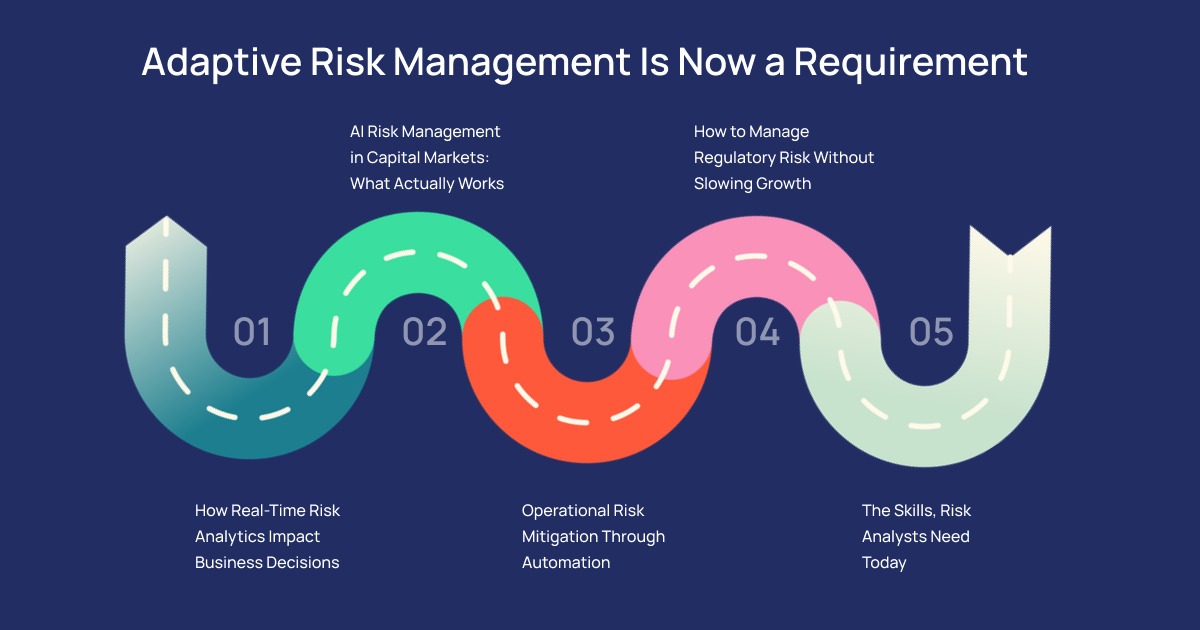
How Real-Time Risk Analytics Impact Business Decisions
AI Risk Management in Capital Markets: What Actually Works
- Continuous monitoring of market, credit, and operational risk
- Automated alerts based on behaviour patterns, not static limits
-
Smarter model validation using historical and live data together
Banks still struggle with model validation. A 2025 survey by the ECB found that nearly 45% of internal risk models required material remediation due to outdated assumptions.
AI-supported validation reduces this burden by flagging drift early, before regulators do.
Operational Risk Mitigation Through Automation
How to Manage Regulatory Risk Without Slowing Growth
-
Maintaining auditable risk trails
- Mapping controls directly to regulatory requirements
- Generating reports aligned with global standards
The Skills, Risk Analysts Need Today
- Interpreting real-time dashboards
- Understanding AI-driven alerts
- Collaborating directly with traders and compliance teams
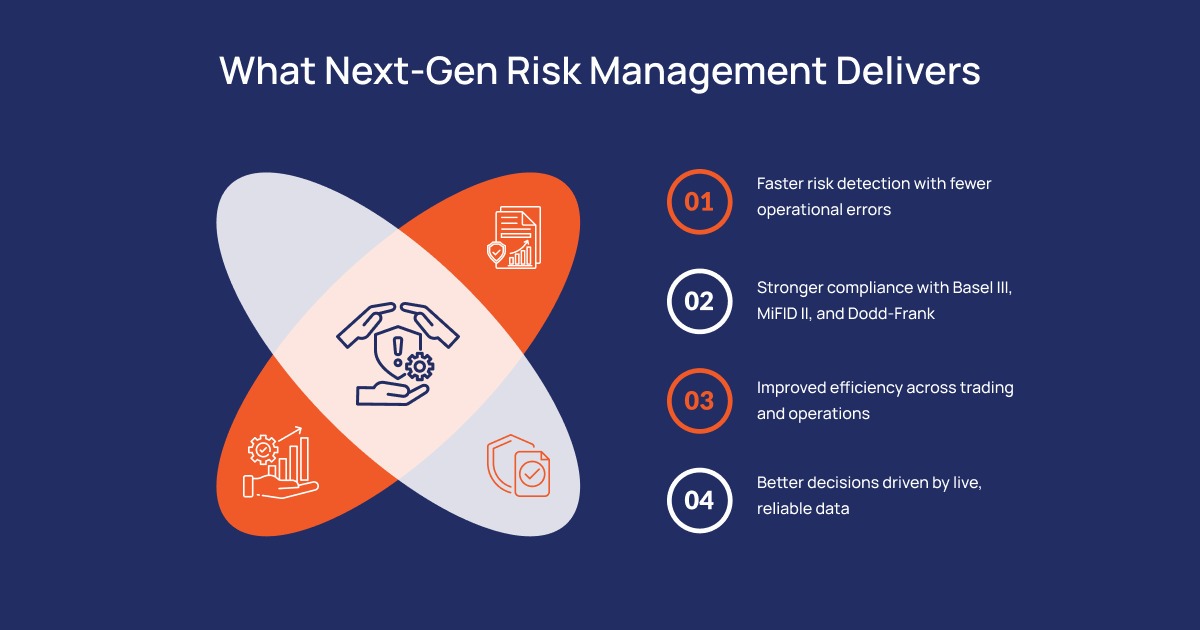
What Next-Gen Risk Management Delivers
- Faster risk detection with fewer operational errors
- Stronger compliance with Basel III, MiFID II, and Dodd-Frank
- Improved efficiency across trading and operations
- Better decisions driven by live, reliable data
Final Thoughts
Risk management in capital markets is entering a new phase. Static controls and manual processes no longer protect firms from modern volatility, regulatory pressure, or operational complexity.
Next-gen risk management combines adaptive risk management, real-time risk analytics, AI-driven insights, and trade reconciliation automation into a single, responsive framework.
For institutions that act now, this shift moves beyond compliance to deliver transparency, speed, and resilience, creating a decisive advantage in markets where timing defines success.
Build a future-ready risk framework with PiTech
PiTech helps capital markets firms move from static controls to real-time intelligence through adaptive risk management, AI-driven analytics, and automation. Explore how our capital markets solutions enable faster decisions, stronger compliance, and resilient operations. Learn more about PiTech’s Capital Markets solutions.

Key Takeaways
- Static risk models can’t keep up with today’s fast-moving, high-frequency capital markets.
- Delayed risk detection is the real threat, not a lack of data.
- Adaptive risk management is essential to respond to live market conditions and volatility.
- Real-time risk analytics improve trading decisions by enabling earlier, smarter intervention.
- AI delivers value when applied pragmatically, from continuous monitoring to proactive model validation.
- Automation reduces operational risk, cutting reconciliation time, errors, and compliance effort.
- Next-gen risk frameworks create competitive advantage through speed, transparency, and resilience.